There are a surprising number of experiments an amateur nuclear physicist can perform, from making a Geiger counter to fusing hydrogen atoms in a fusor. One project which we haven’t seen before is a neutron generator, such as the benchtop neutron generator made by [Rapp Instruments] (translated).
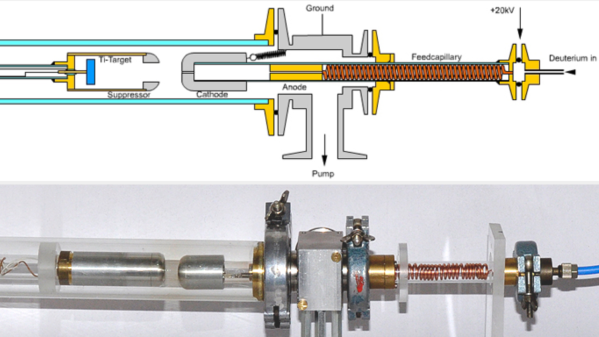
This particular generator takes a feedstock of pure deuterium, which it ionizes and accelerates into a titanium target. The first deuterium nuclei to hit the target react with it to form titanium deuteride, immobilizing them until more ions strike them and they undergo nuclear fusion. The fusion reaction mostly forms helium-4, but sometimes forms helium-3 and a free neutron, which is radiated away. The radiated neutrons are slowed down by a block of high-density polyethylene, and a portion of them strike a silver or indium foil wrapped around a Geiger counter tube. The neutrons activate the silver or indium, and the Geiger counter detects the resultant increase in radioactivity.
The design is a linear particle accelerator built inside an evacuated glass tube. It uses two high-voltage power supplies: a 20 kV supply which ionizes the deuterium gas fed into the tube, and a 100 kV supply which accelerates ions emitted from the source into the target. The target itself is surrounded by a cup-shaped electrode to capture secondary electrons emitted during impact. To prevent arcing, the tube needs to be at a very low pressure, reached by extensive use of an oil diffusion pump.
Radioactivity measurements of the silver and indium foils showed that the generator did work; when irradiating the silver foil for five minutes, it generated 175 counts per second after the neutron source was turned off. Plotting the count rate versus time suggested that a mixture of two silver isotopes was being generated, Ag-110 and Ag-108, based on their half-lives. Irradiation of indium produced a similar exponential decay in radiation.
We recommend checking out the rest of the site; it’s a gold mine of projects, such as this mass spectrometer. For more background on neutron generators, we’ve covered their theory and some of the more common varieties.
neutron5 Articles
Neutron Flux Impact On Quartz Expansion Rate
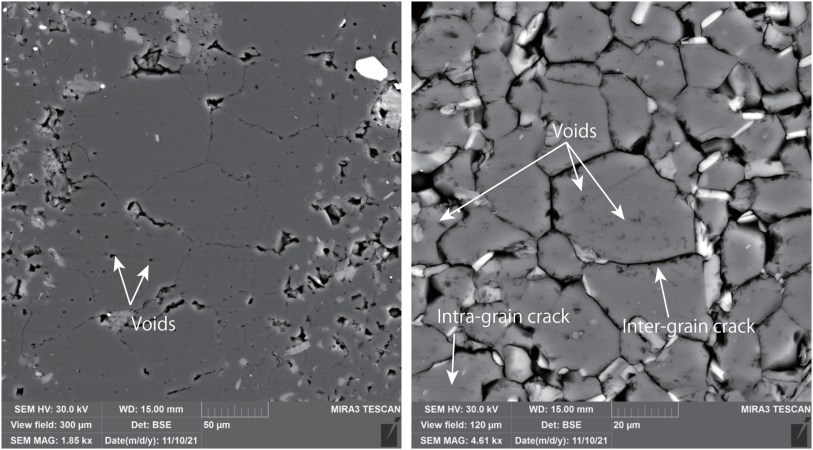
Radiation-induced volumetric expansion (RIVE) is a concern for any concrete structures that are exposed to neutron flux and other types of radiation that affect crystalline structures within the aggregate. For research facilities and (commercial) nuclear reactors, RIVE is generally considered to be one of the factors that sets a limit on the lifespan of these structures through the cracking that occurs as for example quartz within the concrete undergoes temporary amorphization with a corresponding volume increase. The significance of RIVE within the context of a nuclear power plant is however still poorly studied.
A recent study by [Ippei Maruyama] et al. as published in the Journal of Nuclear Materials placed material samples in the LVR-15 research reactor in the Czech Republic to expose them to an equivalent neutron flux. What their results show is that at the neutron flux levels that are expected at the biological shield of a nuclear power plant, the healing effect from recrystallization is highly likely to outweigh the damaging effects of amorphization, ergo preventing RIVE damage.
This study follows earlier research on the topic at the University of Tokyo by [Kenta Murakami] et al., as well as by Chinese researchers, as in e.g. [Weiping Zhang] et al. in Nuclear Engineering and Technology. [Murayama] et al. recommend that for validation of these findings concrete samples from decommissioned nuclear plants are to be examined for signs of RIVE.
Heading image: SEM-EDS images of the pristine (left) and the irradiated (right) MC sample. (Credit: I. Murayama et al, 2022)
Forget Radio! Transmitting With Neutrons
Throughout history, people have devised ways to send information across long distances. For centuries we relied on smoke signals, semaphores, and similar physical devices. Electricity changed everything. First the telegraph and then radio transformed communications. Now researchers at the University of Lancaster have demonstrated another way to send wireless data without using electromagnetic radiation. They’ve harnessed fast neutrons from californium-252 and modulated them with information with 100% success.
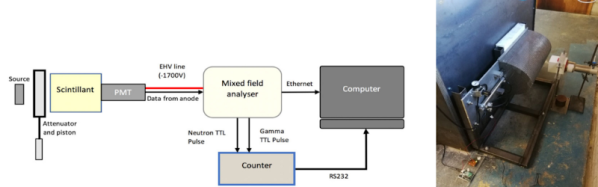
The setup was interesting. The radioactive material was encased in a cubic meter steel tank filled with water. A pneumatic system can move the material to one edge of the tank which allows fast neutrons to escape. A scintillating detector can pick up the increased neutron activity. It seems like it is akin to using what hams call CW and college professors call OOK (on off keying). You can do that with just about anything you can detect. A flashlight, knocking on wood, or — we suppose — neutrons.
We wondered what the practical application of this might be. The paper suggests that the technique could send data through metal containment structures like those of a nuclear reactor or, perhaps, a spacecraft where you don’t want anything unnecessarily breaching the containment. After all, neutrons cut through things that would stop a conventional radio wave cold.
It seems like you only have to prove you can detect something to make this work — it really doesn’t matter what it is you are detecting. It seems like it would be much harder to do more advanced types of modulation using neutrons. Maybe this is why we don’t hear aliens. They are all Morse code operators with neutron-based telegraphs.
Rocket Lab Plans Larger Neutron Rocket For 2024
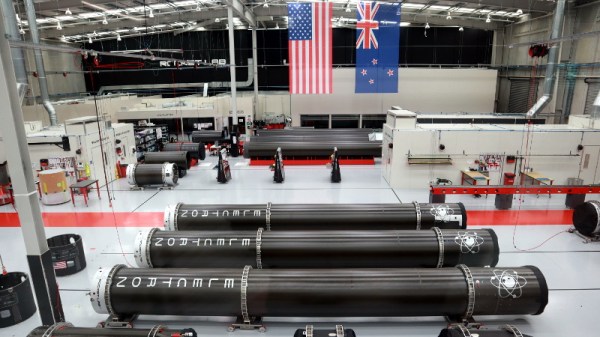
When Rocket Lab launched their first Electron booster in 2017, it was unlike anything that had ever flown before. The small commercially developed rocket was the first to use fully 3D printed main engines, and instead of pumping its propellants with traditional turbines, the vehicle used electric motors that jettisoned their depleted battery packs overboard during ascent to reduce weight. It even looked different than its peers, as rather than a metal fuselage, the Electron was built from a lightweight carbon composite which gave it a distinctive black color scheme.
Packing so many revolutionary technical advancements into a single vehicle was a risk, but Rocket Lab founder Peter Beck believed a technical shakeup was the only way to get ahead in an increasingly competitive market. While that first launch in 2017 didn’t make it to orbit, the next year, Rocket Lab could boast three successful flights. By the end of 2020, a total of fifteen Electron rockets had completed their missions, carrying payloads from both commercial customers and government agencies such as NASA, the United States Air Force, and DARPA.
Rocket Lab’s gambit paid off, and the company has greatly outpaced competitors such as Virgin Orbit, Astra, and Relativity. In fact Electron is now the second most active orbital booster in the United States, behind SpaceX’s Falcon 9. Considering their explosive growth, it’s only natural they’d want to maintain that momentum going forward. But even still, the recent announcement that the company will be developing a far larger rocket they call Neutron to fly by 2024 took many in the industry by surprise; especially since Peter Beck himself had previously said they would never build it.
Continue reading “Rocket Lab Plans Larger Neutron Rocket For 2024”
Irène Joliot-Curie And Artificial Radioactivity
When Marie and Pierre Curie discovered the natural radioactive elements polonium and radium, they did something truly remarkable– they uncovered an entirely new property of matter. The Curies’ work was the key to unlocking the mysteries of the atom, which was previously thought to be indivisible. Their research opened the door to nuclear medicine and clean energy, and it also led to the development of nuclear weapons.
Irène Joliot-Curie, her husband Frédéric, and many of their contemporaries were completely against the use of nuclear science as a weapon. They risked their lives to guard their work from governments hell-bent on destruction, and most of them, Irène included, ultimately sacrificed their health and longevity for the good of society. Continue reading “Irène Joliot-Curie And Artificial Radioactivity”