Salvaging Audio Amplifiers From Vintage Volvos

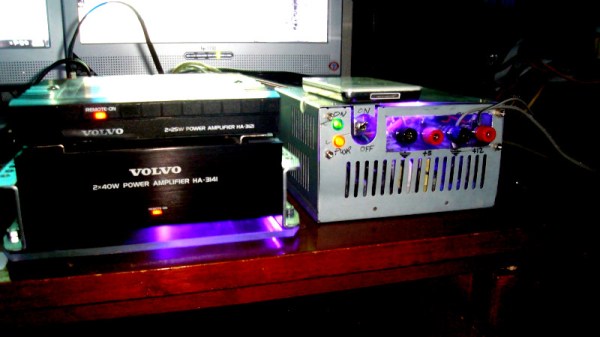
The common automotive scrap yard is a land of plenty for the enterprising hacker., where many items that would be prohibitively expensive elsewhere can often be had for a song. This isn’t just limited to strictly automotive parts either, as the modern vehicle is full of all kinds of hardware. [Nikita] managed to salvage a pair of audio amplifiers from an old Volvo, and put them to good use. It’s a great idea if you’re looking for cheap audio hardware!

The amplifiers are from a Volvo 760 made in 1984. There’s one rated at 40 watts per channel, and a smaller device rated at 25 watts per channel – likely to drive the front and rear speakers from separate amps. The amplifiers take 12 volts nominally, as one would expect. After some initial testing with a car battery and unsticking old relays, things began to crackle into life.

With the hardware now functioning, it was simply a case of bolting the amplifiers into a frame, hooking them up to a converted ATX power supply, and wiring up some connectors for speakers and audio input. With a few bits and pieces invested, [Nikita] now has a good quality amplifier to run audio in the workshop.

There’s plenty of useful hardware you can score down at the wreckers, and we see these parts used in hacks all the time – from peculiar milling machines to automated watering systems.

Electric Cars Sound Off, Starting July 1st

By and large, automakers have spent much of the last century trying to make cars quieter and more comfortable. Noise from vehicles can be disruptive and just generally annoying, so it makes sense to minimise it where possible.

However, the noise from the average motor vehicle can serve a useful purpose. A running engine acts as an auditory warning to those nearby. This is particularly useful to help people avoid walking in front of moving vehicles, and is especially important for the visually impaired.

Electric vehicles, with their near-silent powertrains, have put this in jeopardy. Thus, from July 1st, 2019, the European Union will enforce regulations on the installation of noise-making devices on new electric and hybrid vehicles. They are referred to as the “Acoustic Vehicle Alert System”, and it’s been a hot area of development for some time now. Continue reading “Electric Cars Sound Off, Starting July 1st”

Takata’s Deadly Airbags: An Engineering Omnishambles

Engineers are, for the time being, only human. This applies even more so to executives, and all the other people that make up a modern organisation. Naturally, mistakes are made. Some are minor, while others are less so. It’s common knowledge that problems are best dealt with swift and early, and yet so often they are ignored in the hopes that they’ll go away.

You might have heard the name Takata in the news over the last few years. If that name doesn’t ring a bell you’ve likely heard that there was a major recall of airbag-equipped vehicles lately. The story behind it is one of a single decision leading to multiple deaths, scores of injuries, a $1 billion fine, and the collapse of a formerly massive automotive supplier.

Continue reading “Takata’s Deadly Airbags: An Engineering Omnishambles”

Turbo Subaru Gets DIY Gauges

For the average motorist, the speedometer and the fuel indicator are the primary gauges of interest. Owners of performance or modified cars tend to like having more information on the way the car is running. [JustinN1] is firmly in that camp, and built some WiFi-enabled gauges for his Subaru WRX STi.

The gauges run on the ESP32 platform, chosen for its WiFi hardware and its ease of use with the Arduino platform. This makes programming a snap, and interfacing to a smartphone easy. OLED displays were chosen for their good visibility in both day and night conditions, which is important for automotive applications.

[JustinN1] developed both a boost/vacuum gauge and an oil pressure gauge, both useful for keeping an eye on what the engine is doing. Measuring boost is as simple as using an off-the-shelf analog air pressure sensor. The oil pressure sensor is a resistive part, and must is hooked up through a resistor divider to create an analog voltage for the ESP32 to read.

Code is on Github, and there’s even a version that displays a grinning face when you get into higher boost levels. There are also a series of housings to suit various mounting choices, to help give the gauges a more finished look. We’ve seen other gauge builds too, like this gear indicator for a Suzuki motorcycle. Video after the break.

Continue reading “Turbo Subaru Gets DIY Gauges”

Depotting An Ancient Car Computer

Carburettors were king for decades, until the onward march of technology brought electronic fuel injection to the fore. During their final years, a handful of automakers experimented with computer control of the humble carb, trying to squeeze out every last bit of efficiency and reduce pollution as much as possible. [NeXT] happened to own a vehicle fitted with AMC’s Computerized Engine Control system, and decided to see what made it tick.

This was easier said than done due to choices made by Ford, who manufactured the engine computer for AMC. Unlike modern ECUs which usually feature a metal case fitted with rubber gaskets, the CEC computer was potted in epoxy. [NeXT] was able to de-pot the circuit board by placing it in a stock pot of boiling water, and then slowly peeling the epoxy away.

With the potting removed, it was possible to begin reverse engineering the board. The main microcontroller is an Intel 8049, of the MCS-48 family. The board uses through-hole technology, and only features a handful of other small ICs.

It’s always interesting to look back at forgotten technologies and see how things were done in decades past. [NeXT] hopes to keep working on the project, intending to dump the ROM from the CEC module and build a replacement computer with an Arduino. It’s possible to build your own ECU from scratch, so we’re looking forward to seeing [NeXT]’s AMC Eagle running on modern silicon real soon.

This Two-Wheeled RC Car Is Rather Quick

Radio control cars have always been fun, it’s true. With that said, it’s hard to deny that true speed was unlocked when lithium polymer batteries and brushless motors came to the fore. [Gear Down For What?] built himself a speedy RC car of his own design, and it’s only got two wheels to boot (Youtube link, embedded below).

The design is of the self-balancing type – if you’re thinking of an angry unmanned Segway with a point to prove, you’re in the ballpark. The brains of the machine come thanks to a Teensy 3.6, which runs the PID loops for balancing and control. An MPU6050 gyroscope & accelerometer provide the necessary sensing to enable the ‘bot to keep itself upright in varied conditions. Performance is impressive, with the car reaching speeds in excess of 40 MPH and managing to handle simple ramps and bumps with ease. It’s all wrapped up in a 3D printed frame which held up surprisingly well to many crashes into tripods and tarmac.

Such builds are not just fun; they’re an excellent way to learn useful control skills that can serve you well in industry and your own projects. You can pick up the finer details of control systems in a university engineering course, or you could give our primer a whirl. When you’ve whipped up your first awesome project, we’d love to hear about it. Video after the break.

Continue reading “This Two-Wheeled RC Car Is Rather Quick”

Turn Your Car Into A Simulator

Video games, while entertaining to be sure, are a great way to experience things that could not easily be recreated in real life. Shooting aliens on a giant ring in space is an obvious example, but there are some more realistic examples that video games make much more accessible, such as driving a race car. You can make that experience as realistic as you want, too, and can even go as far as using a real car as your controller.

All modern cars use a communication system to allow their various modules to talk to one another. Fuel injection, throttle position, pedal positions, steering wheel angle, and climate control systems can all communicate on the CAN bus, and by tapping into that information the car can be used as a controller for a video game. Once you plug in to the OBD-II port on a car, you’ll need a piece of software to decode all of that information. [Andrew] uses uinput, a tool that allows Linux machines to take any input signal and map it in any way that can be programmed.

The build also includes the use of an integrated pico projector, allowing the car to be parked and turned into a simulator at any time. It’s similar to another project which used a Mazda instead of a Chevrolet Volt, but it just goes to show how straightforward it can be to take information from the CAN bus of a modern car.

Continue reading “Turn Your Car Into A Simulator”