Thomas Midgley, GM, And The Dark Side Of Progress

Scientific improvements that create industries and save millions of lives often come at a price that isn’t revealed until much later. Leaded gasoline helped the automobile industry take off and synthesized Freon extended the lifespan of lifesaving vaccines, but they took an incredible toll on the environment.

Both were invented in the early 20th century by Thomas Midgley, Jr. After graduating from Cornell in 1911 with a degree in mechanical engineering, he worked briefly for National Cash Register where inventor Charles Kettering had just created the first electronic till. In 1916, Midgley started working for Kettering at Dayton Metal Products Company, which soon became the research division of General Motors.

Continue reading “Thomas Midgley, GM, And The Dark Side Of Progress”
The Filmomat Home Film Processing System

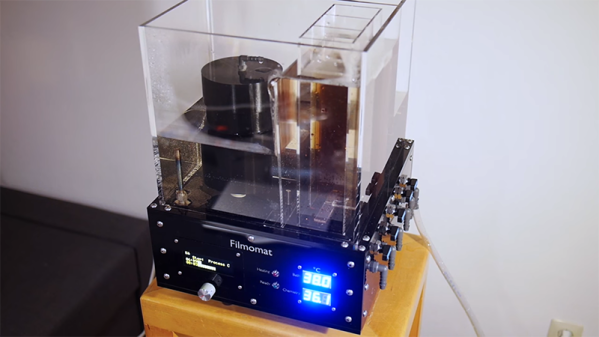
The death of film has been widely reported, but technologies are only perfected after they’ve been made obsolete. It may not be instant photography, but there is at least one machine that will take 35mm film and 5×7″ prints and develop them automatically. It’s called the Filmomat, and while it won’t end up in the studios of many photographers, it is an incredible example of automation.

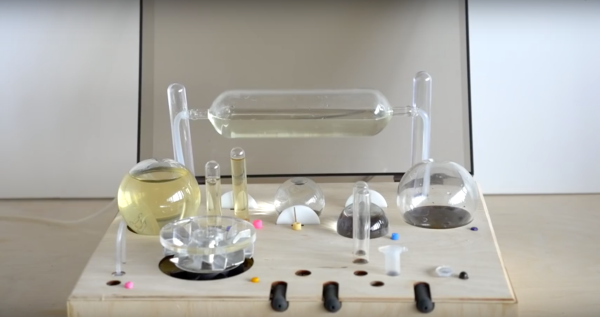
The Filmomat is an incredible confabulation of valves, tubes, and pumps that will automatically process any reasonably sized film, from 35mm to 5×7 color slides. The main body of the machine is an acrylic cube subdivided into different sections containing photo processing chemicals, rinse water, and baths. With a microcontroller, an OLED display, and a rotary encoder, different developing processes can be programmed in, the chemicals heated, developer agitated, and film processed. The Filomat is capable of storing fifty different processes that use three chemicals and a maximum of ten steps.

The video for this device is what sells it, although not quite yet; if enough people are interested, the Filmomat might be sold one day. This is likely the easiest film developing will ever get, but then again a technology is only perfected after it has been made obsolete.

Thanks [WhiteRaven] for sending this one in.

Continue reading “The Filmomat Home Film Processing System”

Basic Toolkit For The Basement Biohacker

Laying hands on the supplies for most hacks we cover is getting easier by the day. A few pecks at the keyboard and half a dozen boards or chips are on an ePacket from China to your doorstep for next to nothing. But if hacking life is what you’re into, you’ll spend a lot of time and money gathering the necessary instrumentation. Unless you roll your own mini genetic engineering lab from scratch, that is.

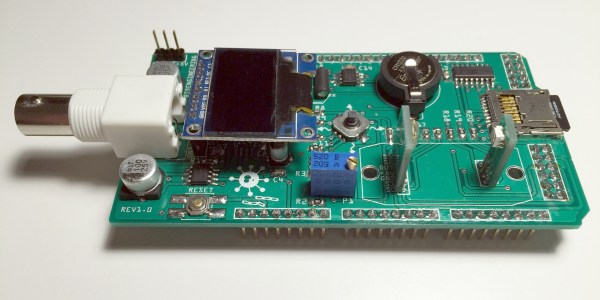
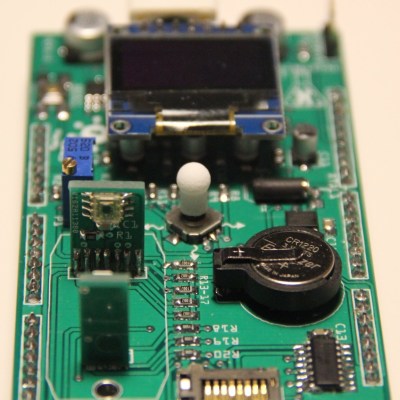
arduino-based-biolab-data-logger-thumbTaking the form of an Arduino mega-shield that supports a pH meter, a spectrophotometer, and a PID-controlled hot plate, [M. Bindhammer]’s design has a nice cross-section of the instruments needed to start biohacking in your basement. Since the shield piggybacks on an Arduino, all the data can be logged, and decisions can be made based on the data as it is collected. One example is changing the temperature of the hot plate when a certain pH is reached. Not having to babysit your experiments could be a huge boon to the basement biohacker.
Biohacking is poised to be the next big thing in the hacking movement, and [M. Bindhammer]’s design is far from the only player in the space. From incubators to peristaltic pumps to complete labs in a box, the tools to tweak life are starting to reach critical mass. We can’t wait to see where these tools lead.

New Magnetic Semiconductor

When you think of South Dakota you generally think of Mount Rushmore and, maybe, nuclear missiles. However, [Simeon Gilbert] will make you think of semiconductors. [Simeon], a student at South Dakota State University, won first place at the annual Sigma Xi national conference because of his work on a novel magnetic semiconductor.

The material, developed in collaboration with researchers from the nano-magnetic group at the University of Nebraska-Lincoln, is a mix of cobalt, iron, chromium, and aluminum. However, some of the aluminum is replaced with silicon. Before the replacement, the material maintained its magnetic properties at temperatures up to 450F. With the silicon standing in for some of the aluminum atoms, the working temperature is nearly 1,000F.

Continue reading “New Magnetic Semiconductor”

IndieGoGo Project Offers DNA Editing For The Home

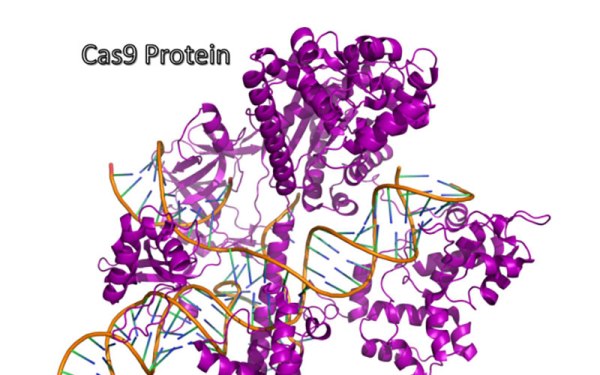
CRISPR is the new darling of the genetics world, because it allows you to easily edit DNA. It is far more effective than previous techniques, being both precise and relatively easy to use. According to this IndieGoGo project, it is coming to your home lab soon. Genetic researchers love Clustered Regularly Interspaced Short Palindromic Repeats (CRISPR) because it allows you to very precisely edit a DNA strand. Using a protein called CAS9, CRISPR can find a very specific sequence in a DNA sequence and cut it. It occurs naturally in cells as part of the immune system: by finding and remembering parts of virus DNA, a cell can recognize and attack it when infected. For the genetics researcher, this allows them to insert new DNA sequences at specific points in the genes of any living cell.

Continue reading “IndieGoGo Project Offers DNA Editing For The Home”

Amino Wants To Bring Bioengineering To Your Workbench

As the maker movement has exploded in popularity in recent years, there has been a strong push to put industrial tools into the hands of amateur tinkerers and hackers. CNC mills, 3D Printers, and laser cutters were all extremely expensive machines that were far too costly for most people until makers demanded them and hackers found ways to make them affordable. But, aside from the home brewing scene, those advancements haven’t really touched on anything organic. Which is a deficiency that Amino, a desktop bioengineering system, is seeking to address.

Amino, created by [Julie Legault], is currently seeking crowd-funding via Indiegogo. Hackaday readers are more suspicious than most when it comes to crowd-funding campaigns, and with good reason. But, [Julie Legault] has some very impressive credentials that lend her a great deal of credibility. She has four degrees in the arts and sciences, including a Masters of Science at the MIT Media Lab.

It was for that degree at MIT that [Julie] started Amino as her thesis. Her plan is to bring the tools necessary for bioengineering to the masses – tools which are traditionally only available in research labs. Those tools are packaged into a small desktop-sized unit called Amino. Backers will receive this desktop system, along with the supplies for their first project. Those projects are predefined, but the tools are versatile enough to allow users to move on to their own projects in the future. [Julie] thinks that the future is in bioengineering, and that the best way to feed innovation is to make the necessary tools both affordable and accessible.

Continue reading “Amino Wants To Bring Bioengineering To Your Workbench”

Potato Battery Cell

The Practical Potato Cell

Potato batteries, lemon batteries, they’re all good fun for the classroom — but is there a way of making them better? [Marcel Varallo] decided to give it a shot — and we gotta admit, it’s a pretty cool idea!

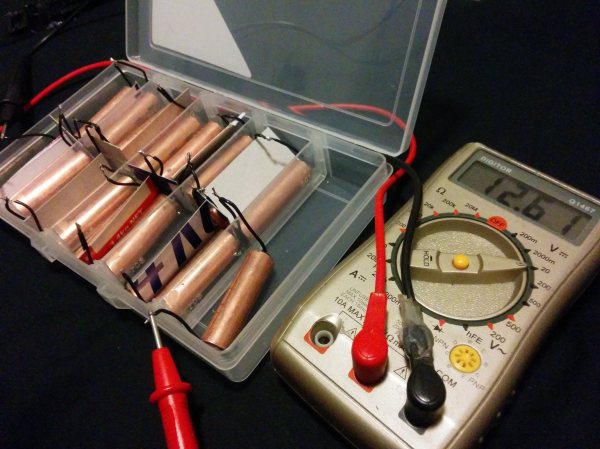
Normally for these fruit and vegetable batteries you poke some leads into the battery, connect it to a clock, and bob’s your uncle. But what if we made them resemble batteries? [Marcel] took some copper pipe, cut it down to size, and poked it through a potato. Now he had a potato-cored, copper tube. Stick a zinc nail in the middle, and you’ve got yourself a battery cell! Or as [Marcel] likes to put it.. a Mar-Cell. Or the more scientific term.. the Solanum tuberosum based electron differencer V1.0.

Each potato cell produces approximately 0.8V, so if you throw eight in series, you’ll have the equivalent of a 6V battery, just maybe not the same mAh rating.

For another cool way to demonstrate electricity to youngsters, we love this lemon battery hack — it’s actually quite elegant.