Portal Turret Plushie Is Cute And Harmless

turret_plushie

As many of you are probably aware, Portal 2 was released last week, and gamers have been going crazy over it. Over the years, people have constructed replicas of their favorite in-game items and “characters”, including portal guns, companion cubes, and turrets.

After playing Portal 2 for a bit, [Jonathan] wanted a turret of his own quite badly. Rather than construct it from hard plastics and resins however, he decided he wanted to construct a cuddly turret that talked.

With the assistance of his friend [Leigh Nunan], he is now the proud owner of a plushie turret. It’s a bit smaller than you might expect, but it is packed full of turret personality. The plushie plays audio from the game, can sense motion near its face, detect if it has been tipped over, and also knows when it has been picked up. [Jonathan] added all of these features by stuffing an Arduino inside the turret, along with a wave shield for playing sounds. Proximity and motion sensing are provided via a trio of different sensors, enabling the turret to behave in the same way its in-game brethren do (minus the machine guns).

It really is a neat little toy, one we would no doubt be glad to have around. Keep reading to see a short video of his plushie turret in action.

Continue reading “Portal Turret Plushie Is Cute And Harmless”

Powering Vehicles With Aluminum

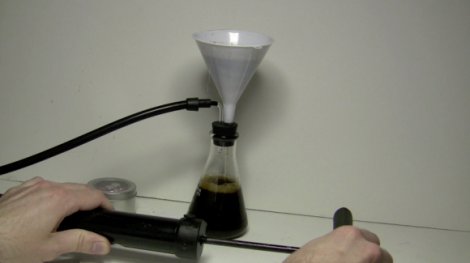
Pop a few aluminum bits into this little RC racer and you’ll have power for around forty minutes. This concept, which has been patented, is the result of a college research project. It uses a chemical reaction between aqueous Sodium Hydroxide and aluminum. The result of that reaction is hydrogen, which is gathered and directed to a fuel cell that drives the car.

Novel? Yes. Interesting? Absolutely. But you should be raising an eyebrow at the dubious choice of fuel that is aluminum.

If you don’t know what we’re talking about let us paint you a picture. Aluminum is a metal that is refined from bauxite ore. It takes an immense amount of electricity to smelt the metal. This is usually justified because aluminum is one of the most recyclable substances on earth, capable of being melted down and reformed countless times. But dissolving it in drain cleaner breaks it down and then it’s gone. So what we have here simply must be the least efficient disposable battery so far developed. It’d probably use less resources to grow and harvest lemons as a power source.

Continue reading “Powering Vehicles With Aluminum”

Compost Heap Temperature Logger Helps Keep Things Hot

compost_temp_logger

HackHut user [lackawanna] is looking to start his own compost pile, but as many urban composters discover, things can get quite smelly if you don’t manage it properly. The process of composting is broken up into two phases, aerobic and anaerobic decomposition. The former is the first stage to occur and produces plenty of heat, but should be scentless. The latter gives off less heat and is more of a stink due to putrefaction. Carefully monitoring the temperature of the pile and restarting the aerobic phase when necessary helps to keep the process “healthy” and scent-free.

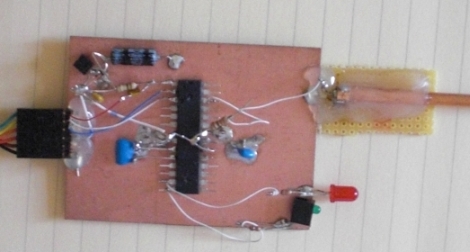
[lackawanna] built a simple temperature monitor that he plans on using to track the status of his compost pile once he gets started. It uses an ATmega328 as the brains of the operation and an old metal can transistor as his temperature sensor. Using relative measurements of the compost pile taken in 10 minute intervals, he can determine when the aerobic phase is underway, as well as when things begin turning anaerobic. At that point, the sensor alerts him that the pile needs to be turned.

The build is pretty simple, but leaves plenty of room for expansion. It should be relatively easy to add a more friendly notification interface as well as install multiple sensors to the pile for obtaining aggregate temperature data.

Toothpaste Diode

While reading the back of a tube a toothpaste [Underling] noticed that one of the ingredients was hydrated silica, gears turned, sparks flew and he wondered if he could possibly make a transistor out of the stuff. After thinking about it he decided that making a diode out of toothpaste would be easier and still prove the idea.

The quick n dirty explanation of this is he smeared some toothpaste on a bit of chrome and set it on fire with a propane torch. When set on fire the result is silica and sodium, heat causes the sodium to bond with the silica and since sodium is negatively charged this forms an n-type semiconductor or half of the diode. Chrome is used for the second half of the diode, for a few reasons, he had some lying around, its positivity charged, and the toothpaste contains a little bit of lye which oxidizes the chrome and burns off, bonding the silica to the metal.

What is left is a thin layer of chrome doped silicon under a layer of sodium doped silicon, which in spots where everything is perfect, acts like a diode, blocking current in one direction but not the other.

Cooking Up Piezo Crystals At Home

piezo_crystal

[Collin] loves piezos – and why not?

According to him, they are about as close to magic as you can find in the world. We can’t really disagree on that one – there’s something oddly enchanting about piezoelectric materials.

Most commercially used piezoelectric devices that you find today are constructed out of man-made ceramic materials such as Lead zirconate titanate, and can be found in grill starters, gas-powered water heaters, etc. While they are common, it’s not exactly easy to synthesize these sorts of ceramic materials at home.

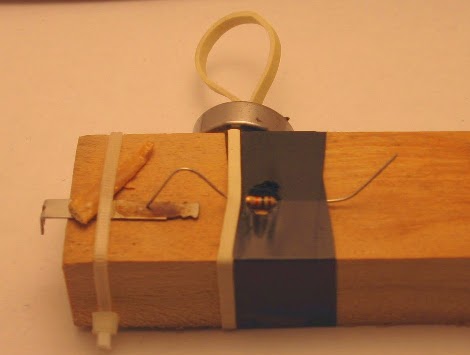
You can however, create piezoelectric crystals in your kitchen, using just a few simple ingredients. In his video, [Collin] shows us how to create Rochelle Salt, one of the first known materials found to exhibit piezoelectricity. The recipe calls for three ingredients, cream of tartar, sodium carbonate (soda ash), and water – that’s it. The procedure is quite simple, requiring you to heat a solution of water and cream of tartar, adding the soda ash a little at a time once it reaches the proper temperature. The solution is filtered after it turns clear and then left to sit overnight while the crystals form.

Take a look at the video embedded below to see how his Rochelle Crystals turned out, and be sure to try this out with your kids if they are interested in electronics. Making crystals that generate electricity when tapped is far cooler than making rock candy any day, trust us on this.

Continue reading “Cooking Up Piezo Crystals At Home”

Simple PCB Etchant Made From Chemicals You Can Put In Your Mouth

etching_test

[Stephen] often finds the need to make his own PCBs at home, and when he got the urge to do some etching recently, he realized that he was fresh out of “Ferret Chloride and Bureaucratic Acid*.” Undeterred by his empty chemical cabinet, he poked around in his kitchen mixing together anything and everything that might have the ability to strip copper from a PCB.

Now, we don’t necessarily recommend this course of action, but it seems that he finally hit upon a winner. He discovered a formula that can be made at home from simple and safe household ingredients which does the job quite nicely. A fair warning however, standard ferric chloride disposal procedures need to be followed when using this solution.

If you want to know what he concocted in his kitchen as well as the chemistry behind it, you will have to visit his site, we won’t ruin it for you. You can however, see the solution at work in the video we have posted below.

*His joke, not ours

Continue reading “Simple PCB Etchant Made From Chemicals You Can Put In Your Mouth”

Arduino-Fart-O-Meter

[robomaniac] shows us some serious application of modern technology with his recent Instructable, (the) Arduino-Fart-O-Meter. The wireless device uses a “perfboard Arduino” to read a remote wired methane sensor, and send data over a nRF2401A radio transceiver.

“The data” is picked up by another Arduino / transceiver combo, which then drives a servo motor connected to the pointer. The meter itself consists of 6 ranges from “Fresh Air” to “Liquid” so there is no doubt in your standing.

The wireless and remote sensor setup makes this an easy device to include into your loved ones chairs while having the meter far enough away (just in case you have to make a run for it). If you want some more accuracy check out the Fart intensity detector we posted about, which adds in temperature and sound to the equation, or how about a chair that twitters your toots?

Join us after the break for a quick video, its a real gas.

Continue reading “Arduino-Fart-O-Meter”