The Vintage Computer Festival East is going down right now, and I’m surrounded by the height of technology from the 1970s and 80s. Oddly enough, Hackaday frequently covers another technology from the 80s, although you wouldn’t think of it as such. 3D printing was invented in the late 1980s, and since patents are only around for 20 years, this means 3D printing first became popular back in the 2000’s.
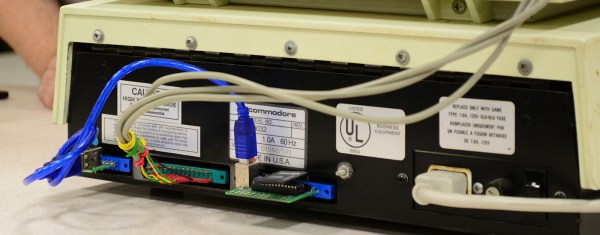
In the 1970s, the first personal computers came out of garages. In the early 2000s, the first 3D printers came out of workshops and hackerspaces. These parallels pose an interesting question – is it possible to build a 1980s-era 3D printer controlled by a contemporary computer? That was the focus of a talk from [Ethan Dicks] of the Columbus Idea Foundry this weekend at the Vintage Computer Festival.
When I was asked to cover the Unconference in Los Angeles last week, I have to admit that I was a more than a little uncomfortable with the idea. I’m not big on traveling, and the idea of meeting a lot of folks was a little intimidating. Surely meeting Hackaday readers in person would be like walking into a real-life version of the comments section of a particularly controversial post. Right?
I couldn’t have been more wrong.
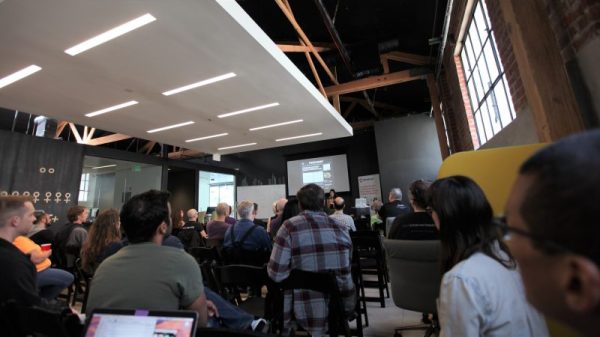
The LA Unconference, held at the Supplyframe Design Lab in Pasadena, was a far more collegial and engaging conference than any I’ve been to in my professional life. I couldn’t have asked for a better group to share the afternoon and evening with, and the quality of the talks was excellent. The Design Lab turned out to be a great space for the event — a large main room for the talks with plenty of little areas to break away for impromptu discussions and networking.
Every year, nestled between a swine auction and beef auction at the fairgrounds in Goshen, Indiana, the world’s greatest 3D-printing meetup happens. The Midwest RepRap Festival draws the greatest minds in 3D printing from around the world, with teams flying in from Prague, Oxford, and Hong Kong. This year was bigger than any other year. Over 1,000 people ventured forth into the sticks to attend this awesome festival dedicated to DIY printers.
There was more to see at MRRF than a single weekend would allow. [Jason Kridner] from BeagleBone was there talking about the latest in fancy single-chip Linux computers. Hackerspaces were there talking about their coolest builds and doing the calculations necessary to strap model rocket engines to 3D printed rockets. A few local colleges sent teams out to talk about their efforts to bring additive manufacturing to their programs. YouTube personalities were there. Check out the rest of the goodies we saw below.
The VCF East is the largest gathering of retrocomputing aficionados on the east coast. It’s three days of talks, exhibits, a flea market, and a pow-wow of the greatest minds buried under obsolete technology. No VCF is complete without a few talks, and this year is shaping up to be great. Keynotes will include [Bjarne Stroustrup], designer / implementor / inventor of C++. Computer historian [Bill Degnan] will give a review of 40 years of ‘appliance computers’, and [Tom Perera], Ph.D. will be giving a talk on the Enigma machine.
The exhibits at VCF are always the star of the show, and this year is no different. Highlights include mechanical computers, the finest from Silicon Graphics, and a version of Unix published by Microsoft. The individual exhibits are always great; last year the world’s first digital camera made an appearance. If you’re in the area, this isn’t an event to miss. VCF is going down at InfoAge, a science center at the former Camp Evans — a military installation that is best described as, ‘DARPA before World War II’.
Hackaday is proud to once again sponsor VCF East. This has been going on for a couple of years now and our Art Director, [Joe Kim] has created some incredible art as part of the sponsorship. Click on the thumbnail of this year’s art to embiggen. The VCF West art from last year is a stunning take on the Macintosh and last year’s VCF East art reflected the retro hackathon we sponsored.
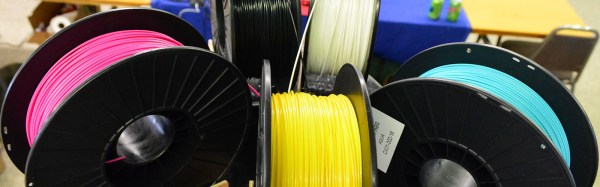
The Midwest RepRap Festival is the best place to go if you want to see the latest in desktop 3D printing. This weekend, we saw full-color 3D printers, a printer with an infinite build volume, new extruders, a fantastic development in the pursuit of Open Source filament, and a whole bunch of D-bots. If you want the bleeding edge in 3D printing, you’re going to Goshen, Indiana.
Of course, it wasn’t always like this. In 2009, MakerBot released the Cupcake, a tiny printer that ushered in the era of democratized 3D printing. The Cupcake was a primitive machine, but it existed, it was open source, and it was cheap – under $500 if you bought it at the right time. This was the printer that brought customized plastic parts to the masses, and even today no hackerspace is complete without an unused Cupcake or Thing-O-Matic sitting in the corner.
The MakerBot Cupcake has not aged well. This should be expected for a technology that is advancing as quickly as 3D printing, but today it’s rare to see a working first generation MakerBot. Not only was the Cupcake limited by the technology available to hackers in 2009, there are some pretty poor design choices in these printers. There’s a reason that old plywood MakerBot in your hackerspace isn’t used anymore – it’s probably broken.
This year at MRRF, [Ryan Branch] of River City Labs brought out his space’s MakerBot Cupcake, serial number 1515 of 2,625 total Cupcakes ever made. He got his Cupcake to print a test cube. If you’re at all familiar with the Cupcake, yes, this is a hack. It’s a miracle these things ever worked in the first place.
3D printing has evolved to a point where dual extrusion isn’t really that special anymore. A few years ago, a two-color frog print would have been impressive, but this isn’t the case anymore. The Midwest RepRap Festival is all about the bleeding edge of what 3D printers are capable of, and this year is no exception. This year, we were graced with a few true multicolor filament-based 3D printers. The biggest and best comes from [Daren Schwenke] and the rest of the Arcus3D crew. This printer is a full color, CMYKW mixing printer that’s able to print in any color imaginable.
The extruder assembly, suspended from the top of the printer
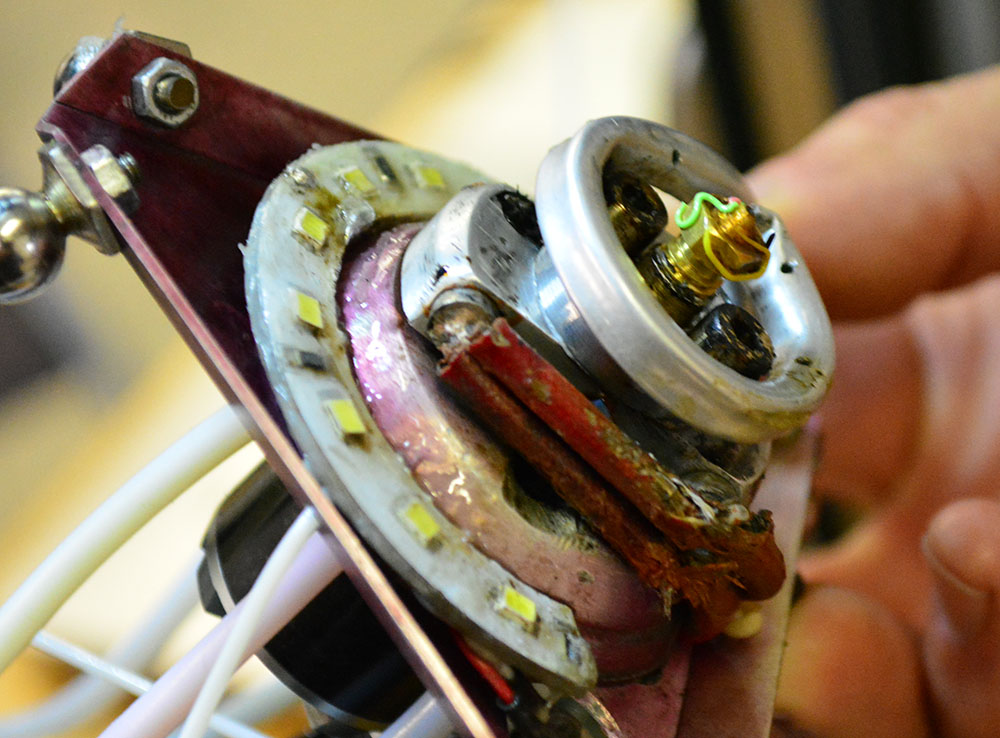
The bizarre mixing hotend, powered by a brushless motor
The electronics for this printer are, to say the least, very weird. The controller board is BeagleBone Black plus a CRAMPS running Machinekit. The hotend is bizarre, feeding six PTFE tubes into a weird water-cooled assembly that mixes and squirts filament out of the nozzle with the help of a small brushless motor. Thanks to a clever design, the end effector of the hotend weighs only about 150 grams – about the same as any other delta printer out there – and this printer is able to move very fast.
Over the last year, we’ve seen a lot of improvements in the state of multi-material and multi-color extrusion for 3D printers. At last year’s Maker Faire NY, Prusa’s i3 quad extruder made an appearance alongside the ORD Solutions RoVa4D printer. These are two completely different approaches to multicolor 3D printing, with the RoVa mixing filament, and the Prusa merely extruding multiple colors. Both approaches have their merits, but mixing extruders are invariably harder to build and the software stack to produce good prints isn’t well-defined.
Even though we’re still in the early years of full-color filament-based printing, this is still an awesome result. In a few years, we’ll be able to look back on [Daren]’s efforts and see where our full-color 3D printers came from – open source efforts to create the best hardware possible.
[Daren] has been working on this printer for a while, and he’s been uploading all his project updates to hackaday.io. You can check out the build log here.
Since the beginning of time, or 2006, the ‘hot glue gun’ part of our CNC hot glue guns have had well-defined parts. The extruder is the bit that pushes plastic through a tube, and the hot end is where all the melty bits are. These are separate devices, even though a shorter path from the extruder to hotend is always better. From Wade’s gear extruder to a nozzle made from an acorn nut, having the hotend and extruder as separate devices has become the standard.
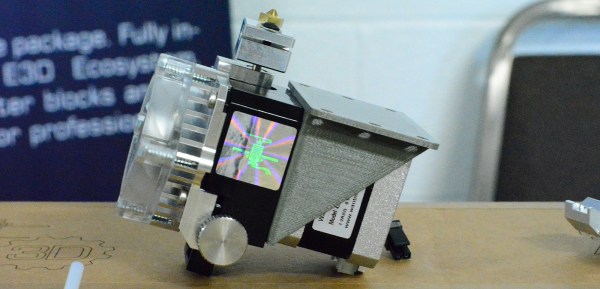
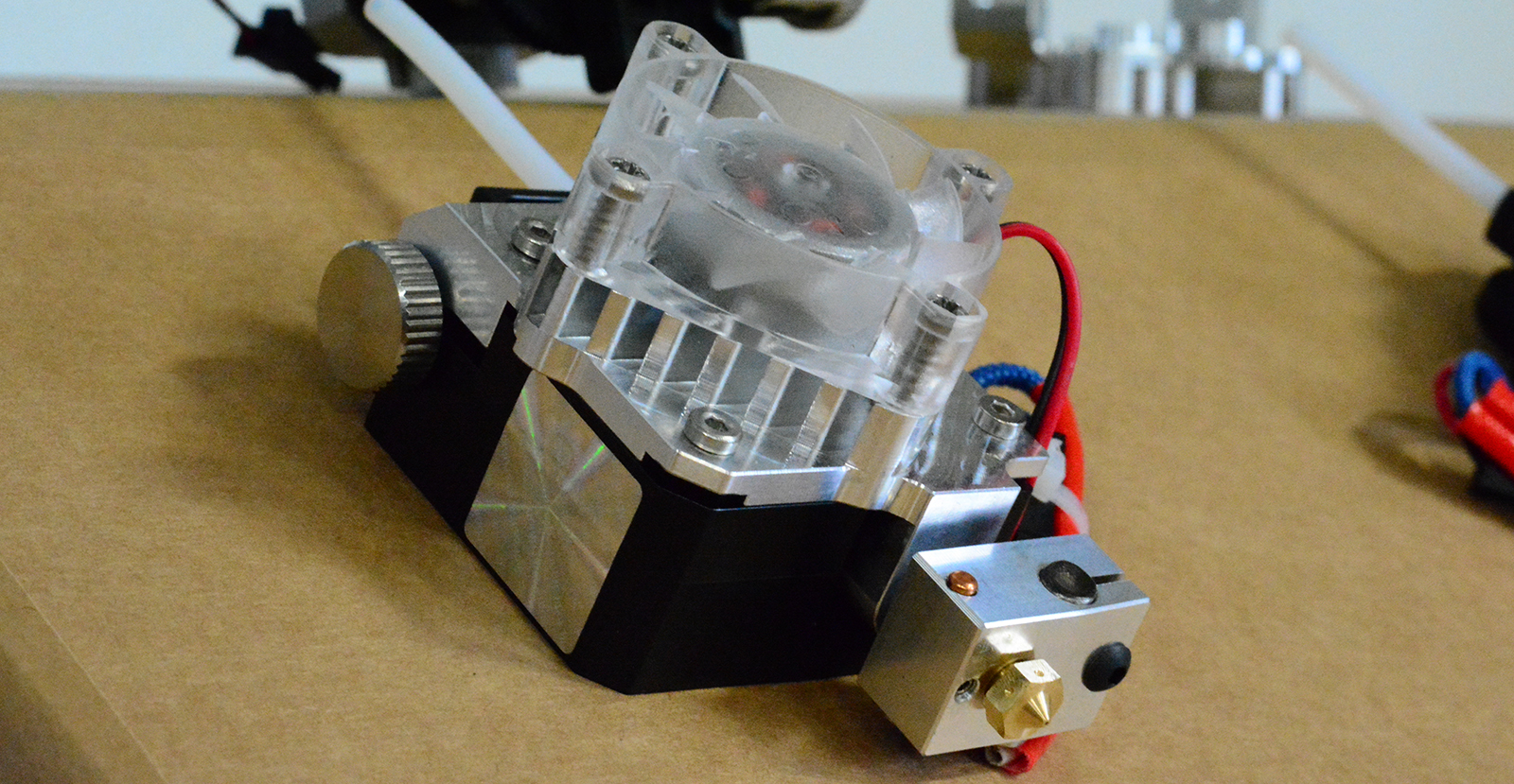
This week at the Midwest RepRap Festival, E3D unveiled the Titan Aero. It’s an extruder and hotend rolled into one that provides better control over the filament, gives every printer more build height, and reduces the mass of a 3D printer toolhead.
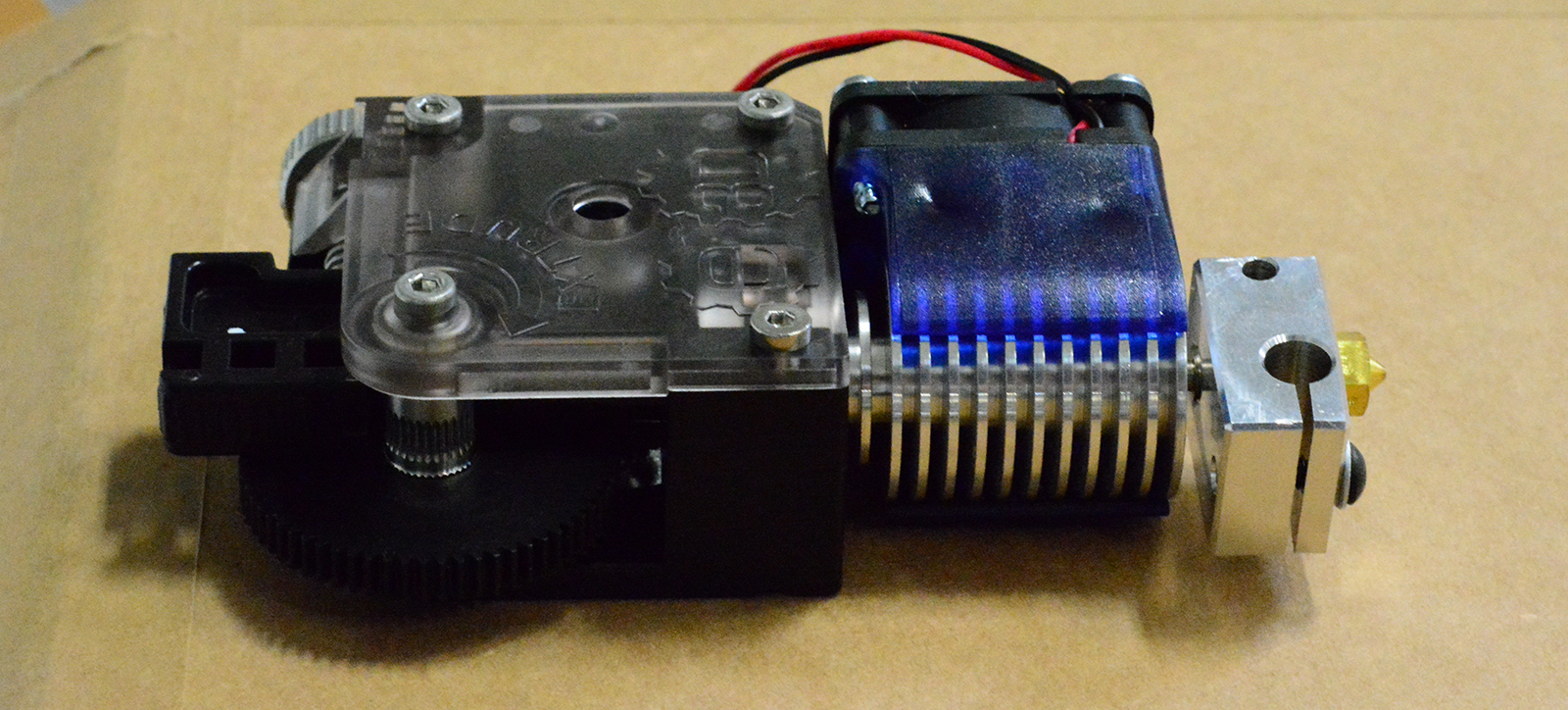
The Titan + V6 hotend. This is significantly longer than the Titan Aero
The Titan Aero extruder + hotend
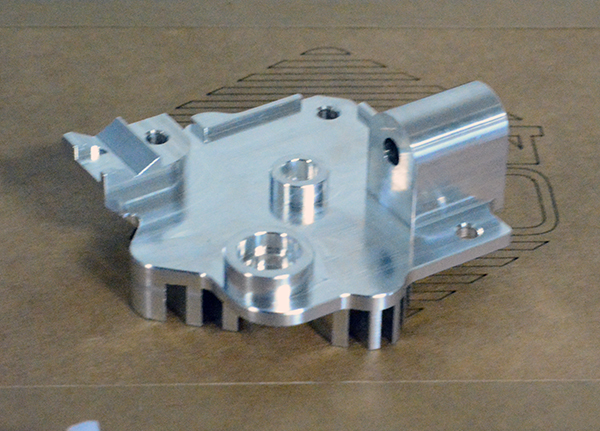
The aluminum thermal block of the Titan Aero
The Titan Aero, revealed on the E3D blog yesterday, is the next iteration of E3D’s entry into the extruder market. It’s a strange mashup of their very popular V6 hotend, with the heat break coupled tightly to the extruder body. A large fan provides the cooling, and E3D’s thermal simulations show this setup will work well.
The core component of the Aero extruder is a fancy and complex piece of milled aluminum. This is the heatsink for the extruder and provides the shortest path possible between the hobbed gear and the nozzle. This gives the Aero better control over the extrusion of molten plastic and makes this the perfect extruder and hotend setup for hard to print materials.
Combine the Aero with a smaller ‘pancake’ stepper motor, and you have a very small, very light hotend and extruder. This makes it perfect for the small printers we’re so fond of and for printers built for fast acceleration. I can easily see a few end effectors for Delta-style printers built around this extruder in the near future.
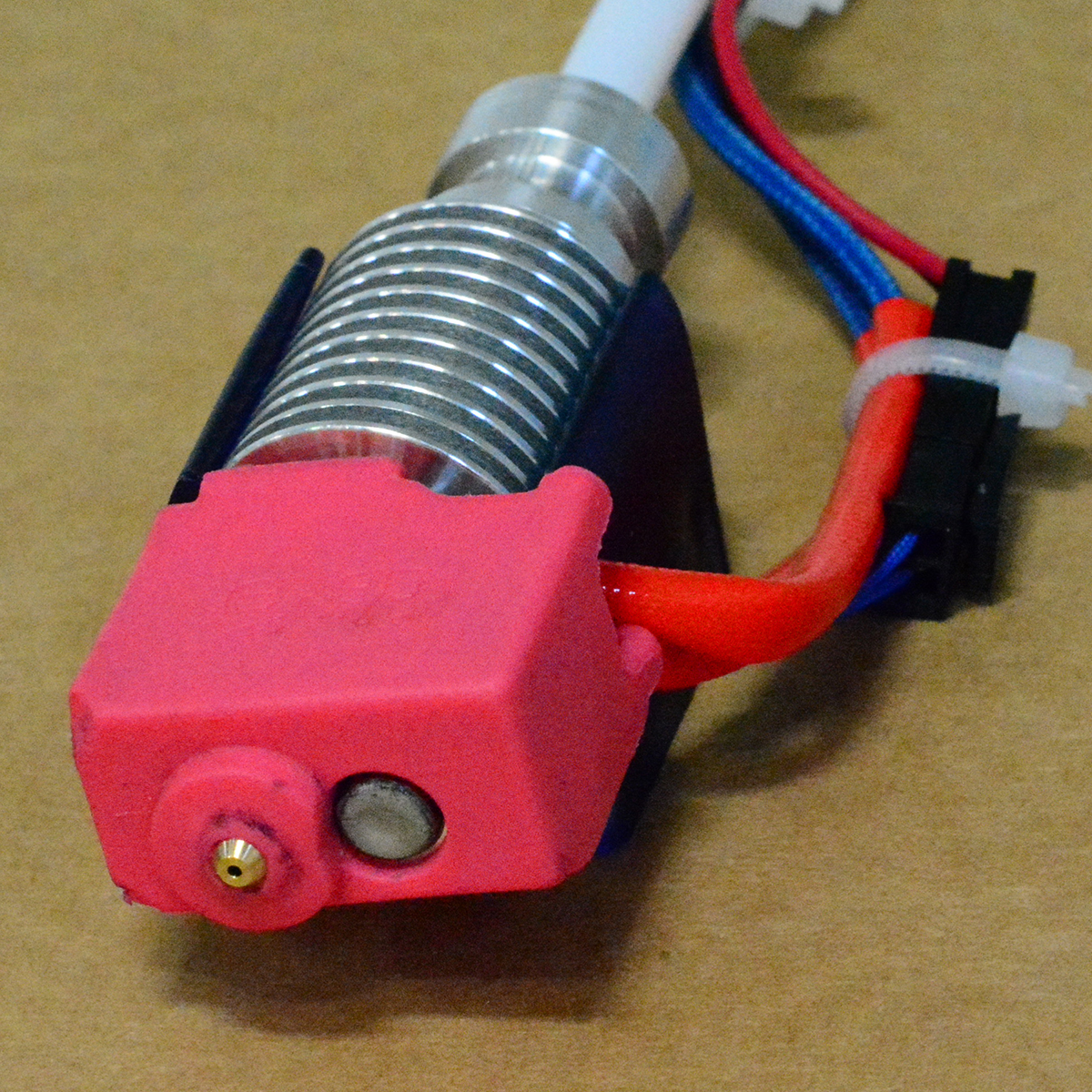
E3D’s Volcano nozzle sock
Also at the E3D booth were a few prototypes of nozzle socks. Late last year, E3D released silicone nozzle covers – we’re calling them nozzle socks – for their V6 hotend. These are small silicone covers designed to keep that carbonized crap off of your fancy, shiny hotend. It’s not something that’s necessary for a good print, but it does keep filament from sticking to your hotend, and you get the beautiful semantic satiation of saying the words nozzle socks.
E3D’s other hotend, the Volcano, a massive and powerful hotend designed to push a lot of plastic out fast, did not get its own nozzle sock at the time. Now, the prototypes are out, and the E3D guys expect them to be released, ‘in about a month’.