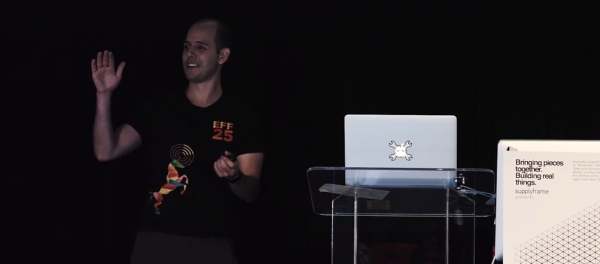
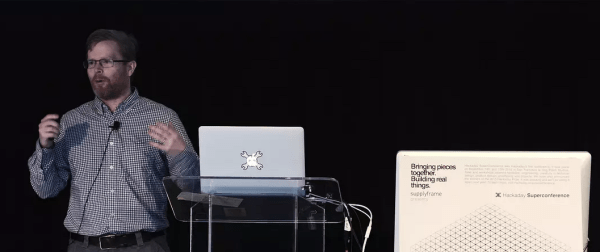
Too often we find ourselves featuring projects on these pages without giving much thought behind the people who made them. Nevertheless, behind the LED panels, github pages, and PCBs that make the hardware magic happen, there’s a person. And not just one person but an entire culture of people who let their conscious hours bleed late into the night over software bugs and bad solder joints. Noah Feehan is one of these veterans, and at this year’s Hackaday SuperConference, he reached out to this culture. Noah comes armed not with projects but with design tips and an infectious enthusiasm that will make you rethink how you use your time and space in the land of DIY. Armed with ten years of experience in art and engineering design, Noah delivers his best tips for fellow hackers. Spare yourself hours of confusion during future builds; kick back, and treat yourself to a few tips from a pro on keeping things together.
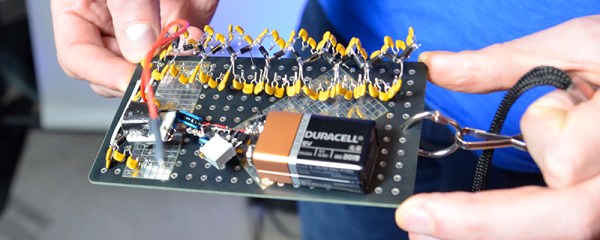
A few weeks ago, we took a look at the best badge hacks at the Hackaday Supercon. These were the best badge hacks anyone has ever seen – including what comes out of DEF CON and the SDR badge from the latest CCC. I’m ascribing this entirely to the free-form nature of the badge; give people a blank canvas and you’re sure to get a diverse field of builds. Now it’s time to take a look at the cream of the crop, hear what the jolly wrencher sounds like, and how to put 1000 Volts in a badge.
There were three categories for the badge hacking competition at the SuperCon – best deadbug, best blinky, and most over the top. A surprising number of people managed to solder, glue, and tape some components to a the piece of FR4 we used as a conference badge, but in the end, only three would win.
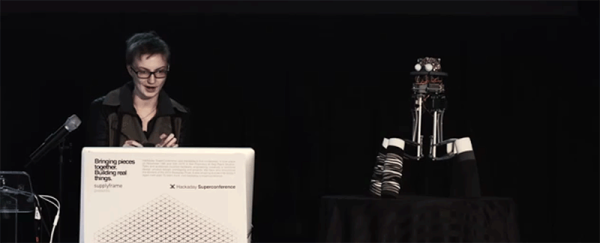
[Sarah Petkus] started off her career as a visual artist with traditional mediums. She has a webcomic called Gravity Road, but somewhere along the line she wanted her creations to come alive. These characters are robots – artistically designed robots – and turning this type of art into a real object isn’t something that happens very often.
Robots usually aren’t art. A Roomba is just a vacuum cleaner that’s meant to turn on a dime, thus the circular shape. The welding robots in a car factory aren’t art, they’re only tools to assemble cars. These are just devices built for a single purpose, and art is for any or every purpose. It’s not something you can really design, but you can engineer a few interesting solutions.
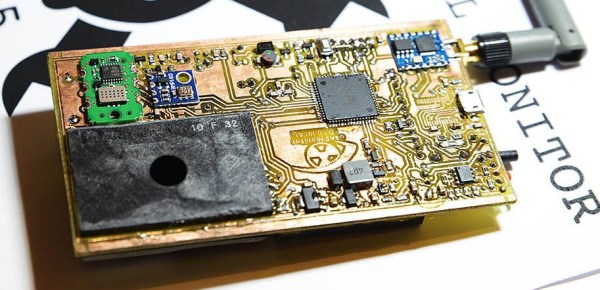
Radu Motisan has been building a global environmental surveillance network which first monitored radiation levels, and since has added the ability to measure air quality. He believes that people need to be more aware of the environment around them in a similar way that society has awakened to issues about personal fitness and health. We can’t do this without a simple and reliable way to measure the environment.
He discussed the project at length during his presentation at the 2015 Hackaday SuperConference. Watch that talk in the video below, then join us after the break for more details on the hardware and infrastructure that collects and presents the data publicly.
Software hackathons are an old hat these days. They’re a great scouting opportunity for talented candidates looking for a job, and they provide the battleground for coding enthusiasts to prove themselves by developing a project from start to finish overnight, albeit, with a few kinks. Hardware hackathons are an entirely different beast. By trading APIs for components and Python libraries for soldering irons, they pull the excitement out of the text editor and onto the workbench for everyone to see.
This article was written for the Omnibus vol #02 Order yours now
While hardware hackathons might be “the next big thing” with you and your four best DIY-pals, the broad range of physical components, from Arduinos to CNC milling time, makes rule-establishment, safety enforcement, and winning criteria far more difficult to constrain within a single night. Enter Muddhacks. This past October, three students from Harvey Mudd College set out to deliver a hardware hackathon that would open their student community’s mind to the thought of tinkering-for-fun in their spare time outside the lab and beyond their homework.
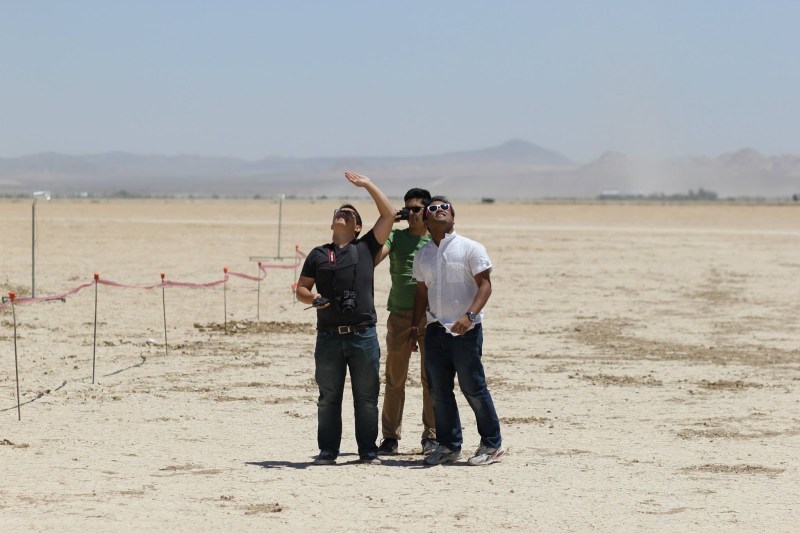
Students [Benjamin Chasnov], [Apoorva Sharma], and [Akhil Bagaria] had just finished their experimental engineering class: E80. Along the way, they designed a custom sensor payload into a meter-long rocket and launched both rocket and payload to measure the rocket’s fundamental frequencies in flight. With a victory behind them, they were ready for their next big project.
(Left to right) [Ben], [Apoorva], and [Akhil] stare skyward as their rocket launch sets them hungry for future projects.As the next semester waned onwards, however, they realized that any big project–no matter how modular–would be a serious time commitment. After some thought, they refactored their idea entirely. Tinkering was a passion shared by each of them; why not spread the love school-wide and bring together a community of engineers-by-night? To resolve their craving for after-hours engineering and to inspire a culture of collaborative tinkering, they set out to bootstrap a hardware hackathon; an event where many projects could be realized by many students in a single night.
Everyone Says Hardware is Hard
For the unitiated, hardware looks hard. Breadboards, LEDs, r`esistors? To those who have never put together a simple circuit before, taking that first leap is a challenge set by a box of components that almost seems to glare back menacingly. The three teammates took this first-timer roadblock as a challenge unto themselves to break down that barrier. Thus, HackWeek was born.
HackWeek was the MuddHacks teams’ answer to get students comfortable gluing modules together to produce a functional project in a short time. How do I make things move? How do I connect things to the internet? What parts do I choose? All of these questions-worth-answering became topics of the three-day event before the hackathon. The idea behind HackWeek was simple: give eager students enough theory and a functional demo that they could probe, tweak, and recompile so that they could feel more comfortable developing their own ideas into projects. On day one, the MuddHacks team brought functional demos of various motors into the hands of eager students. By day two, the three teammates actually assembled a functional hack of their own before the eyes of their listeners: an internet-enabled microwave that could remotely start warming up that cup of ramen on your way back from class.
[Akhil], [Ben], and [Apoorva] bring the Phone-Microwave to life at HackWeek while users try to fire it up remotely.Unlike software hackathons, a successful hardware hackathon involves parts, and the MuddHacks team was well-prepared to bring the participants the parts that they wanted. With ten days to go before the event, [Ben] took orders from each team’s desired list of parts. With a day to go, all parts arrived before the event and made it to their respective user’s hands in “goodie bags” on the last day of HackWeek. On this last day, teams opened their bags and explored the parts given to them and to other teams while taking advice from the mentors present to offer tips for using various components. This time for “open-exploration” ensured that the following night spent hacking would be more fruitful, now that teams had cleared the starting questions for various parts on the previous day.
On the night of MuddHacks, [Ben], [Apoorva], and [Akhil] had completely turned their original aim to build their own project into a night spent mentoring the projects of others. Throughout the night, they became the “ground crew,” bringing advice to debugging teams and keeping the night culture alive with two waves of snacks. “We felt that if students were going to come to our event, it was our responsibility to keep them both awake and happy,” Apoorva mentioned. Classrooms refilled for the night with students eager to bring their robots, LEDs, and gantries to life, but other parts of the school came to life as well. The machine shops reopened, and old oscilloscopes and test equipment emerged from the engineering stock room for loan to any teams that needed them. Even a few professors happened to wander into classrooms and offer advice.
For [Ben], [Apoorva], and [Akhil], fostering a sense of community in tinkering became their top priority. As they wandered between teams, they encouraged stellar performers to take a brief break and help out another team through a bug. At the night’s end, a number of early-rising professors joined the crowd of students to judge the winners. Oddly enough, the MuddHacks team didn’t spend any money on the prizes–but no one seemed to notice or care. For the eighth of the entire undergraduate student body that attended, these students weren’t coming for the prizes. They came to join that culture of tinkerers–to be a fellow hardware-hacker-by-night–eager to do their part to make the world blink.
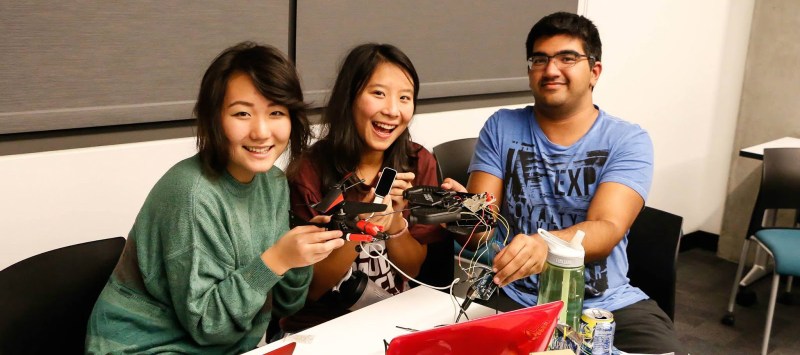
(Left to right) Erin Paeng, Cherie Ho, and Shaan Gareeb take first place by rewiring an rc helicopter for hand-control with a Leap Motion
How to Deliver a Hardware Hackathon
When was the last time you burned yourself downloading someone else’s API? Probably never. With a hardware hackathon, comes a new wave of challenges not seen before in the software variant. With one successful hackathon under their belt, we asked the MuddHacks Team to share some insights for other teams looking to assemble their own hardware hackathon. Here’s what they came up with.
Getting Funding
Charging participants an entrance fee may solve the problem of funding, but for the thrifty, starving student, entrance fees may also weed out people who had a slight curiosity but weren’t eager to throw a few bucks down to support it. The solution? Bring participants in for free and support the hackathon with external funding. The MuddHacks team reached out to a number of companies and encouraged them to take a sincere look at their website and cause.
Administrivia
The Muddhacks team handled most of their administrative work online. Among the tools they chose were
Google Forms for parts orders and feedback
Slack and email lists for real-time updates during the event
Google Spreadsheets for keeping track of order requests
Bootstrap for deploying a website
Assembling Teams
The Muddhacks team mandated that students form teams to enter the hackathon, mostly to foster community and collaboration. They reasoned: “If you already build things for fun on your own, you don’t need a hackathon to get you excited about hardware for the first time.” Most teams self-assembled, but the Muddhacks team also suggests a submission form for stragglers to pair up.
Getting Parts
Ten days before the hackathon, [Ben] put out a call to order parts in a $100 budget range. Each team made part requests, and [Ben] then ordered each of these parts in time for the hackathon. In addition, the Muddhacks team also ordered a collection of additional stock hardware (think: Arduinos and shields).
Setting the Stage
The Muddhacks team received permission to host the night event on the third floor of one of their buildings filled with classrooms. Among points to consider for the setting are:
reliable Wi-Fi connectivity
power outlet access
Safety
Soldering irons and sleep-deprivation don’t mix well. Among the points to consider for safety are tools that will keep users safe (safetly glasses and ventilation in this case). The MuddHacks team also recommends a safety waiver.
Advertising and Swag
Getting people excited is key. Logos, T-shirts, and Mugs all add to the authenticity of the one-night event. The Muddhacks Team brought in each of these to its participants. In addition, they printed posters, deployed a website and facebook page, and pitched to students directly in their computer science and engineering classes.
Keeping the Night Moving
Feed the masses. The MuddHacks team reminds us that, as the hosts and organizers of the event, it’s your responsibility to make sure that attendees are both awake and enjoying their time. Not only did the team provide two rounds of food, they also walked around and engaged participants that needed some help debugging, effectively becoming an extra set of eyes to track down bugs as mentors throughout the night.
Judging
The MuddHacks team brought in their favorite professors to judge teams’ projects. At this event, the MuddHacks team stresses that all participants deserve to see all projects. Not only can they witness something awesome, they can also engage their peers with questions, effectively learning a few extra tricks that they didn’t discover while working on their own project.
Priming for Next Year
From the MuddHacks Team: “Take pictures!” While the first website and facebook page were filled with images of the tools and the setting, next years website and advertisements could be filled with pictorial proof of the promise to participants of a genuine experience. As the first hackathon closes, they also stress that you, the organizers and founders, learn too; and the best way to do so is to collect feedback with some manner of online form. At the same time, this form could also recruit additional hands for assembling next year’s hackathon.
We hope these tips from a stellar hackathon serve as a starting point for developing one of your own. To learn more about MuddHacks, take a quick visit to their website: MuddHacks.com, or follow them on their Facebook page.
This article was specifically written for the Hackaday Omnibus vol #02. Order your copy of this limited edition print version of Hackaday.
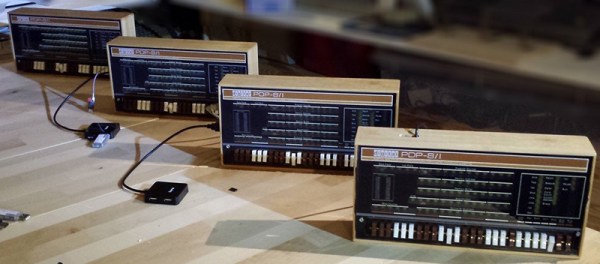
This year’s Hackaday Prize included a category for the Best Product, and there is perhaps no project that has inspired more people to throw money at their computer screens than [Oscar Vermeulen]’s PiDP-8/I. It’s a replica of the PDP-8/I from 1968. Instead of discrete electronics driving the blinkenlights and switches on the front of this computer, [Oscar]’s version uses a Raspberry Pi and the incredible SIMH emulator for dozens of old mainframes and minicomputers. It is, for all intents and purposes, a miniaturized version of a 50 year old computer that will fit on your desk and is powered by a phone charger.
Check out the video of [Oscar]’s talk below then join us after the break for more discussion of his work.
[Alvaro Prieto]’s talk at the Hackaday Supercon began with a slide that asks the rhetorical question “Why Laser-Shooting Robots?” Does a rhetorical question need an answer? [Alvaro] gives one anyway: “Because lasers are awesome.” We concur.
But it doesn’t hurt that DEFCON holds a laser robot contest to give you an excuse, either. You see, [Alvaro]’s laser-wielding robot was the First Place finisher in the 2014 DEFCONBOTS contest, and a much more ambitious design came in third in 2015. His Supercon talk is all about the lessons he’s learned along the way, because that’s really the point of these contests anyway, right?
“I have no idea what I’m doing.”
[Alvaro] started off with a disclaimer, but when [Alvaro] says he doesn’t know what he’s doing, what he means is that he hasn’t received formal training in building laser-wielding, autonomous turret robots. (How did we miss that class in school?)
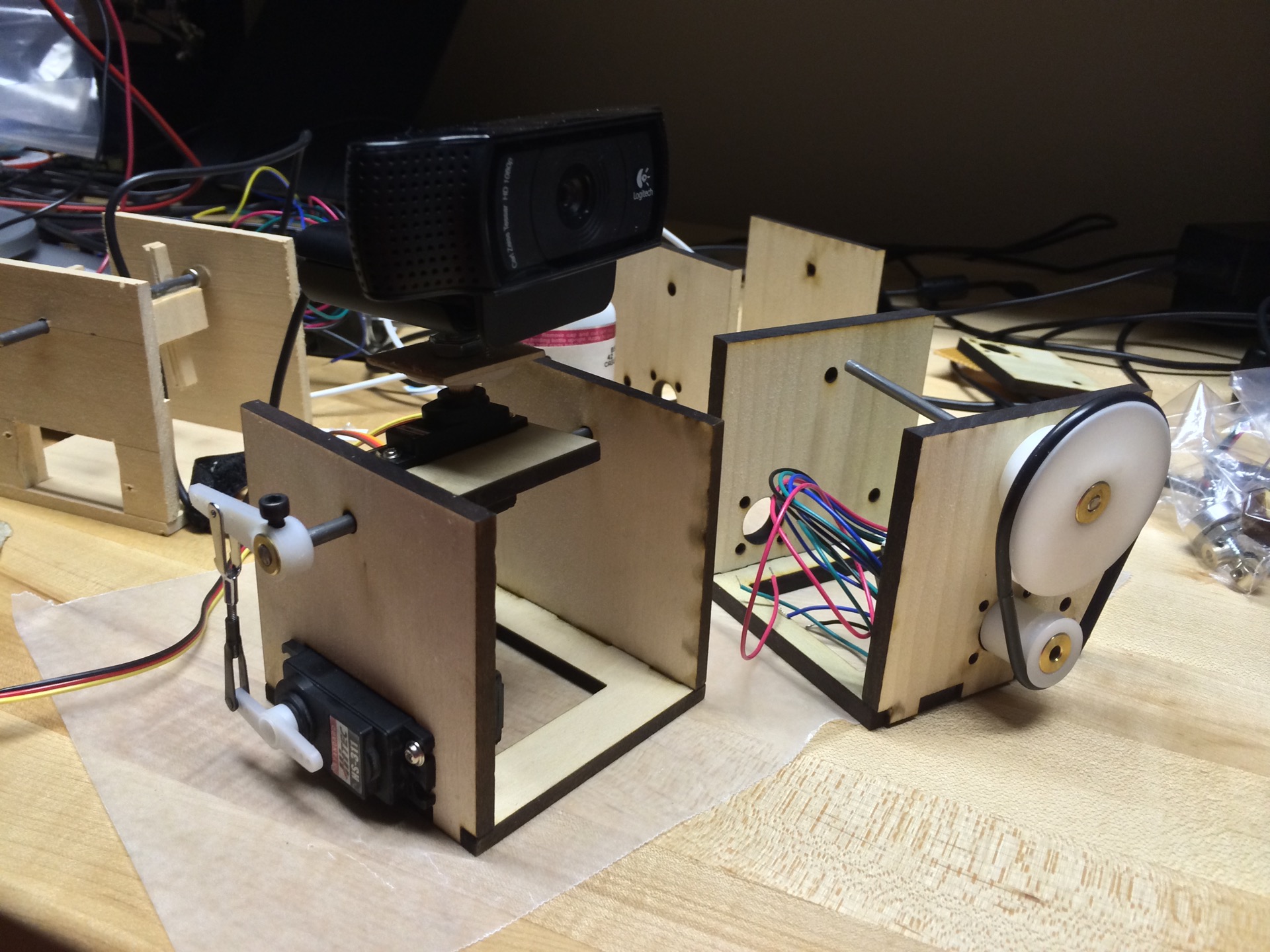
He’s a true hacker, though; he didn’t know what he was doing when he started out but he started out anyway. [Alvaro]’s takes us from the first prototypes where he used servo motors with inadequate angular resolution mounted to balsa wood frames that he (obviously) cut with a knife by hand, through laser-cut frames with custom gearing and stepper motors, all the way to his DEFCONBOTS 2015 entry, based on OpenBeam aluminum extrusions and using professional laser-show galvos capable of swinging the beam around to thousands of points per second.



![[Akhil], [Ben], and [Apoorva] bring the Phone-Microwave to life at HackWeek while users try to fire it up remotely.](https://hackaday.com/wp-content/uploads/2015/12/1498733_865206590158431_3338528161191372467_o.jpg?w=800)