New Contest: Say Goodbye To 2020

Every year you find yourself wanting to build an awesome hack to show off on New Year’s Eve, but like all hackers, you procrastinate and it’s a rush job, if it happens at all. But considering the hot mess of a year 2020 has been, let’s all plan ahead and give 2020 the boot by building the things that make us happy.

The Goodbye 2020! contest kicked off this morning: build something that ushers in the new year in a fun and creative way. Maybe it’s a robot that tears off the pages of a daily desk calendar of 2020, shredding one for each of the last 365 minutes of the year. Build a video countdown device that works with any HDMI screen, or a dedicated LED display — perhaps in hat, glasses, or sweater form factor? There’s unlimited room for creativity here, so don’t forget to show us video of it to get the full effect.

Top three finishers will win a $500, $250, or $100 shopping spree from Digi-Key electronics who are sponsoring the Goodbye 2020! contest. Start your project page on Hackaday.io right now and use the “Submit project to…” drop-down box on the left sidebar to enter it into the contest. We’ll be keeping an eye out for awesome entries from now until the end of December.

Binary Calculator For All 0b10 Types

You know the old joke: There are 10 types of people in the world — those who understand binary, and those who don’t. Most of us on Hackaday are firmly in the former camp, which is why projects like this circuit sculpture binary calculator really tickle our fancies.

Inspired by the brass framework and floating component builds of [Mohit Bhoite], [dennis1a4] decided to take the plunge into circuit sculpture in an appropriately nerdy way. He wisely decided on a starter build, which was a simple 555 timer circuit, before diving into the calculator. Based on an ATMega328P in a 28-pin DIP, the calculator is built on an interesting hybrid platform of brass wire and CNC-routed wood. The combination of materials looks great, and we especially love the wooden keycaps on the six switches that make up the keyboard. There’s also some nice work involved in adapting the TLC5928 driver to the display of 16 discrete LEDs; suspended as it is by fine magnet wires, the SSOP chip looks a bit like a bug trapped in a spider web.

Hats off to [dennis1a4] for a great entry into our soon-to-conclude Circuit Sculpture Contest. The entry deadline is (today!) November 10, so it might be a bit too late for this year. But rest assured we’ll be doing this again, so take a look at all this year’s entries and start thinking about your next circuit sculpture build.

Continue reading “Binary Calculator For All 0b10 Types”

The BYTE Is The Grand Prize Winner Of The 2020 Hackaday Prize

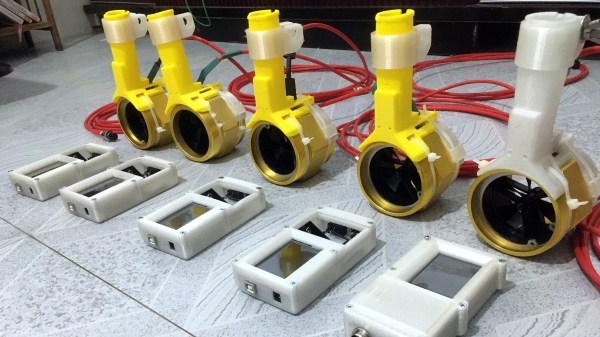
The BYTE, an open-source mouth-actuated input device for people with physical challenges has just been named the Grand Prize winner of the 2020 Hackaday Prize. The award for claiming the top place and title of “Best All Around” in this global engineering initiative is $50,000. Five other top winners and four honorable mentions were also named during this evening’s Hackaday Prize Ceremony, held during the Hackaday Remoticon virtual conference.

This year’s Hackaday Prize focused on challenges put forth by four non-profit partners who have first hand knowledge of the problems that need solving as they work to accomplish their missions. These organizations are Conservation X Labs, United Cerebral Palsy Los Angeles, CalEarth, and Field Ready. Join us below for more on the grand prize winner and to see the Best in Category and Honorable Mention winners from each non-profit challenge, as well as the Best Wildcard project.

Over $200,000 in cash prizes have been distributed as part of this year’s initiative where hundreds of hardware hackers, makers, and artists competed to build a better future. Continue reading “The BYTE Is The Grand Prize Winner Of The 2020 Hackaday Prize”

Finalists Announced For The 2020 Hackaday Prize

In light of everything going on in 2020, the 7th annual Hackaday Prize is devoted to nurturing ideas that could literally help change the world. In a first, we partnered with several nonprofits to help identify some of today’s most difficult problems, ranging from conservation and disaster relief to the need for advanced assistive technology. With over $200,000 up for grabs, including microgrants to help teams work full-time on their projects, this year’s competition was designed to help bring critical solutions to fruition which otherwise might never see the light of day.

But it hasn’t been easy. The global pandemic has made it far more difficult to collaborate on projects in the way we’re all used to, parts have become harder to source, and many makers found themselves so engaged with grassroots efforts to combat COVID-19 that they found little time for anything else. But despite all of this uncertainty, we received hundreds of incredible entries from all over the globe.

It’s never easy to select who will move on to the next round of the competition. But with the help of our nonprofit partners, the panel of expert judges was able to whittle the list of entries down to the 34 finalists that produced some of the most impressive and impactful ideas the Hackaday Prize has ever seen. Let’s take a look at just a few of the projects that will be vying for the top prizes in November.

Continue reading “Finalists Announced For The 2020 Hackaday Prize”

New Contest: Circuit Sculpture Challenge

We’re bringing back one of our most popular contests, the Hackaday Circuit Sculpture Challenge! Make your functional circuits go beyond utility by turning them into art!

Solar-powered circuit sculpture by [Mohit Bhoite] which was featured last year.
Wire and circuit boards are a fantastic media for creating beautiful projects, and for this one we want both the copper and the boards (or lack of) to be part of the beauty. Your sculpture could be crisp and angular bends in brass rod, a rat’s nest of enamel wire, PCBs with organic shapes, or something completely wild. Your only constraint is that there needs to be some type of working circuit involved.

Three entries will be chosen as top winners in the Most Functional, Most Beautiful, and Best Video categories and be awarded $200 in components from Digi-Key who are sponsoring this contest and also putting together a calendar with images of the top twelve sculptures.

The Wonderlandscape by [Michael Aichlmayr] takes the “sculpture” part of Circuit Sculpture to new levels.
Tell us the story of your creation, including a deep dive into how you built the sculpture and what trial and error you went through to pull it off. Many circuit sculptures in the past have included jig-building to get the wire bends just right, so we have a fourth prize of $100 in Tindie credit for the Best Jig build.

Get your project started now on Hackaday.io and use that “Submit Project To:” button in the left sidebar of your project page to enter it in the Circuit Sculpture Challenge. You have until November 10th to submit your entry.

Tech At Home Winners Who Made The Best Of Their Quarantine

Back in April we challenged hackers to make the best of a tough situation by spending their time in isolation building with what they had laying around the shop. The pandemic might have forced us to stay in our homes and brought global shipping to a near standstill, but judging by the nearly 300 projects that were ultimately entered into the Making Tech At Home Contest, it certainly didn’t stifle the creativity of the incredible Hackaday community.

While it’s never easy selecting the winners, we think you’ll agree that the Inverse Thermal Camera is really something special. Combining a surplus thermal printer, STM32F103 Blue Pill, and OV7670 camera module inside an enclosure made from scraps of copper clad PCB, the gadget prints out the captured images on a roll of receipt paper like some kind of post-apocalyptic lo-fi Polaroid.

The HexMatrix Clock also exemplified the theme of working with what you have, as the electronics were nothing more exotic than a string of WS2811 LEDs and either an Arduino or ESP8266 to drive them. With the LEDs mounted into a 3D printed frame and diffuser, this unique display has an almost alien beauty about it. If you like that concept and have a few more RGB LEDs laying around, then you’ll love the Hive Lamp which took a very similar idea and stretched it out into the third dimension to create a standing technicolor light source that wouldn’t be out of place on a starship.

Each of these three top projects will receive a collection of parts and tools courtesy of Digi-Key valued at $500.

Runners Up

Out friends at Digi-Key were also kind enough to provide smaller grab bags of electronic goodies to the creators of the following 30 projects to help them keep hacking in these trying times:

The Making Tech At Home Contest might be over, but unfortunately, it looks like COVID-19 will be hanging around for a bit. Hopefully some of these incredible projects will inspire you to make the most out of your longer than expected downtime.

Assemble Your (Virtual) Robotic Underground Exploration Team

It’s amazing how many things have managed to move online in recent weeks, many with a beneficial side effect of eliminating travel making them more accessible to everyone around the world. Though some events had a virtual track before it was cool, among them the DARPA Subterranean Challenge (SubT) robotics competition. Recent additions to their “Hello World” tutorials (with promise of more to come) have continued to lower the barrier of entry for aspiring roboticists.

We all love watching physical robots explore the real world, which is why SubT’s “Systems Track” gets most of the attention. But such participation is necessarily restricted to people who have the resources to build and transport bulky hardware to the competition site, which is just a tiny subset of all the brilliant minds who can contribute. Hence the “Virtual Track” which is accessible to anyone with a computer that meets requirements. (64-bit Ubuntu 18 with NVIDIA GPU) The tutorials help get us up and running on SubT’s virtual testbed which continues to evolve. With every round, the organizers work to bring the virtual and physical worlds closer together. During the recent Urban Circuit, they made high resolution scans of both the competition course as well as participating robots.

There’s a lot of other traffic on various SubT code repositories. Motivated by Bitbucket sunsetting their Mercurial support, SubT is moving from Bitbucket to GitHub and picking up some housecleaning along the way. Together with the newly added tutorials, this is a great time to dive in and see if you want to assemble a team (both of human collaborators and virtual robots) to join in the next round of virtual SubT. But if you prefer to stay an observer of the physical world, enjoy this writeup with many fun details on systems track robots.