Using Arduino For Quadcopter Spectrum Analyzers

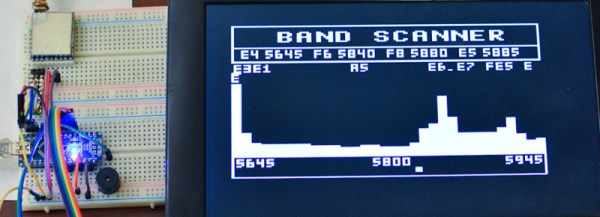
First-person-view (FPV) flying, by adding a camera, video transmitter, and video goggles to the meat on the ground, is one of the best ways to experience remote-controlled flight. For just a few hundred dollars, it’s the closest thing you’re going to get to growing wings and flying through the trees of your local park. One of the most popular and cheapest ways to go about this is the Boscam RX5808 wireless receiver – a $9 module able to pull down video from an aircraft over 5.8GHz radio. Stock, this radio module is just okay, but with a few modifications, it can be turned into a very good receiver with a spectrum analyzer and autoscan.

The Boscam RX5808 has three DIP switches to allow for eight different channels for receiving video, and this is where most RC hobbyists stop. But the module also has a very capable SPI interface, and by adding a simple Arduino, the complete capabilities of this receiver can be unlocked.

The core software for the build is [markohoepken]’s rx5808-pro and rx5808_pro_osd, and [crazyheea]’s rx5808-pro-diversity to enable all the capabilities available in the RX5808 receiver. With an off-the-shelf LCD, this mess of wires and boards turns into an auto-scanning spectrum analyzer that’s also able to put video from a drone onto a screen.

[garagedrone] put together a very complete demo video of the entire build. You can check that out below.

Continue reading “Using Arduino For Quadcopter Spectrum Analyzers”

Tie-Fighter Quadcopters Anyone Can Build

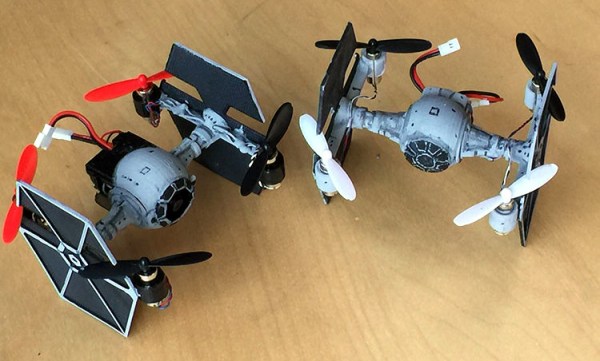
These are things of beauty, and when in flight, the Tie Fighter Quadcopters look even better because the spinning blades become nearly transparent. Most of the Star Wars-themed quadcopter hacks we’ve seen are complicated builds that we know you’re not even going to try. But [Cuddle Burrito’s] creations are for every hacker in so many different ways.

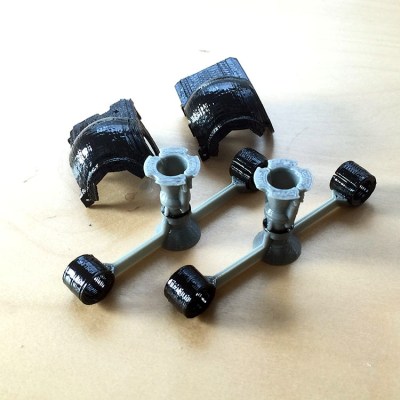
tie-fighter-drone-partsFirst off, he’s starting with very small commodity quadcopters that are cheap (and legal) for anyone to own and fly. Both are variations of the Hubsan X4; the H107C and the H107L. The stock arms of these quadcopters extend from the center of the chassis, but that needs to change for TFFF (Tie Fighter Form Factor). The solution is of course 3D Printing. The designs have been published for both models and should be rather simple to print.
ABS is used as the print medium, which makes assembly easy using a slurry of acetone and ABS to weld the seams together. Motor wires need to be extended and routed through the printed arms, but otherwise you don’t need anything else. Even the original screws are reused in this design. Check out test flights in the video after the break As for the more custom builds we mentioned, there’s the Drone-enium Falcon.

Continue reading “Tie-Fighter Quadcopters Anyone Can Build”

Naviator Drone Uses Its Propellers To Fly And Swim

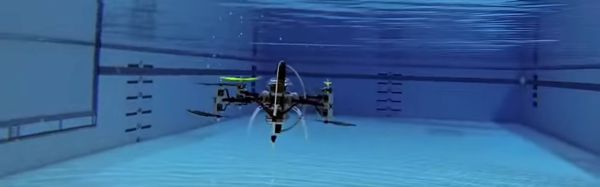
Rutgers University just put out a video on a “drone” that can fly and then drop into a body of water, using its propellers to move around. This isn’t the first time we’ve covered a university making sure Skynet can find us even in the bathtub, but this one is a little more manageable for the home experimenter. The robot uses a Y8 motor combination. Each motor pair on its four arms spin in opposite directions, but provide thrust in the same direction. Usually this provides a bit more stability and a lot more redundancy in a drone. In this case we think it helps the robot leave the water and offers a bit more thrust underwater when the props become dramatically less efficient.

We’re excited to see where this direction goes. We can already picture the new and interesting ways one can lose a drone and GoPro forever using this, even with the integral in your toolbox. We’d also like to see if the drone-building community can figure out the new dynamics for this drone and release a library for the less mathematically inclined to play with. Video after the break.

Continue reading “Naviator Drone Uses Its Propellers To Fly And Swim”

CES: Self-Flying Drone Cars

CES, the Consumer Electronics Show, is in full swing. Just for a second, let’s take a step back and assess the zeitgeist of the tech literati. Drones – or quadcopters, or UAVs, or UASes, whatever you call them – are huge. Self-driving cars are the next big thing. Flying cars have always been popular. On the technical side of things, batteries are getting really good, and China is slowly figuring out aerospace technologies. What could this possibly mean for CES? Self-flying drone cars.

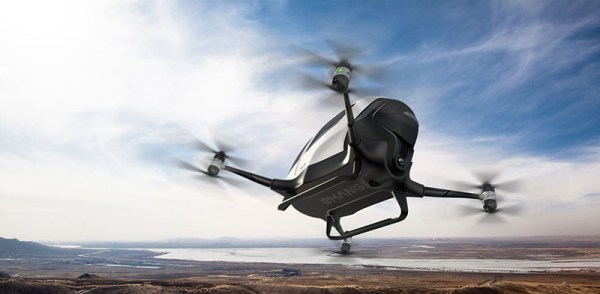
The Ehang 184 is billed as the first autonomous drone that can carry a human. The idea is a flying version of the self-driving cars that are just over the horizon: hop in a whirring deathtrap, set your destination, and soar through the air above the plebs that just aren’t as special as you.

While the Ehang 184 sounds like a horrendously ill-conceived Indiegogo campaign, the company has released some specs for their self-flying drone car. It’s an octocopter, powered by eight 106kW brushless motors. Flight time is about 23 minutes, with a range of about 10 miles. The empty weight of the aircraft is 200 kg (440 lbs), with a maximum payload of 100 kg (220 lbs). This puts the MTOW of the Ehang 184 at 660 lbs, far below the 1,320 lbs cutoff for light sport aircraft as defined by the FAA, but far more than the definition of an ultralight – 254 lbs empty weight.

In any event, it’s a purely academic matter to consider how such a vehicle would be licensed by the FAA or any other civil aviation administration. It’s already illegal to test in the US, authorities haven’t really caught up to the idea of fixed-wing aircraft powered by batteries, and the idea of a legal autonomous aircraft carrying a passenger is ludicrous.

Is the Ehang 184 a real product? There is no price, and no conceivable way any government would allow an autonomous aircraft fly with someone inside it. It is, however, a perfect embodiment of the insanity of CES.

Surviving The FAA Regulations: Modelers Move Indoors

New FAA rules are making radio-controlled aircraft a rough hobby to enjoy here in the USA. Not only are the new drone enthusiasts curtailed, but the classic radio-controlled modelers are being affected as well. Everyone has to register, and for those living within 30 miles of Washington DC, flying of any sort has been effectively shut down. All’s not lost though. There is plenty of flying which can be done outside of the watchful eye of the FAA. All it takes is looking indoors.

Continue reading “Surviving The FAA Regulations: Modelers Move Indoors”

Open-Source Firmware For A Mini Quadrotor

Since you’re going to have to be flying your “drones” indoors anyway in the USA, at least in the US Capitol region, you might as well celebrate the one freedom you still have — the freedom to re-flash the firmware!

The Eachine H8 is a typical-looking mini-quadcopter of the kind that sell for under $20. Inside, the whole show is powered by an ARM Cortex-M3 processor, with the programming pins easily visible. Who could resist? [garagedrone] takes you through a step-by-step guide to re-flashing the device with a custom firmware to enable acrobatics, or simply to tweak the throttle-to-engine-speed mapping for the quad. We had no idea folks were doing this.

Spoiler alert: re-flashing the firmware is trivial. Hook up an ARM SWD programmer (like the ST-Link V2) and you’re done. Wow. All you need is firmware.

The firmware comes from [silverxxx], and he’s written all about it on the forum at RCGroups.com. He’s even got the code up on GitHub if you’re interested in taking a peek. It looks like it’d be fun to start playing around with the control algorithms. Next step, Skynet!

Reading the forum post, it looks like you’ll have to be a little careful to get the right model quad, so look before you leap. But for the price, you can also afford to mess up once. Heck, at that price you could throw away the motors and you’d have a tricked-out ARM dev kit.

And if you insist on hacking everything, you can probably re-purpose a wireless mouse controller to control the thing. Write your own code for the controller and you’ve got an end-to-end open firmware quadcopter for a pittance.

Truck-Sized Star Destroyer Takes Flight

While some of you may have been to see the new Star Wars movie, you might be sad that everything happened a long time ago in a galaxy far away. But there’s a group of RC enthusiasts called [Flite Test] who are trying to bring at least a little bit of that fantasy into real life. They’ve created a truck-sized Star Destroyer that actually flies. It looks kind of terrifying, too.

While it’s not as big as a “real” Star Destroyer, it’s certainly one of the biggest we’ve ever seen in real life. Built out of foam, this monstrosity is 15 feet long and powered by two huge electric motors and a large lithium polymer battery. Of course they didn’t start out by building this huge flying spaceship; they created a smaller model as proof-of-concept and flew that one around for a while to make sure everything was shipshape. While it’s exciting to see the small model in flight, it’s another thing to see the 15-foot version swooping around.

We’re sad to report that the Star Destroyer did meet a similar fate as the one that Rey was scavenging at the beginning of the movie (spoilers: it crashed), we hope that the RC team rebuilds it so it’s space worthy again. Maybe they can even add a real-life ion drive or a few lasers to make it even more real.

Continue reading “Truck-Sized Star Destroyer Takes Flight”