Video: The Lowly Diode — Umpteen Functions With Only Two Pins

The lowly diode, a device with only two leads, can nonetheless do many things. Diodes can detect, rectify, suppress, emit light, detect light, change capacitance, emit microwaves and more. This wide range of use means diodes are included in almost every design and it’s well worth learning more about the inner workings of all kinds of diodes.

My introduction to diodes started like many of my generation with a homemade crystal radio set. My first diode was a piece of pencil graphite in contact with an old fashion safety razor with the joint of the two dissimilar materials — graphite and steel — creating the diode. In this configuration the diode is said to be “detecting” which is the act of turning a weak radio signal into a weak audio signal. At least in my home town of Marion Indiana, one radio station was stronger than the other so that I didn’t have to listen to two stations at once.

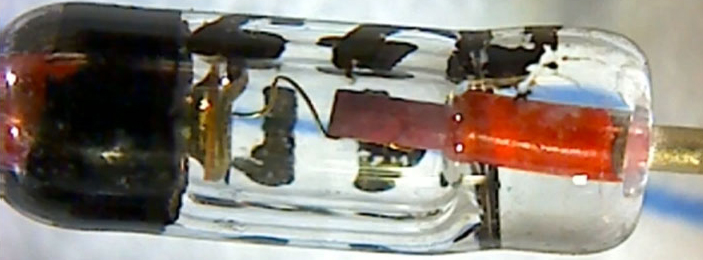
Germanium Glass Diode
The venerable 1N34A Germanium Signal Diode.

I eventually learned about “real” diodes and the 1N34A Germanium diode was my “goto” diode into my teens. Nowadays looking into a modern version of the 1N34A you can still see the semblance of the old “cat’s whisker” by looking carefully into the diode.

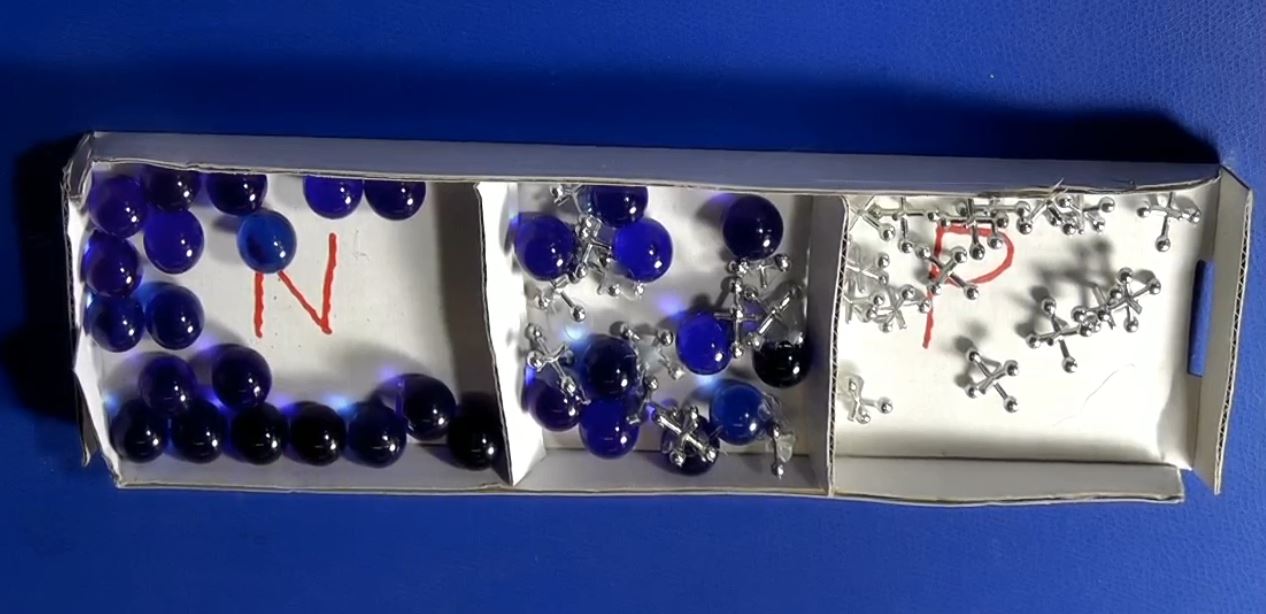
A quick and somewhat inaccurate semblance of the way a diode works can be demonstrated with marbles and jacks representing negative electrons and positive “holes”. Holes are basically an atom missing an electron due to the combination of elements, a process known as doping. Join me after the break for the explanation.

Demonstrating a PN Junction with marbles and Jacks.

Continue reading “Video: The Lowly Diode — Umpteen Functions With Only Two Pins”

ISEE-3: On Track To Come Home

map
Intended trajectory from ICE team in 1986 (blue), 2001 ephemeris of ISEE-3 (white) and current ephemeris (red/green). Click to embiggen.

When last we heard of the progress of commanding the derelict ISEE-3 satellite into stable orbit between the Earth and the sun, the team had just made contact with the probe using the giant dish in Arecibo, sent a few commands, and started gathering data to plot where the spacecraft is and where it will be. A lot has happened in a week, and the team is now happy to report the spacecraft is alive and well, and much, much closer to the intended trajectory than initially believed.

Before last week, the best data on where ISEE-3 was heading was from a 13-year-old data set, leaving the project coordinators to believe a maneuver of about 50-60  m/s was necessary to put the spacecraft into the correct orbit between the Earth and the sun. With new data from Arecibo, that figure has been reduced to about 5.8 m/s, putting it extremely close to where the original ICE navigation team intended it to go, all the way back in 1986. This also gives the team a bit of breathing room; the original planned maneuver to capture the spacecraft required nearly a third of the available fuel on board. The new plan only requires the spacecraft expend about 5% of its fuel stores. This, of course, brings up the idea of continuing the planned mission of the rebooted ISEE-3 beyond the Earth-Sun L1 point, but that is very much putting the cart before the horse.

Of course, getting ranging data of the spacecraft is only a small part of what has happened with the ISEE-3 part this week. Thanks to the ‘away team’ sent to Arecibo to install hardware and attempt to make contact with the satellite, both transceivers are working, telemetry is being downloaded from the probe, and work has begun on refining the exact position of ISEE-3 to compute where and when the spacecraft needs to make its maneuver.

Regular Hackaday feature and software defined radio god [Balint] was on hand with the away team at Arecibo to install his company’s SDR unit on the largest dish on the planet. His happy dance of the first data from ISEE-3 made the blog rounds, but the presentation (PDF) and photo gallery tell the story of working on the largest dish on the planet much better.

There’s still a lot of work to be done by the ISEE-3 team as they figure out how best to capture the spacecraft and prepare for the burn in the following week. They should have the exact orbit of ISEE-3 nailed down early this week, and after that, ISEE-3 could on a path back home in less than two weeks.

OLED display, blue LED and Smartcard

Developed On Hackaday: We Have Final Prototypes!

The last few weeks have been quite tense for the Mooltipass team as we were impatiently waiting for our smart cards, cases and front panels to come back from production. Today we received a package from China, so we knew it was the hour of truth. Follow us after the break if you have a good internet connection and want to see more pictures of the final product

Mooltipass final prototype

Continue reading “Developed On Hackaday: We Have Final Prototypes!”

Entry Is Easy: The Hackaday Prize

[youtube=https://www.youtube.com/watch?v=L1N5oM4hmw8&w=580]


Failing to submit an entry for The Hackaday Prize is a big mistake. The worst you can do is make an awesome contribution to Open Hardware, but you could win a trip to space or hundreds of other prizes. It’s simple to get started:

  1. Sign up for an account on Hackaday.io
  2. Start documenting your project with the tag #TheHackadayPrize
  3. Click the “Submit project to…” button to make it official

Not simple enough? We even made some screenshots to prove how easy it is. Check them out after the break.

Make it connected, make it open, make it awesome, and you could win!

Continue reading “Entry Is Easy: The Hackaday Prize”

Keep Those Filaments Lit, Design Your Own Vacuum Tube Audio Equipment

It was a cold January Saturday night in Chicago and we had big plans. Buddy Guy’s Legends bar was packed. We setup directly under one of the PA speakers less than 15′ from the stage. Time to celebrate. Skip the glass, one pitcher each and keep them coming. We’re about to make bootleg recording history. Conversation evolved into bloviation on what our cover art would look like, certainly it would be a photo of our battery powered tube mic pre-amp recently created in my basement lab. We had four hours to kill before Buddy’s appearance. Our rate of Goose Island and Guinness consumption would put us at three-sheets to the wind by 11. Must focus. It’s time, Buddy was on. Much fumbling about and forgetting how to turn on the Japanese-made 24 bit digital recorder with its nested LCD menus, cryptic buttons, and late 90’s firmware. Make it work. We did, just in time for the bouncers to notice the boom mike and battery packs. Wait, wait… maybe we should talk about why tube amps are worth this kind of trouble first.

Yes, vacuum tubes do sound better than transistors (before you hate in the comments check out this scholarly article on the topic). The difficulty is cost; tube gear is very expensive because it uses lots of copper, iron, often point-to-point wired by hand, and requires a heavy metal chassis to support all of these parts. But with this high cost comes good economic justification for building your own gear.

This is one of the last frontiers of do-it-yourself that is actually worth doing.

Continue reading “Keep Those Filaments Lit, Design Your Own Vacuum Tube Audio Equipment”

THP Judge: Ian From Dangerous Prototypes

ian-dangerous-prototypesAs we start to get into the swing of The Hackaday Prize we want to take some time to talk to the judges.

[Ian Lesnet] is an accomplished hardware developer. He is, of course, near and dear to our hearts as a Hackaday writer emeritus.

During his time here he came up with an idea for an amazing tool that would let you work with components using a multitude of protocols before heading off to write your firmware. The tool was called the Bus Pirate and [Ian] built an formidable Open Hardware community up around this and several other tools and unique ideas.

[Hackaday] Why do you think people should put together an entry for The Hackaday Prize?

[Ian] There’s never a bad time to hack something together, but with an incentive like SPACE!!! how can you refuse?

[Hackaday] If you could enter, what style of project would you build and where would you try to go with the idea?

[Ian] We like to make electronics hardware that helps debug stuff, but lately we’re rocking more potentially deadly machines that do things. I’d finish up our death chomp robot that slices and dices reels of components into handy kit-sized lengths, while printing values and part numbers on the back paper. Definitely not a winner, but it looks great when it’s chewing parts!

[Hackaday] Is there anything that participants can do with their project write-ups to make your life easier as an adjudicator?

[Ian] Writing and English classes are a special hell for me, but there are some good tips for clear communication. I always start with an overview – “tell them what you’re going to tell them”. This usually means a description of the hack, the major components used, and how they work together. The introduction should have enough info that another hacker can piece everything together without digging through the whole writeup. An overview illustration or hand drawing explaining the methodology is really helpful for visualizing a complex hack.

[Hackaday] You have vast experience with Open Hardware projects. I think one of the tough things for beginners is navigating the Open Hardware licenses available. Do you have any advice for noobs to learn more about licenses and perhaps on narrowing them down?

[Ian] If you want the world to be a better place put all your work in the Public Domain (Creative Commons Zero) for anyone to use however they want. That’s the license with the least bullshit attached. If you have a billion dollar secret idea by all means keep it in your closet and show it to no one, because that’s about the only thing that will protect it from innovators and imitators. Other licenses fall somewhere in the middle, but for our stuff we’ve decided to go Public Domain wherever possible.

[Hackaday] We’ve seen a lot of collaborative projects come out of DP. Do you have any advice you can share for finding collaborators for a hardware project?

[Ian] The best advise I’ve heard (not mine) is to wait until a project is done to decide ownership share. Hackers are quick to settle on equal ownership, but during the project (or the long haul support period) collaborators may loose interest or be unable to continue as planned. With equal ownership remaining team members must finish the whole project just get a portion of the future gains. It demotivates the remaining team members and kills momentum. By waiting to see how things play out you’ll have a much better idea how to divide ownership for a successful long term collaboration.

[Hackaday] Can you name a favorite piece of bench equipment and tell us why it is at the top of your list?

[Ian] For years I used $10 “fire starter” soldering irons, even for surface mount soldering. An adjustable iron is a nice thing to have though, along with a bright light and head magnifier. A hot air rework station is the tool I can’t live without. It’s for fixing mistakes, which I make constantly, and when it dies everything crashes to a halt.

[Hackaday] What do you think of the evolution of the kit and small-run electronics industry over the last decade? Where would you like to see it go, and do you have any insights about what will get it there, or possible barriers that stand in the way?

[Ian] It’s huge now. Crowd source funding sites alone have become home to how many cool hacks, designs, and projects? Local, short-run assembly houses using a fairly standard set of components would make it a lot easier to get into hardware without 1337 soldering skillz.


SpaceWrencherThe Hackaday Prize challenges you to build the future of connected devices. Build the best and claim a trip into space or one of hundreds of other prizes.


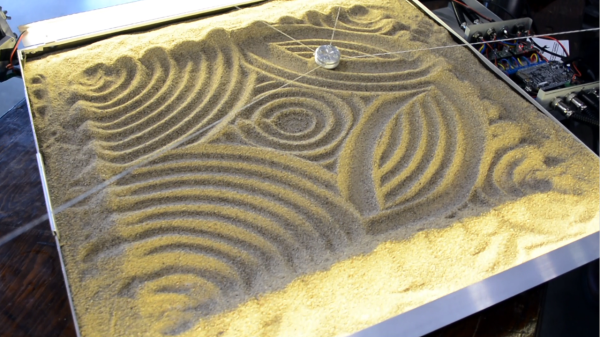
Four strings drag an aluminum slug through a sandbox

CNC Zen Garden

[youtube=https://www.youtube.com/watch?v=Ge4H4Uw630o&w=580]


Meet the second version of [David’s] sand manicuring CNC machine. We saw version one about six months ago which he built for a science museum in Canada. This offering is much the same, except for the controller. The initial version demanded a full-blow computer to drive it but now that has been swapped out in favor of a Beaglebone Black.

The software has no feedback on the position of the plotter, which is an aluminum slug that [David] machined at Calgary Protospace. It needs to be in a specific position when the machine starts out, and from there patterns are traced by calculating how much spooling or unspooling of the four strings will move the slug.

There’s a bunch of other really neat art installations and projects on [David’s] webpage, it’s worth clicking through!