Battery Engineering Hack Chat Gets Charged Up

Turn the clock back a couple of decades, and the only time the average person would have given much thought to batteries was when the power would go out, and they suddenly needed to juice up their flashlight or portable radio.  But today, high-capacity batteries have become part and parcel to our increasingly digital lifestyle. In fact, there’s an excellent chance the device your reading this on is currently running on battery power, or at least, is capable of it.

So let’s get to know batteries better. What’s the chemical process that allows them to work? For that matter, what even is a battery in the first place?

It’s these questions, and more, that made up this week’s Battery Engineering Hack Chat with Dave Sopchak. Our last Hack Chat of 2022 ended up being one of the longest in recent memory, with the conversation starting over an hour before the scheduled kickoff and running another half hour beyond when emcee Dan Maloney officially made his closing remarks. Not bad for a topic that so often gets taken for granted.

Continue reading “Battery Engineering Hack Chat Gets Charged Up” →

This Week In Security: Scamming The FBI, In The Wild, And AI Security

If you’re part of a government alphabet agency, particularly running a program to share information to fight cybercrime, make sure to properly verify the identity of new members before admission. Oh, and make sure the API is rate-limited so a malicious member can’t scrape the entire user database and sell it on a dark web forum.

Putting snark aside, this is exactly what has happened to the FBI’s InfraGuard program. A clever user applied to the program using a CEO’s name and phone number, and a convincing-looking email address. The program administrators didn’t do much due diligence, and approved the application. Awkward.

BSD Ping

First off, the good folks at FreeBSD have published some errata about the ping problem we talked about last week. First off, note that while ping does elevate to root privileges via setuid, those privileges are dropped before any data handling occurs. And ping on FreeBSD runs inside a Capsicum sandbox, a huge obstacle to system compromise from within ping. And finally, further examination of the bug in a real-world context casts doubt on the idea that Remote Code Execution (RCE) is actually possible due to stack layouts.

If someone messes up somewhere, go look if you messed up in the same or similar way somewhere else.

Sage advice from [Florian Obser], OpenBSD developer. So seeing the ping problem in FreeBSD, he set about checking the OpenBSD ping implementation for identical or similar problems. The vulnerable code isn’t shared between the versions, so he reached for afl++, a fuzzing tool with an impressive list of finds. Connect afl++ to the function in ping that handles incoming data, and see what shakes out. The conclusion? No crashes found in this particular effort, but several hangs were identified and fixed. And that is a win. Continue reading “This Week In Security: Scamming The FBI, In The Wild, And AI Security” →

Supercon 2022: Sam Mulvey Shows You How To FM Radio

Sam Mulvey built his own radio station in Tacoma, WA. Is there a better way to meld ham radio practice with a colossal number of DIY electrical and computer projects? Sam would say there isn’t one! This 45-minute talk is basically the lessons-learned review of setting up KTQA 95.3 – the radio station on the hill.

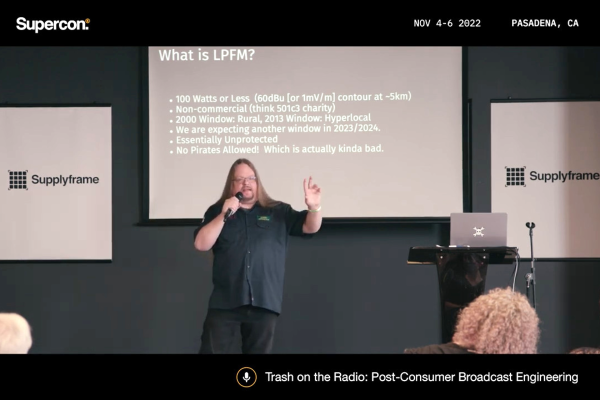
Sam starts out the talk by introducing you to LPFM. And maybe you didn’t know that there’s a special type of license issued by the US FCC allowing non-profit community radio stations up to 100 W, covering an radius of around 5 km. It’s like running a pirate radio station, but by jumping through a few legal hoops, made legal.

Trash on the Radio

Putting a radio station together on a budget requires a ton of clever choices, flexibility, and above all, luck. But if you’re willing to repair a busted CD player or turntable, scrounge up some used computers, and work on your own amplifiers, the budget doesn’t have to be the limiting factor.

Being cheap means a lot of DIY. For instance, Sam and friends made a custom console to support all the gear and hide all the wiring. Some hot tips from the physical build-out: painted cinderblocks make great studio monitor stands, and Cat-5 can carry two channels of balanced audio along with power, with sufficient isolation that it all sounds clean. Continue reading “Supercon 2022: Sam Mulvey Shows You How To FM Radio” →

Australia’s Soft Plastic Recycling Debacle

We’ve all been told to cut back on waste to help prevent environmental crisis on Earth. Reducing waste helps reduce the need to spend time and energy digging up fresh materials, and helps reduce the amount of trash we have to go out and bury in the ground in landfills. Recycling is a big part of this drive, allowing us to divert waste by reprocessing it into fresh new materials.

Sadly, though, recycling isn’t always as magical as it seems. As Australia has just found out, it’s harder than it sounds, and often smoke and mirrors prevent the public from understanding what’s really going on. Here’s how soft plastic recycling went wrong Down Under.

Continue reading “Australia’s Soft Plastic Recycling Debacle” →

The Story Behind The TVGuardian Curse Catcher

The recent flurry of videos and posts about the TVGuardian foul language filter brought back some fond memories. I was the chief engineer on this project for most of its lifespan. You’ve watched the teardowns, you’ve seen the reverse engineering, now here’s the inside scoop.

Gumby is Born

TVG Model 101 Gumby (Technology Connections)

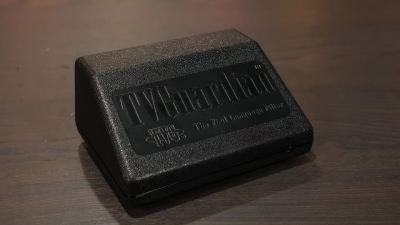
Back in 1999, my company took on a redesign project for the TVG product, a box that replaced curse words in closed-captioning with sanitized equivalents. Our first task was to take an existing design that had been produced in limited volumes and improve it to be more easily manufactured.

The original PCB used all thru-hole components and didn’t scale well to large quantity production. Replacing the parts with their surface mount equivalents resulted in Model 101, internally named Gumby for reasons long lost. If you have a sharp eye, you will have noticed something odd about two parts on the board as shown in [Ben Eater]’s video. The Microchip PIC and the Zilog OSD chip had two overlapping footprints, one for thru-hole and one for SMD. Even though we preferred SMD parts, sometimes there were supply issues. This was a technique we used on several designs in our company to hedge our bets. It also allowed us to use a socketed ICs for testing and development. Continue reading “The Story Behind The TVGuardian Curse Catcher” →

Hyundai To Lead US Market For Hydrogen Fuel Cell Trucks

Hydrogen has long been touted as a potential fuel of the future. While it’s failed to catch on in cars as batteries have taken a strong lead, it still holds great promise for larger vehicles like trucks.

Hyundai have been working diligently in this space over the last few years, with its Xcient line of fuel-cell powered trucks. It’s set to dominate the world of hydrogen trucking in the US as it brings a fleet of vehicles to California next year.

Continue reading “Hyundai To Lead US Market For Hydrogen Fuel Cell Trucks” →

All About USB-C: Cable Types

USB-C cables and connectors: these are controversial topics, and rightfully so – I don’t want to pull any punches. I will also show you that things don’t have to be that bad for you, as long as you’re willing to apply a few tricks and adjust your expectations.

Wild West of Wiring

You might have a bunch of USB-C cables, and they all might look exactly the same, but you’ve likely experienced that they’re not the same internally, and often there’s not a label in sight. Yes, it’s pretty bad, and one could argue it’s getting worse.

I’d like to clarify that I’m only talking about USB C male – USB C male cables here. While cables like USB-A to USB-C are popular, they are quite simple; you get USB 2.0 or USB 3.0 data and 2 A of current at most, and the USB-C plug is usually hardwired as “host, will supply five volts”, which is defined by a pullup resistor. Also, while cables like “Type-C to DisplayPort” might look like cables at a glance, they are adapters with a meaningful amount of active circuitry in them.

Purely following the specification, there used to be six types of USB-C to USB-C cables out there. Then, it became eight. Now, I’m afraid, there’s twelve of them, purely following the spec, and there’s way more when counting all the out-of-spec cables. Good news is – for most of the time, majority of these cables will be suitable for simple tasks like charging and data transfer, and situations where you need a very specific cable are going to be rare enough. Still, let’s go through it, and you’ll see that they’re easier to tell apart than it might look. Continue reading “All About USB-C: Cable Types” →