Supercon 2022: Chris Combs Reveals His Art-World Compatibility Layer

[Chris Combs] is a full time artist who loves using technology to create unique art projects and has been building blinky artwork since about a decade now. In his 2022 Supercon talk “Art-World Compatibility Layer: How to Hang and Sell Your Blinky Goodness as Art” (Slides, PDF), [Chris] takes us behind the scenes and shows us how to turn our blinky doodads in to coveted art works. There is a big difference between a project that just works, and a work of art, and it’s the attention to small details that differentiates the two.

Just like the field of engineering and technology, the art world has its own jargon and requires knowledge of essential skills that make it intimidating to newcomers. It’s not very easy to define what makes an artwork “art” or even “Art”, and sometimes it’s difficult to distinguish if you are looking at a child’s scrawls or a master’s brushstrokes. But there are a few distinguishing requirements that a piece of artwork, particularly one revolving around the use of technology, must meet.

Continue reading “Supercon 2022: Chris Combs Reveals His Art-World Compatibility Layer”

Largest Ever Hydrogen Fuel Cell Plane Takes Flight

In the automotive world, batteries are quickly becoming the energy source of the future. For heavier-duty tasks, though, they simply don’t cut the mustard. Their energy density, being a small fraction of that of liquid fuels, just can’t get the job done. In areas like these, hydrogen holds some promise as a cleaner fuel of the future.

Universal Hydrogen hopes that hydrogen will do for aviation what batteries can’t. The company has been developing flight-ready fuel cells for this exact purpose, and has begun test flights towards that very goal.

Continue reading “Largest Ever Hydrogen Fuel Cell Plane Takes Flight”

Hackaday Links Column Banner

Hackaday Links: April 2, 2023

It may be hard to believe, but it’s time for the Hackaday Prize again! The 2023 Hackaday Prize was announced last weekend at Hackaday Berlin, and entries are already pouring in. The first-round challenge is all about “Re-engineering Education,” which means you’ve got to come up with a project idea that helps push back the veil of ignorance somehow. Perhaps you’ve got a novel teaching tool in mind, or a way to help students learn remotely. Or maybe your project is aimed at getting students involved and engaged. Whatever it is — and whatever the subject matter; it doesn’t just have to be hacking-adjacent — get an entry together, build a team, and get to work. The first round closes on April 25, so get to it!

Continue reading “Hackaday Links: April 2, 2023”

Hackaday Does Berlin

If you’re wondering why there was no newsletter last weekend, it was because we had our hands full with Hackaday Berlin. But boy, was it worth it! Besides being the launch party for the tenth annual Hackaday Prize, it was the first Hackaday gathering in Europe for four years, and it was awesome to see a bunch of familiar faces and meet many more new ones.

In a world that’s so interconnected, you might think that social media can take care of it all for you. And to some extent that’s true! If I could count the number of times I heard “I follow you on Twitter/Mastodon” over the course of the event!

But then there were tons of other meetings. People who are all interested in building and designing analog synthesizers, even some who live in the same urban megalopolis, meeting each other and talking about modules and designs. People who love flip dots. On the spot collaborations of people writing video drivers and people making huge LED walls. And somehow there’s still room for this to happen, even though the algorithms should have probably hooked these folks up by now.

From the perspective of hosting the conference, I get the most satisfaction from seeing these chance meetings and the general atmosphere of people learning not only new things, but new people. This cross-fertilization of friendships and project collaborations is what keeps our community vital, and especially coming out of the Pandemic Years, it’s absolutely necessary. I came away with a long list of new plans, and I’m sure everyone else did too. And for some reason, social media just isn’t a substitute. Take that, TwitFace!

Hackaday Podcast 212: Staring Through ICs, Reading Bloom Filters, And Repairing, Reworking, And Reballing

It was quite the cornucopia of goodness this week as Elliot and Dan sat down to hash over the week in hardware hacking. We started with the exciting news that the Hackaday Prize is back — already? — for the tenth year running! The first round, Re-Engineering Education, is underway now, and we’re already seeing some cool entries come in. The Prize was announced at Hackday Berlin, about which Elliot waxed a bit too. Speaking of wax, if you’re looking to waterproof your circuits, that’s just one of many coatings you might try. If you’re diagnosing a problem with a chip, a cheap camera can give your microscope IR vision. Then again, you might just use your Mark I peepers to decode a ROM. Is your FDM filament on the wrong spool? We’ve got an all-mechanical solution for that. We’ll talk about tools of the camera operator’s trade, the right to repair in Europe, Korean-style toasty toes, BGA basics, and learn just what the heck a bloom filter is — or is it a Bloom filter?

Check out the links below if you want to follow along, and as always, tell us what you think about this episode in the comments!

Download your own personal copy!

Continue reading “Hackaday Podcast 212: Staring Through ICs, Reading Bloom Filters, And Repairing, Reworking, And Reballing”

This Week In Security: Macstealer, 3CX Carnage, And Github’s Lost Key

There’s a naming overload here, as two bits of security news this week are using the “MacStealer” moniker. We’re first going to talk about the WiFi vulnerability, also known as Framing Frames (pdf). The WPA encryption schemes introduced pairwise encryption, ensuring that not even other authenticated users can sniff each others’ traffic. At least that’s the idea, but this attack finds a couple techniques to bypass that protection.

A bit more background, there are a couple ways that packets can be delayed at the sender side. One of those is the power-save message, that signals the access point that the given client is going into a low power state. “Hold my calls, I’m going to sleep.” That message is a single bit in a frame header. And notably, that bit isn’t covered by WPA encryption or verification. An attacker can send a message, spoof a victim’s MAC address, and the access point marks that client as being in power-save mode.

This observation leads to a question: What happens when the encryption details change between the packet joining the queue, and actually transmitting? Turns out, the specifications on WiFi encryption don’t spell it out, and some implementations do the last thing you’d want, like sending the packets in the clear. Whoops. This behavior was the case in the Linux kernel through version 5.5.0, but starting with 5.6.0, the buffered packets were simply dropped when the encryption key was unavailable. Continue reading “This Week In Security: Macstealer, 3CX Carnage, And Github’s Lost Key”

Jac Goudsmit and Ralf Porankiewicz at Supercon 2022

2022 Supercon: Jac And Ralf Explore The Secrets Of The Digital Compact Cassette

During the 1990s, music was almost invariably stored on CDs or cassette tapes. When the new millennium came around, physical formats became obsolete as music moved first to MP3 files, and later to network streams. But a few years before that big transition, there were several attempts at replacing the aging cassette and CD formats with something more modern. You might remember the likes of MiniDisc and Super Audio CD, but there were a few other contenders around.

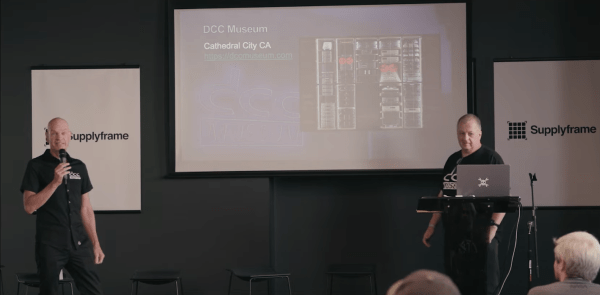
The Digital Compact Cassette, or DCC, was one such format. Released by Philips in 1992 as a replacement for the analog audio cassette, it failed to gain traction in the market and disappeared before most people had even heard of it. Not so for [Jac Goudsmit] and [Ralf Porankiewicz] however, who have spent years researching all aspects of the DCC system and shared some of the results in their 2022 Supercon talk.

[Ralf] is the curator of the DCC Museum in Cathedral City, California, which owns examples of all DCC equipment ever released, as well as several devices that never made it to market. He also aims to document the history of audio recording and DCC’s contribution to it, which goes further than you might think. For example, the audio compression format used in the DCC system, called PASC, was an early version of what would later become MP3 – though most histories of audio compression ignore this fact.

[Jac], for his part, made an extensive study of all the technical features of the DCC format. He has written numerous articles about his findings, first in the DCC FAQ and later by maintaining the relevant Wikipedia articles. He is running several projects aimed at keeping the format alive, often in collaboration with the DCC Museum.

[Jac] and [Ralf] begin their talk with a brief introduction to the system and its media. DCC players were designed to be compatible with analog audio cassettes, so DCC cartridges are the same basic size, though with a different type of tape inside. Playback devices contain a complex set of magnetic heads to read either the analog signals from classic tapes, or the digital data stored on DCCs.

One unique feature of DCC is Interactive Text Transfer Service, or ITTS, which is a separate data area on the tape that can hold additional information like song lyrics or even simple animations. It was intended to be displayed on players that supported it, but no such devices were ever released. Luckily, [Jac] and [Ralf] managed to find a rare ITTS decoder system used in a tape mastering facility, and were able to reveal the contents of this “secret track”, which is present on all prerecorded tapes, for the first time.

User-recorded tapes never had any ITTS data, and differed from prerecorded ones in several other ways, too. The most obvious difference was that professionally-made tapes could be indexed by song title, while home-made ones could only jump to track numbers. [Jac] and [Ralf] are however working to enable all the professional features on home-made tapes as well, through a number of software and hardware projects.

The most basic software needed is an encoder and decoder for the PASC format, which [Jac] developed from existing MP1 sofware. But to explore some of the more obscure hardware features, he had to reverse-engineer several different DCC players. This led him to discover many interesting half-finished features: the ITTS data sector is one example, but he also found out that some players send ready-to-use VU meter data to their front panel, even though they are unable to display that information.

[Jac] was also one of the first people to buy the DCC-175 portable DCC player when it was released in 1995. This was the only DCC player ever sold with a computer interface, allowing direct transfer of digital audio between a computer and a DCC tape. The parallel port interface and its accompanying Windows 9x software are completely obsolete and unusable with modern PCs, so [Jac] is working on directly accessing the data from the DCC-175 through a custom cable. He’s making good progress: he already figured out the electrical interface and wrote some software that enables him to control the tape recorder directly.

We can’t help but be impressed by the amount of effort both [Jac] and [Ralf] have put into understanding and documenting all the intricacies of a long-obsolete audio format. Thanks to their efforts, we can still appreciate the impressive technology behind DCC – even if it never came close to replacing its analog cousin.

Continue reading “2022 Supercon: Jac And Ralf Explore The Secrets Of The Digital Compact Cassette”