Supercon On The Rise: More Amazing Talks Revealed

The drum beat of the Hackaday Superconference grows louder. Are you ready for it? We’re spending the week revealing the talks and on our third day we’re barely half-way through. Check out the incredible speakers who will be at Supercon to share tales of hardware creation.

This is the Ultimate Hardware Conference and you need to be there! We’ll continue to announce speakers and workshops as final confirmations come in. Supercon will sell out so grab your ticket now before it’s too late.

Jeroen Domburg
Magic Paintbrush: Everyone Can Paint with Printer Cartridges

Always wanted to paint like Bob Ross, but have the artistic skills of a wet cardboard box? Perhaps you can be helped by a printer cartridge and some electronics.

Bryce Salmi
3D Printing An Orbital Class Rocket

Challenging traditional manufacturing techniques used to build orbital class rockets. Here’s how Relativity Space 3D prints rocket engines (104 tests already) and avionics.

Sarah Petkus
Sensing and Indicating a Sensual State

“SHE BON” can sense and indicate the wearer’s level of arousal/excitement. It explores ways in which we can use our bio-data to communicate aspects of our being that would otherwise go unnoticed, as well as how technology can help us add another layer of texture to how we express our individuality.

Zach Fredin
Novelty Soldering

Novel soldering techniques for building art, prototypes, and short hand-built production runs using techniques like SMT cordwood, carved FR4, and small scale free-air.

Kelly Ziqi Peng
Diffractive Optics for Augmented Reality

Learn to design optical elements like diffractive waveguides (Magic Leap, Hololens, Akonia, Digilens), and electronically controlled elements that can changing depth in real-time. More importantly, learn how to make your own with accessible machine shop equipment.

Brett Smith
Why Do It the Hard Way?

Microcontrollers have lots of built-in functionality that goes unused because long datasheets can be overwhelming. That ends now.

Chris Gammell
Improve Your Circuit Toolbox

Simple designs will save your next product if you know which circuits to piece together. Utility circuits practical for everyday electronics.

 

Arsenijs Picugins
DIY Linux Portables

From powering it efficiently, to software constraints, picking the right hardware, and connecting it all in a fail-safe way, know the pitfalls of designing a Linux-powered portable.

We Want You at Supercon!

The Hackaday Superconference is a can’t-miss event for hardware hackers everywhere. Join in on three amazing days of talks and workshops focusing on hardware creation. This is your community of hardware hackers who congregate to hack on the official hardware badge and on a slew of other projects that show up for the fun. Get your ticket right away!


Friday Hack Chat: Is There Life On Mars?

Mars ain’t the kind of place to raise a kid. In fact, it’s cold as hell. There’s no one there to raise them if you did, or is there? Is there life on Mars? That’s the question NASA has been trying to answer for the last forty years, and with the new Mars rover, we might get closer to an answer. For this week’s Hack Chat, we’re going to be talking with the people responsible for some interesting instruments flying on the Mars 2020 rover.

Our guest for this week’s Hack Chat will be [Matteo Borri], an Italian engineer who’s been living in the US for the better part of a decade now. He’s had various projects ranging from robotics — including a BattleBot — AI, and aerospace. [Matteo] is also one of the engineers behind the Vampire Charger, a winner in the Power Harvesting Module Challenge in this year’s Hackaday Prize.

Right now, [Matteo] is working on an interesting project that’s going to fly on the next Mars rover. He’s developed a chlorophyll spectroscope for NASA and the Mars Society. This week, [Matteo] is going to share the details of how this device works and how it was developed.

During this Hack Chat, we’re going to be discussing various technology that’s going into the search for life on Mars and elsewhere in the galaxy such as:

  • Chlorophyll detection
  • Mars Rovers
  • Various other hardware hacks

You are, of course, encouraged to add your own questions to the discussion. You can do that by leaving a comment on the Hacking with Fire event page and we’ll put that in the queue for the Hack Chat discussion.

join-hack-chat

Our Hack Chats are live community events on the Hackaday.io Hack Chat group messaging. This week we’ll be sitting down on Friday, October 5th, at noon, Pacific time. We have some amazing time conversion technology.

Click that speech bubble to the right, and you’ll be taken directly to the Hack Chat group on Hackaday.io.

You don’t have to wait until Friday; join whenever you want and you can see what the community is talking about.

Retrotechtacular: Disposing Of Sodium, 1947-Style

A high school friend once related the story about how his father, a chemist for an environmental waste concern, disposed of a problematic quantity of metallic sodium by dumping it into one of the more polluted rivers in southern New England. Despite the fact that the local residents were used to seeing all manner of noxious hijinx in the river, the resulting explosion was supposedly enough to warrant a call to the police and an expeditious retreat back to the labs. It was a good story, but not especially believable back in the day.

After seeing this video of how the War Department dealt with surplus sodium in 1947, I’m not so sure. I had always known how reactive sodium is, ever since demonstrations in chemistry class where a flake of the soft gray metal would dance about in a petri dish full of water and eventually light up for a few exciting seconds. The way the US government decided to dispose of 20 tons of sodium was another thing altogether. The metal was surplus war production, probably used in incendiary bombs and in the production of aluminum for airplanes. No longer willing to stockpile it, the government tried to interest industry in the metal, but to no avail due to the hazard and expense of shipping the stuff. Sadly (and as was often the case in those days), they just decided to dump it.

Continue reading “Retrotechtacular: Disposing Of Sodium, 1947-Style” →

The Modular Connector And How It Got That Way

They adorn the ends of Cat5 network patch cables and the flat satin cables that come with all-in-one printers that we generally either toss in the scrap bin or throw away altogether. The blocky rectangular plugs, molded of clear plastic and holding gold-plated contacts, are known broadly as modular connectors. They and their socket counterparts have become ubiquitous components of the connected world over the last half-century or so, and unsurprisingly they had their start where so many other innovations began: from the need to manage the growth of the telephone network and reduce costs. Here’s how the modular connector got that way.

Continue reading “The Modular Connector And How It Got That Way” →

Eight More Speakers You’ll See At Supercon

Level-up your hardware chops at the Hackaday Superconference. We’re delighted to share more of the amazing speakers who are headed to Pasadena in just a few weeks. Scroll down for eight incredible talks that will inform, inspire, and excite the engineering muse inside of you.

This is the Ultimate Hardware Conference and you need to be there! We’ll continue to announce speakers and workshops as final confirmations come in. Supercon will sell out so grab your ticket now before it’s too late.

Kitty Yeung
Tech-Fashion Designs and the Wearables Industry

Driven by creative designs, the wearables industry has tremendous opportunities but also faces significant challenges in scaling and scientific research. Building programmable garments and what the future will bring.

Erika Earl
How to Stay Grounded When You Have Zero Potential

Why “ground” is critical and important for developing electronic hardware and how to approach a grounding scheme in your designs.

David Prutchi
DIY Ultraviolet Photography

Modifying cameras, building lenses, and selecting filters to see like the bees. Exploring ultraviolet spectrum for the artistic and technically-minded.

Brad Luyster
Communication, Architecture, and Building Complex Systems for SPAAACE

Building the first dual-rotor modular centrifuge to fly on the ISS. Ingenuity and standing on the shoulders of giants to build complex systems.

Estefannie
Daft Punk Is Playing In My Helmet

A whirlwind tour of tools and techniques for fabricating amazing reproductions in the home workshop; electronics, vacuum forming, 3D printing, and sooooo much sanding bring a faithful Daft Punk Helmet clone to life.

Scott Swaaley
Lessons Learned in Designing High Power Line Voltage Circuits

Practical tips for designing with high-power line voltage circuits to make AC design and tinkering safe, effective, and just as cheap as DC.

Alex Hornstein
Hacking the Lightfield

Taking holographic photos and video with regular cameras and panache. Custom photo rigs and the crazy problem of making a lightfield video rig.

Ted Yapo
Dealing with a Cheap Spectrum Analyzer

A surprisingly simple circuit, some interesting math,
and an article in the inaugural edition of the Hackaday Journal of What You Don’t Know.

We Want You at Supercon!

The Hackaday Superconference is a can’t-miss event for hardware hackers everywhere. Join in on three amazing days of talks and workshops focusing on hardware creation. This is your community of hardware hackers who congregate to hack on the official hardware badge and on a slew of other projects that show up for the fun. Get your ticket right away!

Cool Tools: The Pantorouter Turns Tracing On Its Side

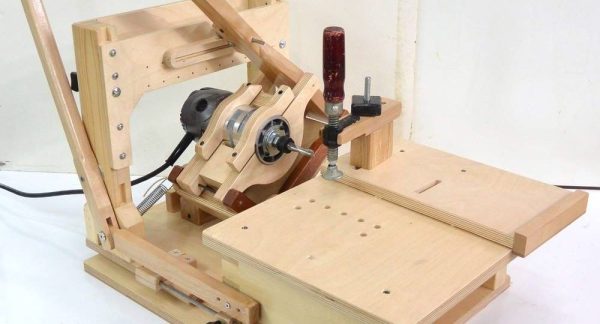
Not too long ago we wrote about a small CNC tool for automating certain parts of the woodworking process. At the time it seemed unusual in its intentionally limited scope but a few commenters mentioned it reminded them of another device, [Matthias]’s Pantorouter. It didn’t take much investigation to see that the commenters were right! The MatchSticks device does feel a bit like a CNC version of the Pantorouter, and it seemed like it was more than worth of a post by itself. The Pantorouter is a fascinating example of another small manual-but-automated tool for optimized for accelerating and improving certain woodworking operations.

Continue reading “Cool Tools: The Pantorouter Turns Tracing On Its Side” →

Just A Taste Of The Talks At Supercon

The Hackaday Superconference is taking on a life of its own. Speaker selection is done and invitations are on the way out. Below is a taste of the confirmed talks in store for you this November in Pasadena.

This is the Ultimate Hardware Conference and you need to be there! We’ll continue to announce speakers and workshops as final confirmations come in. Supercon will sell out so grab your ticket now before it’s too late.

Ben Krasnow
Depositing copper circuitry and optical displays onto 3D-printed parts

Producing printed circuits on plastic mechanical parts can be accomplished with a standard laser cutter and a handful of chemicals available from online retailers.

Ruth Grace Wong
Firmware From the Firehose

Practical tips for people who don’t know anything about firmware for deciphering the code and tracking down bugs.

Amie Danielle Dansby
Swords and High Voltage: Creating 3D Printing Designs for Electronics Props

You can easily bring digital video game assets to the human world with 3D printing, but what about modifying files, or adding electronics?

Sam Zeloof
Home Chip Fab: Silicon IC Fabrication in the Garage

IC and semiconductor fabrication techniques, tools, and processes that allow for mid 1970’s era device fabrication on a small budget in the home workshop.

Zach Archer
Live Coding a 40-Foot LED Sign

This is the story of how the massive 500-watt LED Toorcamp sign was designed, developed, and constructed inside of 3 weeks.

Leigh Johnson
Portable Deep Object Detection

The fundamentals of deep learning modules and object detection using Tensorflow and Keras on a Raspberry Pi.

We Want You at Supercon!

The Hackaday Superconference is a can’t-miss event for hardware hackers everywhere. Join in on three amazing days of talks and workshops focusing on hardware creation. This is your community of hardware hackers who congregate to hack on the official hardware badge and on a slew of other projects that show up for the fun. Get your ticket right away!