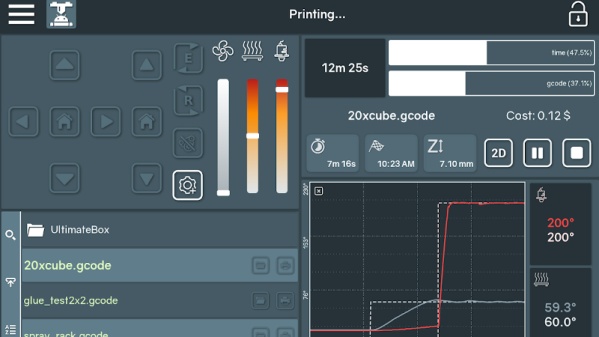
Controlling OctoPrint On The Go

Not too long ago I took the plunge into the world of OctoPrint by shoehorning a Raspberry Pi Zero into a PrintrBot Play, and I have to say, the results were quite impressive. OctoPrint allows you to run your 3D printer untethered from your computer, but without all the downsides of printing off of an SD card. Generally running off of a Raspberry Pi, OctoPrint serves up a very capable web interface that gives you full control over slicing and printing from essentially any device with a modern browser.

That’s all well and good if you’ve got your laptop with you, or you’re sitting at your desktop. But what if you’re out of the house? Or maybe out in the garage where you don’t have a computer setup? OctoPrint is still happily serving up status information and a control interface, you just don’t have a computer to access it. Luckily, there are options for just that scenario.

In this post we’re going to take a look at a couple of options for controlling and monitoring OctoPrint from your mobile device, which can help truly realize its potential. Personally I have an incredible amount of anxiety when leaving a 3D printer running a long job, and in the past I’ve found myself checking every 10 minutes or so to see if it was done. Now that I can just glance at my phone and see an ETA along with status information about the machine, it’s given me the confidence to run increasingly longer and complex prints. Continue reading “Controlling OctoPrint On The Go”


Hackaday Links Column Banner

Hackaday Links: March 4, 2018

Guess what’s happening next weekend? The SoCal Linux Expo. SCALE is in its 16th year, and is the second greatest convention happening this year at the Pasadena Convention Center. The first, of course, is AlienCon this summer, with a special guest appearance by the guy with the hair on Ancient Aliens. What’s cool at SCALE? Tons of stuff! Tindie and Hackaday will have a booth, you’ll be able to check out the new stuff from System 76, and this is where I first picked up my most cherished possession, a Microsoft (heart) Linux sticker. NEED A TICKET? Cool, use the code ‘HACK’ to get 50% off!

[Muth] over on hackaday.io has been working on a very, very, very cool high voltage display. It’s a ИГГ1-64x64M, or a Gazotron, or something. What is it? It’s a two-color (green and red) 64×64 pixel VFD bitmap display. You want the king of all vacuum-based displays? Here you go. Progress on driving this display is slow, but it’s happening, and it will result in the coolest clock ever created.

Need a pick and place machine? Don’t want to shell out thousands for a Neoden? Here’s an Indiegogo campaign for the Open Placer, a machine that works with OpenPNP software. It’s got vision and a 295x195mm working area.

A few months ago, news came from Havana that the US embassy was under attack. Staffers at the US embassy in Cuba were feeling sick and apparently suffered neurological damage. Explanations ranged from poisoning to some sort of non-lethal weapon. Now, there might be a banal explanation. Researchers at the University of Michigan think it could simply be two ultrasonic sensors placed just the right distance apart. Acoustic interference happens, and that inaudible 35kHz signal becomes a maddening audible signal.

Last week, we had a great talk with OSH Park about PCBs. These Hack Chats are getting out of control, but at least we have a transcript. The biggest takeaway? They’re out of jellybeans, but OSH Park is working on new stickers.

Open Hardware Summit is the greatest con for all things Open Hardware. This year, it’s going to be in Boston. The Summit will be held on September 27th, 2018 at MIT Stratton Student Center. If you’d like to get there a week and a half early, the MIT ham flea market is the third Sunday of the month.

Unionize Your Variables – An Introduction To Advanced Data Types In C

Programming C without variables is like, well, programming C without variables. They are so essential to the language that it doesn’t even require an analogy here. We can declare and use them as wildly as we please, but it often makes sense to have a little bit more structure, and combine data that belongs together in a common collection. Arrays are a good start to bundle data of the same type, especially when there is no specific meaning of the array’s index other than the value’s position, but as soon as you want a more meaningful association of each value, arrays will become limiting. And they’re useless if you want to combine different data types together. Luckily, C provides us with proper alternatives out of the box.

This write-up will introduce structures and unions in C, how to declare and use them, and how unions can be (ab)used as an alternative approach for pointer and bitwise operations.

Continue reading “Unionize Your Variables – An Introduction To Advanced Data Types In C”

New Part Day: ATMegas With Programmable Logic

Since Microchip acquired Atmel, the fields of battle have fallen silent. The Crusaders have returned home, or have been driven into the sea. The great microcontroller holy war is over.

As with any acquisition, there is bound to be some crossover between two product lines. Both Atmel’s AVR platform and Microchip’s PICs have their adherents, and now we’re beginning to see some crossover in the weird and wonderful circuitry and design that goes into your favorite microcontroller, whatever that might be. The newest part from Microchip is an ATMega with a feature usually found in PICs. This is a Core Independent Peripheral. What is it? Well, it’s kinda like a CPLD stuck in a chip, and it’s going to be in the new Arduino board.

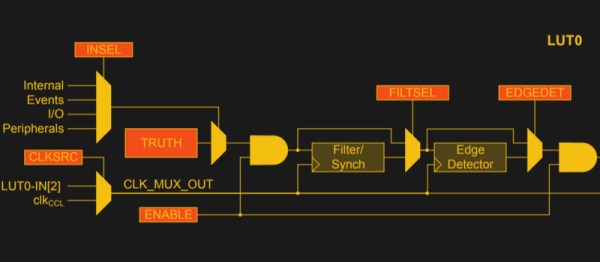
The ATMega4809 is the latest in a long line of ATMegas, and has the features you would usually expect as the latest 8-bit AVR. It runs at 20MHz, has 48 K of Flash, 6 K of SRAM, and comes in a 48-pin QFN and TQFP packages. So far, everything is what you would expect. What’s the new hotness? It’s a Core Independent Peripheral in the form of Configurable Custom Logic (CCL) that offloads simple tasks to hardware instead of mucking around in software.

So, what can you do with Configurable Custom Logic? There’s an application note for that. The CCL is effectively a look-up table with three inputs. These inputs can be connected to I/O pins, driven from the analog comparator, timer, UART, SPI bus, or driven from internal events. The look-up table can be configured as a three-input logic gate, and the output of the gate heads out to the rest of the microcontroller die. Basically, it’s a tiny bit of programmable glue logic. In the application note, Microchip provided an example of debouncing a switch using the CCL. It’s a simple enough example, and it’ll work, but there are a whole host of opportunities and possibilities here.

Additionally, the ATMega4809, “has been selected to be the on-board microcontroller of a next-generation Arduino board” according to the press release I received. We’re looking forward to that new hardware, and of course a few libraries that make use of this tiny bit of custom programmable logic.

Friday Hack Chat: Everything PCB

It was not too long ago that all PCB design packages were proprietary. Getting PCBs made was expensive, and if you tried to do this over the Internet, the best way was to download a board house’s proprietary software, design your board in their software suite, and send your boards off to be made. A 5 cm square board would cost two hundred dollars. I know this to be true because I’ve said it before, and no one has corrected me.

For this week’s Hack Chat, we’re talking Everything PCB with OSH Park. OSH Park is the leading creators of perfect purple PCBs. They have POGs, and for the last two weeks, they’ve been one of the few places you can send some Gerbers to and have it manufactured in a timely manner if you live in the US. Because China was closed.

For this week’s Hack Chat, we’re going to be talking about everything PCB. How do you do castellated holes? How do you mill slots and square or otherwise non-round holes? Internal cutouts? Stop mask expansion? Artwork? Panelization? Why purple? More POGs!

Our guests for this chat will be [Dan Sheadel] and [Drew Fustini] of OSH Park, and they’re going to be there answering all your questions. [Dan] has been around OSH Park from the beginning and enjoys designing tiny useless robots and mentoring students building better ones. [Drew] is an Open Source hardware developer, firmware designer, a BeagleBoard board member, and is usually found at hardware meetups wearing purple.

join-hack-chat

Our Hack Chats are live community events on the Hackaday.io Hack Chat group messaging. This Hack Chat is going down Friday, March 2nd at noon, Pacific time. Want to know what time this is happening in your neck of the woods? Have a countdown timer!

Click that speech bubble to the right, and you’ll be taken directly to the Hack Chat group on Hackaday.io.

You don’t have to wait until Friday; join whenever you want and you can see what the community is talking about.

Fail Of The Week: The Little Ultrasonic Knife That Couldn’t

We all know the feeling of an idea that sounded great when it was rattling around in our head, only to disappoint when we actually build the thing. It’s a natural consequence of trying new stuff, and when it happens, we salvage what we can and move on, hopefully in wisdom.

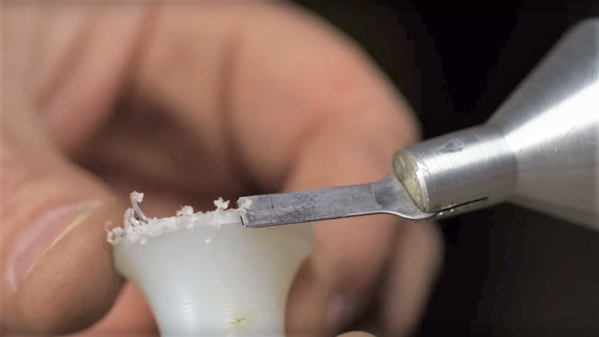
The thing that at least semi-defeated [This Old Tony] was an attempt to build an ultrasonic cutter, and it didn’t go well. Not that any blood was shed in the video below, although there seemed like there would be the way [Old Tony] was handling those X-Acto blades. His basic approach was to harvest the transducer and driver from a cheap ultrasonic cleaner and retask the lot into a tool to vibrate a knife rapidly enough to power it through tough materials with ease.

Spoiler alert: it didn’t work very well. We think the primary issue was using a transducer that was vastly underpowered compared to commercial (and expensive) ultrasonic cutters, but we suspect the horn he machined was probably not optimized either. To be fair, modeling the acoustic performance of something like that isn’t easy, so we can’t expect much. But still, it seems like the cutter could have worked better. Share your thoughts on how to make version 2.0 better in the comments.

The video is longish, but it’s as entertaining as any of [Old Tony]’s videos, and packed full of incidental gems, like the details of cavitation. We enjoyed it, even if the results were suboptimal. If you want to see a [This Old Tony] project that really delivers, check out his beautiful boring head build.

Continue reading “Fail Of The Week: The Little Ultrasonic Knife That Couldn’t”

One Week Left For Hackaday Belgrade Proposals

Do you have your tickets for Hackaday Belgrade? Our premiere European conference is on 26 May and tickets are on a rapid trajectory to sell out.

Those of you weighing the idea of presenting a talk, you now have less than one week to get your proposal to us. While we have already accepted several exemplary talks, final decisions won’t be made until after the submission deadline passes on Sunday, March 4th.

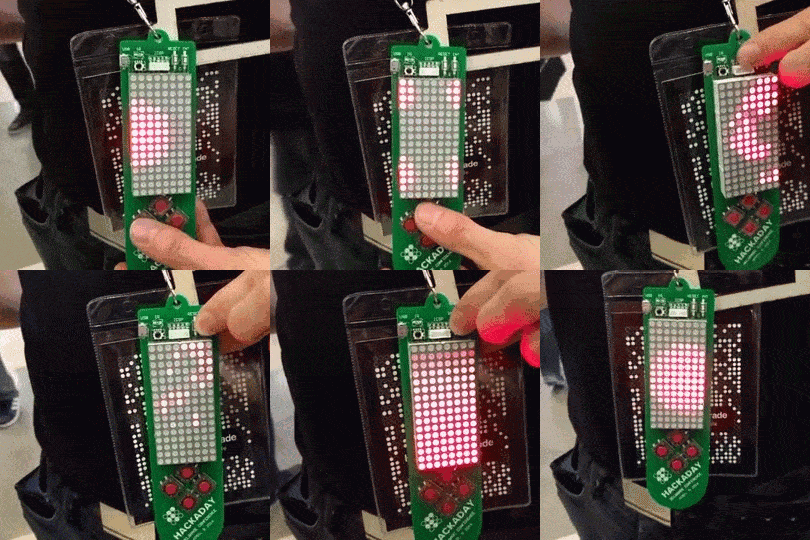
Mike Harrison showing off his demo work on the 2016 Hackaday Belgrade badge. If you have stories of the demoscene, consider sending in a talk proposal.

What kind of talks are we looking for? We’d love to have a few talks about the demoscene. The conference badge this year is a full-blown retrocomputer, and we’re working on a BASIC for it. If you can push pixels on a Comodore 64, we’d love to hear you talk about it. We’re also suckers for the lesser known stories of tech history (Mike Harrison’s talk on the Eidophor projector tech all but forgotten to history was a delight).

We’re always interested in creative design; think circuit boards that aren’t square and enclosures that go beyond just putting something in a simple box. And of course we’re forever in search of the rare gems that share a glimpse of the research world, like this computing cluster built to get around limited supercomputer time when calculating quantum effect simulations.

These are great talks presented to an audience hungry to share your excitement. Get those proposals in by the end of this weekend!