Relive The Hackaday Belgrade Conference

The Hackaday Belgrade Conference was an amazing success. For proof, you need look no farther than the slate of talks that we have been publishing over that past several weeks. Each looks at different angles of the hardware universe; what does it mean to create hardware, where have we been, where are we going, and where does inspiration for the next great design come from?

The talks have now all been published and collected into one video playlist; it was an intense day of talks all caught in one streaming frenzy. But if you can’t make it through in one sitting, I’ve also listed the individual talks after the break so you that you may pick and choose.

There are, however, two talks that have just been published this afternoon. These are the opening remarks presented by Aleksandar Bradic and the closing remarks which I presented. When we meet people we’re often asked about what is going on behind the scenes. It’s really easy to think that nobody cares about what it takes to pull together a conference, run an amazing engineering challenge, or how we decide what we think matters when looking to the future. Alek covers the back story of how Supplyframe and Hackaday came together, as well as what led us to choose Belgrade for this conference. I discuss what I think is a core virtue of Hackaday; the free and open sharing of information and ideas. It’s a concept I believe in, and the most noble of reasons for documenting your work so that others may build upon your knowledge and skill.

Hackaday | Belgrade went beyond what we even considered possible. It joins the 2016 SuperConference (whose talk videos have also been published) as a shining example of our strong, active, and engaged community who want to spend their time enabling everyone — hackers, designers, and engineers alike — to succeed.


Continue reading “Relive The Hackaday Belgrade Conference”

Hackaday Links: May 22, 2016

Lulzbot’s TAZ 6 has been released. Lulzbot’s printers consistently place in the top three of any 3D printing list, and the TAZ 6 will likely be no exception. [James Bruton] was one of the lucky ones who got a review unit, and first looks are promising. The TAZ 6 has the auto bed leveling found in the Lulzbot Mini, and a ‘power tower’ for all the electronics. There are completely unconfirmed rumors (or someone told me and I forgot who) that the power tower will be available separately at some point.

The most impressive circuit we’ve seen this week month year is the dis-integrated 6502. It’s a discrete 6502 CPU, about a square foot in size. It’s slow, but it works. RAM and ROM is easy to make embiggened, which means someone needs to build a dis-integrated 6522 VIA. Who’s game?

[Jeremy Cook] wanted to learn another CAD package, in this case Onshape. Onshape is the ‘first cloud-only CAD package’, which has one huge bonus – you can run it anywhere, on anything – and one huge minus – it’s in the cloud. He designed a bicycle cupholder.

Last week, several thousand Raspberry Pi Zeros shipped out to retailers in the US and UK. For a time, Pi Zeros were in stock in some online stores. Now? Not so much. Where did they all go? eBay, apparently. It’s called arbitrage, and it’s the only risk-free form of investment.

Remember those ‘bed of nails’ toys, that were basically two sheets of plastic, with hundreds of small pins able to make 3D impressions of your face and hands. No, there is no official name for these devices, but here’s a Kickstarter for a very clever application of these toys. You can use them to hold through hole parts while soldering. Brilliant.

You should not pay attention to 3D printers on Kickstarter. Repeat after me: you should not give money to 3D printers on Kickstarter. Here’s a 3D printer on Kickstarter, promising a 3D printer for $74. I own several hats, and will eat one if this ships by next year.

Remember bash.org? It’s being reimplemented on hackaday.io.

Hacklet 108 – Simple Functional 3D Prints

We featured 3D printer projects on last week’s Hacklet. This week, we’re looking at a few awesome projects created with those printers. Trying to pick great 3D printed projects on Hackaday.io is a bit like staring at the sun. There are just way too many to choose from. To make things a bit easier, I’ve broken things down into categories. There are artistic prints, complex mechanical or electronic prints, and then there are simple functional prints, which is the topic we’re featuring today. Simple functional prints are designs which perform some function in the world. By simple, I mean they have only a few moving parts or electronic components. Let’s get right to it!

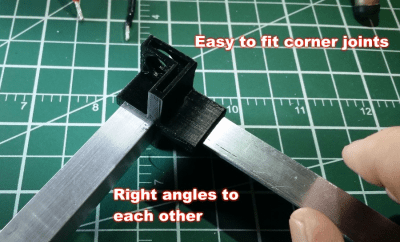
cornersWe start with [Scott] and L Extrusion Endcaps. Every Home Depot, Lowes, or hardware store has a selection of extruded aluminum. Typically there are a few flat bars, and some L brackets. L brackets are great, but they can be a pain to work with. Most of us don’t have the skills or the tools to weld aluminum, so nuts and bolts are the only way to go. [Scott’s] given us another option. He’s designed a set of 3D printable brackets that slip onto the ends of the brackets. The brackets make quick work of building boxes, racks, or anything with 90° or 45° angles.


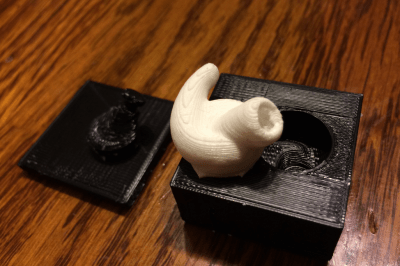
earbudNext up is [Joe M] with 3D Printed Molds: Custom Silicone Earbuds. [Joe] had a set of Bluetooth earbuds he enjoyed, but the rubber tips left a bit to be desired. Not a problem when you have a 3D printer on hand. [Joe] measured the plastic part of his earbuds and the rubber tips from a different set he liked. A bit of CAD magic later, and he had a model for the perfect earbud tip. While he could have directly printed the tip in a flexible filament like NinjaFlex, [Joe] opted for a pure silicone tip. He printed molds, then mixed silicone caulk with cornstarch (as a catalyst). The resulting earbuds sound and feel great!

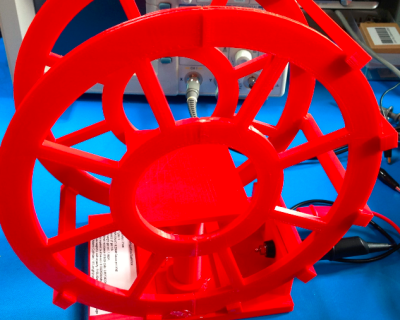
coil2Next we have [Jetty] with Highly Configurable 3D Printed Helmholtz Coil. Helmholtz coils are used to create uniform magnetic fields. Why would you want to do that? It could be anything from measuring magnets to cancelling out the effect of the earth’s magnetic field on a device being tested. [Jetty’s] wrote an OpenScad program which allows the user to enter parameters for their coil. [Jetty’s] program then calculates the coil’s magnetic properties, and outputs a printable .stl file. Building the coil is as simple as printing it and wrapping some copper wire. [Jetty] found that his coil was within 60nT (nanoTesla) of the expected value. Not bad for a bit of plastic and wire!


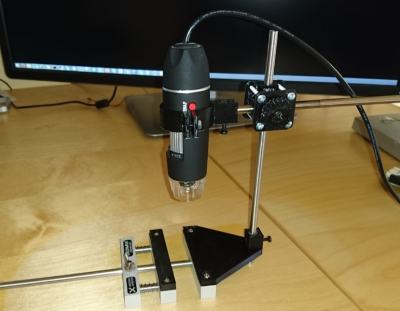
scope1Finally we have StickScope,  [SUF’s] entry in the 2016 Hackaday Prize. Like many of us, [SUF] loves his StickVise. Sometimes you need a bit of magnification to see those tiny 0201 resistors though. [SUF] had a cheap USB microscope on hand, so he designed StickScope, a USB microscope mount designed especially for the StickVise. Two 6mm steel rods are the backbone of the design. 3D printed clamps hold the system together like a miniature boom microscope. This is actually the third revision of the design. [SUF] found that the original design couldn’t be used with parts close to the bar which holds the microscope. A small jaw extender was the perfect tweak.


If you want to see more simple functional 3D printed projects, check out our new simple functional 3D prints list! If I missed your project, don’t be shy, just drop me a message on Hackaday.io. That’s it for this week’s Hacklet. As always, see you next week. Same hack time, same hack channel, bringing you the best of Hackaday.io!

Evolving Storytelling To Marry The Ancient Skills With The Digital Age

Storytelling is an art. It stretches back to the dawn of man. It engages people on an emotional level and engages their mind. Paulina Greta Stefanovic, a user experience researcher and interaction designer is on the cutting edge of bringing our technology together with the best human aspects of this long tradition.

The information age is threatening storytelling — not making it extinct, but reducing the number of people who themselves are storytellers. We are no longer reliant on people in our close social circles to be exquisite story tellers for our own enjoyment; we have the luxury (perhaps curse?) of mass market story-telling.

Paulina’s work unlocks interactive storytelling. The idea isn’t new, as great storytellers have always read their audience and played to their engagement. Interactive storytelling in the digital age seeks to design this skill into the technology that is delivering the story. This is a return from passive entertainment.

This breaks down into interactive versus responsive. At its simplest, think of responsive as a video that has a pause button. You can change the flow of the story but you can’t make the story your own. Surprisingly, this is a new development as the ability to pause playback is but a few decades old. So you can pause a responsive medium, but true interactive experiences involve creation — the audience is immersed in the story and can make substantive changes to the outcome during the experience.

This equates to a power transfer. The creator of the media is no longer in complete control, ceding some to the audience. We are just at the start of this technology and it looks like the sky is the limit on what we can do with algorithmic interactions.

Video games are the forerunners of this change. They already have branching stories that let the users make choices that greatly affect the storyline. This industry is huge and it seems obvious that this active aspect of story consumption is a big part of that success. Even more intriguing is a “drama management system” (a new term to me but I love it) that results in a story whose ending nobody knows until this particular audience gets there. What a concept, and something I can’t wait to see for myself!

If you find these concepts as interesting as I do, check out Paulina’s talk below, which she presented at the Hackaday Belgrade conference.

Hackaday Dictionary: Lithium Ion Batteries

Battery technology is a constant chemical war between the laws of physics and the desire of engineers to make devices smaller. On one side, the laws of physics declare that there are limits to how much energy you can store inside a battery, and on the other side are the engineers looking for ways to sneak around these laws. For many devices, the best compromise between these two sides is the lithium ion battery, usually abbreviated to Li-ion.

Continue reading “Hackaday Dictionary: Lithium Ion Batteries”

Virtually Free Rapsberry Pis

One of the nice things about the Raspberry Pi is that it runs Linux and you can do a lot of development right on the board. The converse of that is you can do a lot of development on a Linux desktop and then move things over to the Pi once you get the biggest bugs out. However, sometimes you really need to run code on the actual platform.

There is, however, an in-between solution that has the added benefit of upping your skills: emulate a Pi on your desktop. If you use Linux or Windows on your desktop, you can use QEMU to execute Raspberry Pi software virtually. This might be useful if you don’t have a Pi (or, at least, don’t have it with you). Or you just want to leverage your large computer to simplify development. Of course we would be delighted to see you build the Pi equivalent of the Tamagotchi Singularity but that’s a bit beyond the scope of this article.

Since I use Linux, I’m going to focus on that. If you insist on using Windows, you can find a ready-to-go project on Sourceforge. For the most part, you should find the process similar. The method I’ll talk about works on Kubuntu, but should also work on most other Debian-based systems, including Ubuntu.

Continue reading “Virtually Free Rapsberry Pis”

Shaper Tools Will Blow Your Mind

Have you ever wanted to own a full-sized ShopBot? What if some geniuses somewhere made a tool the size of a coffee maker that had the same capabilities? Does an augmented reality, real-time feedback, interactive, handheld CNC router that can make objects ranging in size from a pillbox to an entire conference room table sound like a thing that even exists? It didn’t to me at first, but then I visited the Shaper Tools office in San Francisco and they blew my mind with their flagship tool, Shaper Origin.

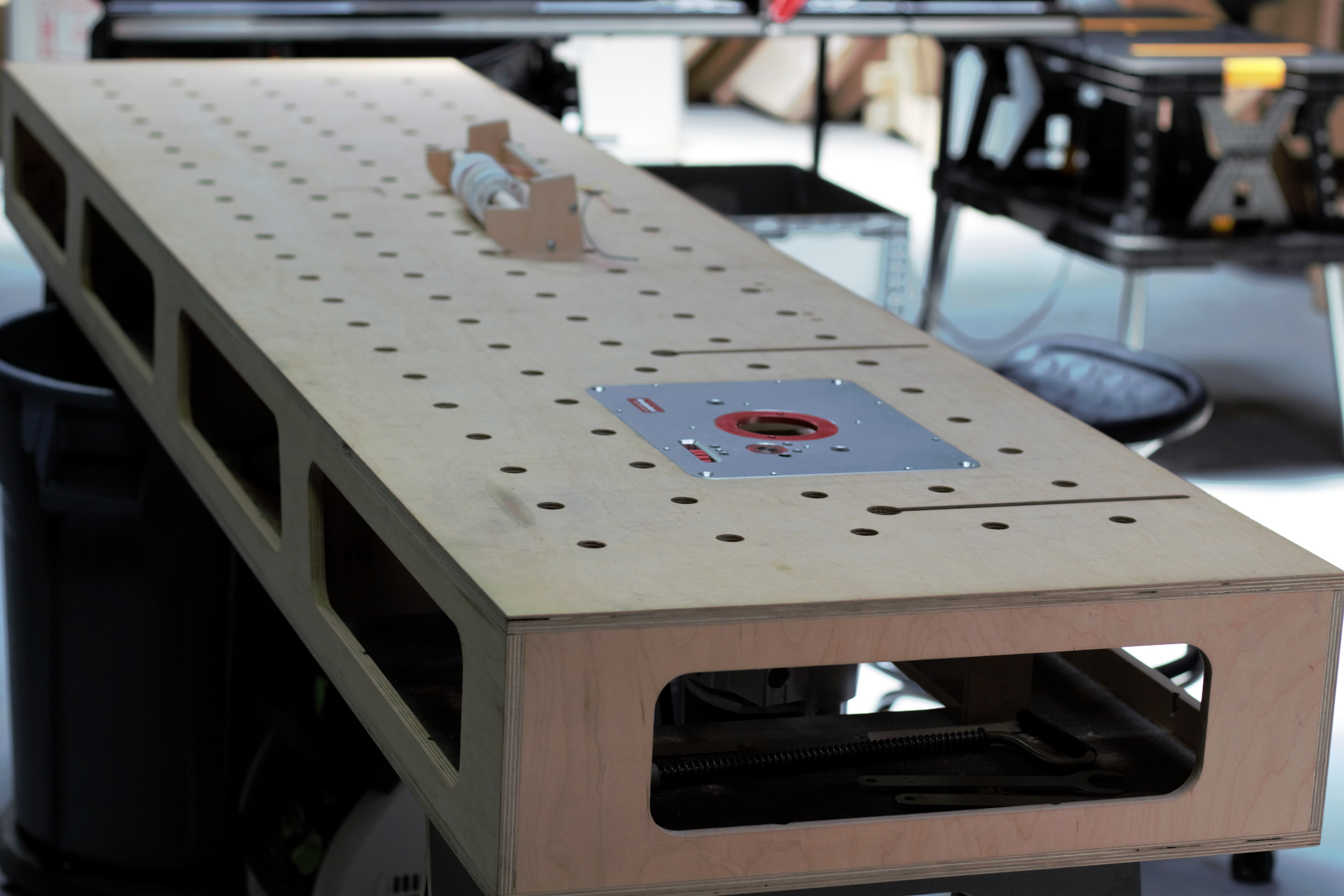
This table and the spool holder sitting on it was made with a machine the size of a coffee maker.

It’s impossible for me not to sound like a fan boy. Using Shaper Origin was one of those experiences where you just don’t know what to say afterwards. This is what the future looks like.

I’ve used a lot of CNC tools in my life, from my first home-built CNC conversion, to 1980s monstrosities that ran off the floppy kind of floppy disks, and all the way over to brand new state-of-the-art vertical machining centers. I had to shake a lot of that knowledge off when they demoed the device to me.

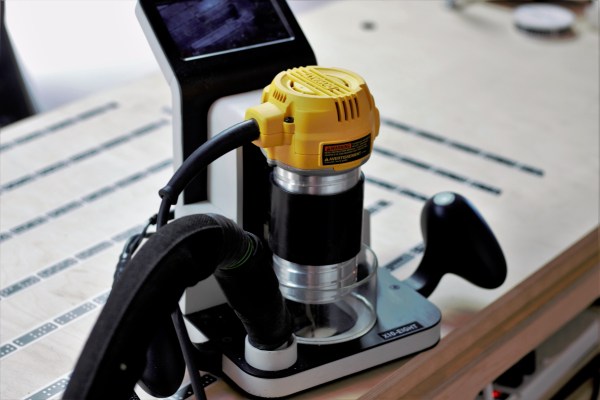
Origin is a CNC router built into the form factor of a normal wood router. The router knows where it is on the work piece. You tell it where on the piece you would like to cut out a shape, drill a hole, or make a pocket. It tells you where to go, but as you move it keeps the cutting bit precisely on the path with its three axes of control.

Continue reading “Shaper Tools Will Blow Your Mind”