graph

We Have A Problem: Earthquake Prediction

Nepal | 25 April 2015 | 11:56 NST

It was a typical day for the 27 million residents of Nepal – a small south Asian country nestled between China and India. Men and women went about their usual routine as they would any other day. Children ran about happily on school playgrounds while their parents earned a living in one of the country’s many industries. None of them could foresee the incredible destruction that would soon strike with no warning. The 7.8 magnitude earthquake shook the country at its core. 9,000 people died that day. How many didn’t have to?

History is riddled with earthquakes and their staggering death tolls. Because many are killed by collapsing infrastructure, even a 60 second warning could save many thousands of lives. Why can’t we do this? Or a better question – why aren’t we doing this? Meet [Micheal Doody], a Reproductive Endocrinologist with a doctorate in steel rodphysical biochemistry. While he doesn’t exactly have the background needed to pioneer a novel approach to predict earthquakes, he’s off to a good start.
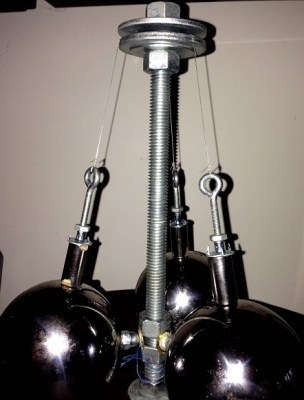
He uses piezoelectric pressure sensors at the heart of the device, but they’re far from the most interesting parts. Three steel balls, each weighing four pounds, are suspended from a central vertical post. Magnets are used to balance the balls 120 degrees apart from each other. They exert a lateral force on the piezo sensors, allowing for any movement of the vertical post to be detected. An Arduino and some amplifiers are used to look at the piezo sensors.

The system is not meant to measure actual vibration data. Instead it looks at the noise floor and uses statistical analysis to see any changes in the background noise. Network several of these sensors along a fault line, and you have yourself a low cost system that could see an earthquake coming, potentially saving thousands of lives.

[Michael] has a TON of data on his project page. Though he’s obviously very skilled, he is not an EE or software guy. He could use some help with the signal analysis and other parts. If you would like to lend a hand and help make this world a better place, please get in touch with him.

Continue reading “We Have A Problem: Earthquake Prediction”

Retrotechtacular: The Hammond Novachord

Just when we thought we’d heard of all the cool early synthesizers, a tipster rattled our jar with news that someone completely restored a Novachord. These spinet piano-shaped prototypical synthesizers were made by Hammond for only four years. About a thousand of them were built before sales sagged and parts became scarce in 1942. It is estimated that only 200 or so are still around today.

The Novachord’s sounds are generated by a bank of twelve monostable vacuum tube oscillators. Each one is tuned to a pitch of the chromatic scale in what is called divide-down architecture. [Hammond] and his co-creators [John Hanert] and [C.N. Williams] used the property of dividing a frequency in half to generate the same tone, but one octave lower. This design means that all 72 notes can be played at the same time. Adjustable formant filters shape the often otherworldly sounds, which are then passed through flexible tube-based envelopes.

[Phil] knew it would be a big job to restore a Novachord in any condition. Thousands of passive components all had to be replaced. The cabinet bore all the hallmarks of a well-used parlor instrument—water rings from cocktails, scratches, and cigarette burns galore. [Phil] says that woodworking really isn’t his thing, but he did an outstanding job nonetheless of sanding every nook and cranny and applying several coats of stain. There are tons of drool-inducing pictures on his project site, and several clips of [Phil] really putting it through its paces.

Thanks for the tip, [Mike]!

Retrotechtacular is a weekly column featuring hacks, technology, and kitsch from ages of yore. Help keep it fresh by sending in your ideas for future installments.

The Problem With Kickstarter: A Lack Of Transparency

Since 2010, over one and a half billion dollars has been transferred from Kickstarter backers to project creators, and with Kickstarter’s 5% cut taken on each dollar collected, that means Kickstarter has had somewhere in the neighborhood of 75 to 80 million dollars in revenue in the last five years. That’s a success by any measure, and as with this huge amount of money, questions must be asked about the transparency of Kickstarter.

This is not a post about a Kickstarter project for an impossible project, a project that breaks the laws of physics, or one that is hyped beyond all reasonable expectations. This is a post about Kickstarter itself, and it’s been a long time coming. In the past, Kickstarter has shown at least some transparency by cancelling projects that are obvious rebrandings of white label goods – a direct violation of their rules. Kickstarter has even cancelled projects that violate the laws of physics, like this wireless charging Bluetooth tag. It’s a start, but Kickstarter has a much larger problem on its plate: the Staff Pick problem.

Continue reading “The Problem With Kickstarter: A Lack Of Transparency”

Hollywood Finally Gets Hacking Right With Mr. Robot

Author’s note: I’m keeping spoilers out of this article, but they will surely show up in the comments.

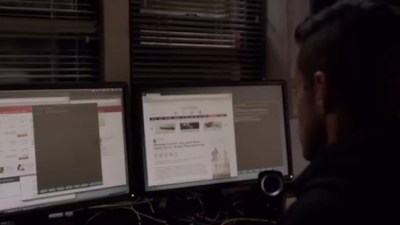
A few weeks ago I started hearing about a new show on the USA network, Mr. Robot. The synopsis for the show was “Mr. Robot is a psychological thriller that follows a young programmer who works as a cyber-security engineer by day and a vigilante hacker by night.” Yeah, that sounds like another Hollywood crapfest. Cue crazy GUIs and virtual reality flybys representing hacking scenes. After watching the pilot though, I realized I couldn’t have been more wrong. I was hooked for the entire 10 week first season.

elliot-hacksLet’s start with the hacking, which is the whole reason this article is here on Hackaday. Show creator [Sam Esmail] isn’t a hacker himself, but he is tech savvy enough to see how poorly hacking has been portrayed on TV and in the movies. He knew he could do it better. The solution was good consultants, in the form of [Michael Bazzell] and others. The team helped shape the show into a rather realistic portrayal of hacking techniques. Elliot Alderson (Rami Malek), the main character, is the “vigilante” hacker described in the synopsis. Within the first 10 minutes of the pilot, he is turning a child pornographer in to the police. How does he catch the creeper? Tor exit node exploits, of course.

The onion routing protocol is not as anonymous as you think it is. Whoever’s in control of the exit nodes is also in control of the traffic, which makes me the one in control.

This is an accurate description of some of the exploits which have been demonstrated on the tor network. There aren’t any VR hacking scenes to be found either. In fact, several characters watch and make fun of the “flu shot” scene in Hackers. In this show, the command line isn’t hidden, it’s celebrated. We see every command the characters type, from netstat to CAN bus dumps. In one scene, Elliot even fires up a windows virtual machine so he can run DeepSound on his Kali Linux box.

The hacking isn’t all software either. Everyone’s favorite Linux single board computer is featured prominently in the first season. We can’t knock a show where a character looks at another and says “Ok, we all know what a Raspberry Pi is, what’s your point?”

Continue reading “Hollywood Finally Gets Hacking Right With Mr. Robot”

Hackaday Links Column Banner

Hackaday Links: August 23, 2015

Dutch security conference! It’s called hardwear.io, it’ll be in The Hague during the last week of September, and they have the CTO of Silent Circle/Blackphone giving the keynote.

Baltimore’s awesome despite what the majority of the population says, and they have a few hackerspaces. One of them has an Indiegogo going right now to save the space. Want a tour of the space? Here you go.

[Fran Blanche] made it on to the Amp Hour. Included in this episode are discussions about the boutique guitar pedal market and the realities of discarded technology that took us to the moon.

Speaking of electronics podcasts, SolderSmoke is 10 years old now.

TARDIS-shaped guitars are nothing new, but [Gary] from the LVL1 hackerspace in Louisville, KY is making an acoustic one. The neck is, of course, taken from another guitar but the entire TARDIS-shaped body is custom-made. Now do resonance calculations on something that’s bigger on the inside.

Think German-made means German quality? [AvE], [Chris], or whatever we call him did a teardown of a Festool Track Saw. It’s a thousand dollar tool that will start to stink in a few years and has bearings that don’t make any sense.

Love 8-bit? There’s a Kickstarter from 8-bit generation for a documentary about the love, loss, resurrection and continuation of old computers. Dozens of very interesting interviews including one from our own [Bil Herd]

Hacklet 71 – Waterborne Projects

Water: Life on earth wouldn’t exist without it. 71 percent of the Earth is covered by water. That only leaves 29 percent for us humans to live – and not all of that land is inhabitable. Water is so important that most human settlements start near water of some sort. Water to drink, or water to move goods. With all this water in oceans, lakes, and rivers, it is no surprise that hackers, makers, and engineers alike build some incredible projects that work on and under the water.

Continue reading “Hacklet 71 – Waterborne Projects”

Retrotechtacular: One Does Not Simply String Up A Half-Million VDC Transmission Line

It takes strong and determined population to build a lasting civilization. If the civilization includes electricity and the inhabitants live in a hilly place with an often-unforgiving climate, the required strength and determination increases proportionally. Such is the case of the gentlemen who strung up the first half-million VDC transmission line across New Zealand, connecting the country’s two main islands.

Construction for the line known as the HVDC Inter-Island link began in 1961. It starts at the Benmore hydroelectric plant on the south island and runs north to Cook Strait via overhead cables. Then it travels 40km underwater to the north island and ends near Wellington. This is the kind of infrastructure project that required smaller, preliminary infrastructure projects. Hundreds of miles of New Zealand countryside had to be surveyed before breaking ground for the first tower support hole. In order to transport the materials and maintain the towers, some 270 miles of road were laid and ten bridges were built. Fifteen camps were set up to house the workers.

The country’s hilly terrain and high winds made the project even more challenging. But as you’ll see, these men were practically unfazed. They sent bundles of steel across steep canyons on zip lines and hand-walked wire haulage rope across gullies because they couldn’t otherwise do their job. Six of these men could erect a tower within a few hours, which the filmmakers prove with a cool time-lapse sequence.

Splicing the mile-long conductors is done with 100-ton compressors. Each connection is covered with steel sleeve that must be centered across the joint for optimum transmission. How did they check this? By taking a bunch of x-rays with a portable cesium-137 source.

Continue reading “Retrotechtacular: One Does Not Simply String Up A Half-Million VDC Transmission Line”