Yukikaze, Music Visualizations

[youtube=http://www.youtube.com/watch?v=b4HtUwAkVDg]

[Taichi Inoue] put together this beautiful visualization system called Yukikaze, japanese for “snow wind”. Basically a spectrum analyzer, Yukikaze is delightful to watch. We would love to see what kind of response he gets, as most of the footage shows very slowly changing smooth jazz. While we don’t think he gets crisp EQ visualizations out of this since it is a single large chamber, we still think it is amazing to watch.

[via MakeZine]

Vuvuzela Removal

We’re hearing complaints everywhere about the noisemakers called Vuvuzelas during the world cup. Whether you are a fan of the sport or not, you can appreciate when a fellow hacker gets annoyed and start hacking. [Tube] has created a software filter that manages to remove the sound of the Vuvuzela from the videos. He shares the process of how it was all created, using Logic Express and a Mac mini (Google translation). Maybe this will also provide some relief from the constant stream of Vuvuzela whining as well.

[via DVice]

Distance Measurement Input Device

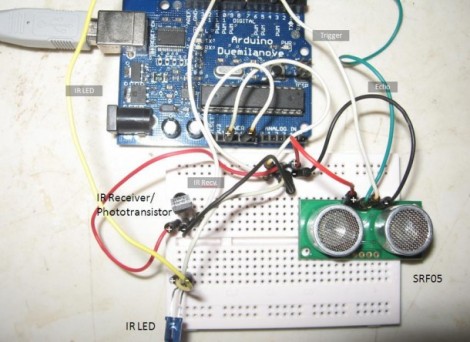
[Larry] put a different spin on a television remote control. He used an Arduino and an IR receiver to learn the codes from the factory remote. Now that he can use an IR LED to playback these signals he worked on an alternative to pressing buttons as the input. The ultrasonic range finder seen above allows him to wave his hand in front of the device to change channels and alter the volume levels. Check it out after the break.

There are many other ways that gestures could be used with this system, including a laser based input method. We’d like to see [Larry’s] system incorporated into a coffee table of some kind, as long as there was an opening for the range finder to work.

Continue reading “Distance Measurement Input Device”

Child-sized Cocktail Cabinets

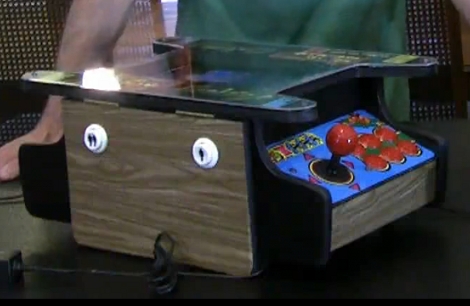
[Sam Seide] dropped us a line about his new arcade creation. We loved his Punch-Out build that used a punch dummy as a game controller. This time around he’s made some mini-cocktail style MAME cabinets. He removed the screen from a netbook and placed it face-up underneath the acrylic bezel. There are controls on either side for two players as we would expect from any quality cocktail cabinet. The control panels are interfaced through the now familiar iPac boards and are a bit unfinished on the underside but that doesn’t decrease our need to see one of these on the coffee table at home. Check out demo and an outline of the parts inside after the break.

Continue reading “Child-sized Cocktail Cabinets”

Adding SCART To A Cheap CRT Television

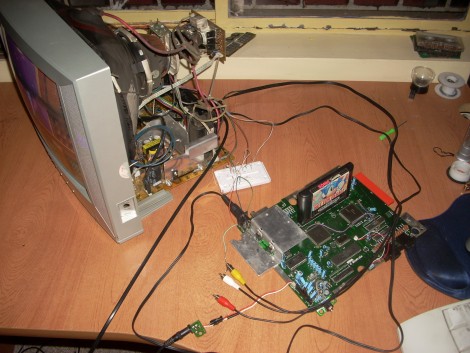
[133MHz] cracked open a cheap tube television to add a SCART connector. He knew he had a chance at success when he discovered all of the knock-outs on the back of the connector panel because one of them was exactly the right size for the connector. But it wasn’t quite as easy as soldering in one component. He ended up injecting his own RGB data from the SCART connector directly into the onscreen display, making an end run around the missing feature. [133MHz] removed some resistors in the circuit and used the empty lead holes to patch in his own circuit, feeding the RGB data from the SCART connector to the OSD chip in the format it needed.

This one takes you way down the rabbit hole. We’re glad he provided so much background about the hack but it’s going to take us a little while to fully wrap our heads around how he figured it out.

[Thanks Victor]

32-bit ARM7 Gaming rig

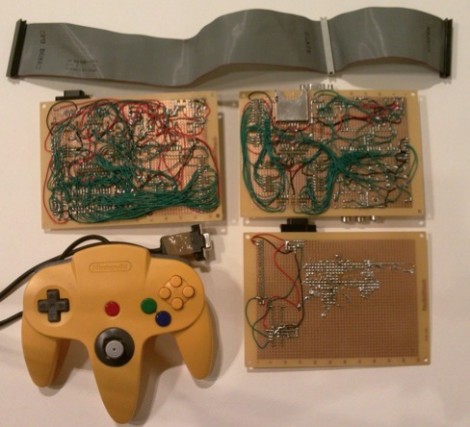
Are you hardcore enough to build your own 32-bit ARM powered gaming console AND use point-to-point soldering to accomplish this? [Craig Bishop] did just that when building his GameSphere console project. First thing’s first, click through the jump and watch the game play video. He wrote that game in the C language in less than a day which in itself is quite remarkable. On the hardware side of things he’s got an interesting mix; an Ateml AT91R40008 chip drives this system with PIC 18F4682 for VGA signal generation and a PIC 18F2685 to interface with the N64 controller. We like what he’s done so far and would love to see this end up in its own game cabinet. Continue reading “32-bit ARM7 Gaming rig”

Electromechanical Game: Running With The Bulls

[vime0 =http://vimeo.com/11700747]

We’ve been watching the progress of this build for a while on Flickr. It looks like they’ve finally completed the electromechanical game, Running with the bulls. Based off of the event by the same name, you have to keep your guy from being trampled by the bulls as the charge.  The entire bull structure is pulled forward on a timing chain with a stepper motor with each bulls individual side to side movement being servo driven. It actually looks kind of fun.