Shiftbrite Coffee Table

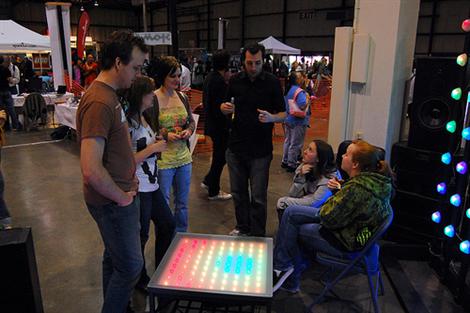
Here’s a project we’ve been wanting to do for a while. Over at macetech.com they’ve posted an LED coffee table that uses a 9×9 RGB LED grid. For the LEDs, they used the shiftbrite modules we’ve seen before. The table is capable of displaying pre written patterns as well as accepting patterns from a computer via bluetooth. They’ve set it up to connect to a twitter feed and display to a live cam on their site. Though we would love to reproduce this, we need a little more justification than “ooooh, shiny”  for the funds involved. Anyone want to donate 100 shiftbrights?

Controllable LEDs Spice Up The Living Room

[youtube=http://www.youtube.com/watch?v=YyjDcAzNJQ0]

[Sprite_tm] brings us another great hack by lighting up the living room. Unsatisfied with just replacing incandescent bulbs with an LED alternative he went with strips of LEDs to illuminate the length of a wall. Starting with a seven-meter strip of the lights, he cut it down to fourteen pieces in order to make the RGB devices individually controllable. [Sprite_tm] whipped up a design for controller boards using RS-485 to communicate with each, and sourcing an ATtiny2313 for the PWM necessary to generate any color. As you can see in the video above, the finished project is brilliant. Oh, and the Lounge Music as a background is nice too.

Rube Goldberg FTW

This video was on its way to a links post until we saw the game of chess right in the middle of it (bishop to H5). [Tom] and [Ben] put their Master of Manufacturing Engineering degrees to use by jam-packing every conveyance method possible into a Rube Goldberg machine. There’s violin bows, a polo mallet, a rolling candle, a ball-popping umbrella, texting cell phones, toppling jewel cases, and plenty of ball-on-tracks implementations. All of that setup and all that the device does is… well, you’ll have to see for yourself.

[Thanks Phil via DVICE]

CueCat, Meet Arduino

[youtube=http://www.youtube.com/watch?v=eUO3vn-ivqo]

Have you ever felt like you needed a portable barcode scanner around the house? No? Well, [Mkanoap] did, so he made one. He has hooked his CueCat up to his Arduino to capture barcode data and store it on an SD card. He is using it as an inventory tool for his personal library. Where before he had to carry a laptop around to do his scanning, or lug the books to his desk, he now just scans wherever he pleases.

You may notice some silly sounds dubbed over the video. Take note, these are the actual sounds it plays. The camera didn’t pick them up well enough, so he dubbed them in. You wouldn’t want to miss out on the entire experience would you?

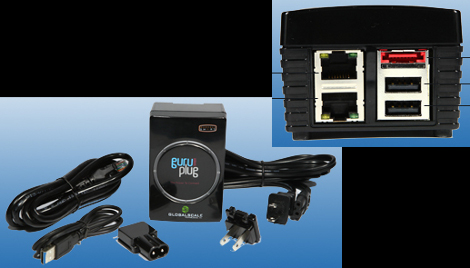
GuruPlug, The Next Generation Of SheevaPlug

Meet GuruPlug, an all-in-one server that is now available for pre-order. This is the next generation of the popular SheevaPlug that features some added goodies. The base model sells for the same $99 and appears to have the same specs as the original but for $30 more, the GuruPlug Server PLUS moves to 2 Gigabit Ethernet ports, one eSATA connector, and built-in WiFi and Bluetooth. All of this for $129 and it only pulls 5 watts? Wow.

Update: Thanks to [Foerdi] and to [Phil Burgess] for the pointing out that the hardware diagram on the features page shows WiFi and Bluetooth for both models.

[Thanks Chris]

Ez430 Home Automation

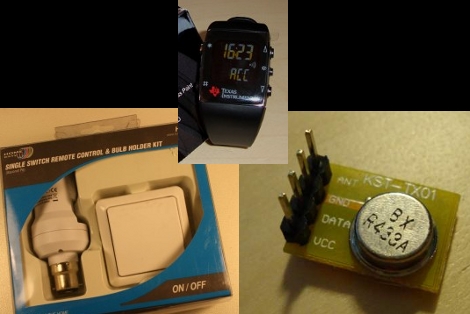
[Oliver] has been doing some work to use his TI ez430 Chronos wristwatch for some home automation. He’s working with a RF controllable lightbulb adapter which operates in the 433 MHz band. A dirt-cheap breadboard-friendly transmitter is available from Seeed Studios and he uses this in conjunction with a computer and an Arduino. Before the trolls get to their thing, YES, this is incredible overkill. But remember that he’s prototyping. We hope that if he intends to actually use this setup he’ll migrate to something like an ATtiny2313 running V-USB. Better yet, you should be able to tap into the watch’s companion receiver and cut the computer out completely.

If you’re easily amused you’ll appreciate the video of a light turning on and off after the break. If you’re a little harder to please then take a look at Oliver’s methods of using Python processing for the watch’s data.

Ok, now we’ve seen this watch turning on lights and unlocking doors. What else ‘ya got?

Pipe Heating With An ATMega8

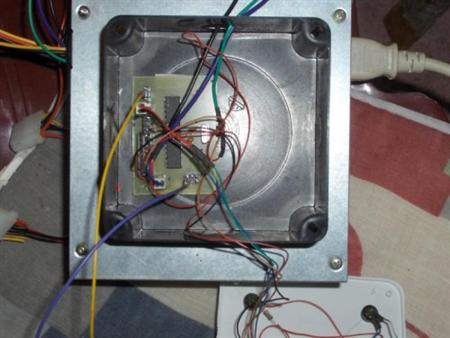
[Viktor] wanted a system to keep his pipes from freezing.  The common method of using heat tape works pretty well, but can be wasteful. Many people just turn it on for the entire winter. [Viktor] wanted to automate the heat tape’s power so that it only activated during times that the pipes could actually freeze. To do this, he rigged an ATMega8 to a temp probe and is using it to control an ATX power supply. Pretty slick [Viktor].

[via HackedGadgets]