VU Meter Record Player Lights It Up

vu_intro-image

[Michaël Duerinckx] was given a turntable for his last birthday from his fiancée — since then he’s started collecting records like nobodies business. But about a month ago he started itching to do an electronics project — he decided to upgrade his record player to include a VU Meter!

As he began designing he soon realized he didn’t have all the tools he needed to do this project right — a perfect excuse to go check out his local makerspace, SoMakeIt!

He started prototyping the VU Meter on a breadboard, and opened up the record player – it was like this thing was made to be hacked. Two free connections off the power supply to power his circuit, bingo! Continue reading “VU Meter Record Player Lights It Up”

Press Button Get Party Mode

partymode2_2 If you’re looking to do something awesome with a graphing calculator, [Chris] is the guy to go to. He’s literally written the book on the subject. His PartyMode project, however, has absolutely nothing to do with calculators. It’s a fantastic display of lights, colors, and sounds that has been rebuilt again and again over the years, and something [Chris] has finally gotten around to documenting.

The idea for [Chris]’ PartyMode is a single button that will transform a room from a boring computer lab or dorm room into a disco with 22.4 channel sound, and computer displays used as panels of color. The first version began in the lab in his school’s EE department that included ten CRT monitors. There were a few VUFans featured on the good ‘ol Hackaday, but a few problems with regulations and politics brought this version of PartyMode to a premature end.

The second version is a miniaturized, ‘press a button, get a party’ setup with a crazy number of RGB LEDs, a few more of those computer fan VU meters, and a Bluetooth app to control everything. Unlike the first version, the PartyMode 2.0 is fully independent from a computer, instead relying on an ATMega to do the audio processing and handling the Bluetooth interface. Judging from the videos below, it’s quite the site, and if you need an instant party, you could do much worse.

Continue reading “Press Button Get Party Mode”

Here Come The RGB LED Clones

ws2812 and clones timing

It seems like every third project on Hackaday uses WS2812 RGB LEDs in some way. We all love our blinkenlights, and bright, cheap, serial controlled RGB LEDs are the bees knees.

As with all products these days, competing manufacturers have discovered the huge market for these things, and clones are now available. [Tim] recently took a look at the PD9823, as well as three versions of the WS2812. [Tim] is considered something of a WS2812 guru here at Hackaday. You might remember him from his WS2812 driver optimization article, which should be required reading for any WS2812 hacker.

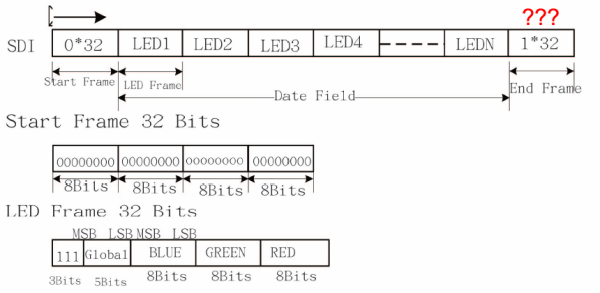
As many of us know, the timing characteristics for these LEDs can be a pain to work with. The values also differ between the WS2812S and WS2812B. [Tim] discovered that the new through hole WS2812D parts are different yet again, though rather close to the B parts. The PD9823’s designers must have studied the WS2812’s closely, as their 190ns time base falls directly between WS2812S 166ns time and the 208ns time of the WS2812B. The PD9823 also requires a slightly longer reset pulse.

The takeaway is that well written drivers such as [Tim’s] should have no problem with the new parts, but compatibility is something to keep in mind as more clones hit the market.

The 200 LED Ring Clock

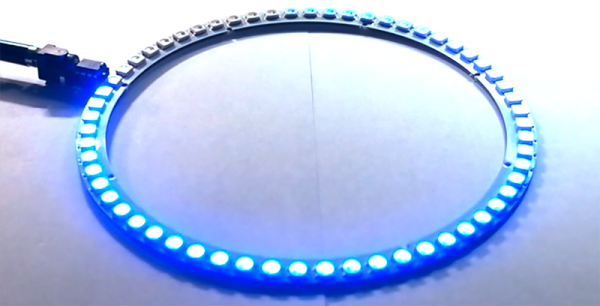
There are LED clocks, and then there are LED clocks that can blind you from 30 paces. [Stiggalicious’s] LED ring clock is of the latter variety. 200 WS2812B/Neopixel RGB LEDs drive the ring clock to pupil searing levels. The clock runs on ATMega1284P, with timekeeping handled by an NXP PCF8563 real-time clock chip. Code is written in Arduino’s wiring language using Adafruit’s Neopixel library.

Building the clock with a single Printed Circuit Board (PCB) would be both expensive and wasteful. [Stiggalicious] cleverly designed his clock to be built with 8 copies of the same PCB. Each board makes up a 45° pie slice of the ring. All 8 PCBs have footprints for the CPU, clock chip, and other various discrete parts, but only the “master” section has these parts populated. 7 “slave” sections simply pass clock, data, power and ground through each LED. He used Seeedstudio’s board service to get 10 copies of his PCB made, just in case there were any mistakes.

[Stiggalicious] rolled the dice by buying exactly the 200 LEDs he needed. Either he got really lucky, or the WS2812 quality testing has improved, because only one LED had a dead blue LED.

If you’d like to find out more, [Stiggalicious] gives plenty of details in his Reddit thread. He doesn’t have a webpage setup for the clock but he’s uploaded his source code (pastebin link) and Altium schematic/PCB files (mega.nz link). We may be a bit biased, but hackaday.io would be a perfect spot for this or any other project!

5000 Lumen LED Projector? Naw, How About A Whopping 1 Candela?

1 candle projector

One of our readers recently found a ASK Proxima C170 (also sold as the InFocus LP600) in the waste bin, thrown away because it stopped working — He snatched it up and decided to try tinkering with it. A visual inspection quickly found the problem, a 100uF cap had blown!

He replaced the capacitor and got the projector to turn on again without much difficulty. Not wanting to pay a few hundred dollars for a bulb he’s ordered a 5000lm 50W LED array from China to give it new life as an LED projector, because as it turns out it’s a fairly simple hack to trick the projector into thinking it has an official lamp in it. It’s just a matter of shorting a few leads on some of the photo-couplers!

In fact, once this hack is done, you can use any kind of light source you want! So just for kicks he decided to try using a tea light candle. It actually managed to project an image on the wall thanks to the optics of the projector! Functional? Not really, but it’s a cool way to prove a successful hack towards an even cooler end project though!

For other fun projector hacks, check out this roundup we did a few years ago.

[Thanks thefamoushat!]

Network Controlled Decorative LED Matrix Frame

LED-Pixel-FrameThere is nothing better than a project that you can put on display for all to see. [Tristan’s] most recent project, a Decorative LED Matrix Frame, containing 12×10 big square pixels that can display any color, is really cool.

Having been built around a cheap IKEA photo frame this project is very doable, at least for those of you with a 3D printer. The 3D printer is needed to create the pixel grid, which ends up looking very clean in the final frame. From an electronics perspective, the main components are a set of Adafruit Neopixel LED strips, and an Arduino Uno with an Ethernet shield. The main controller even contains a battery backup for the real time clock (RTC) when the frame is unplugged; a nice touch. Given that the frame is connected to the local network, [Tristan] designed the frame to be controlled by a simple HTML5 interface (code available on GitHub). This allows any locally connected device to control the frame.

Be sure to check out the build details, they are very well done. If you are still not convinced how cool this project is, be sure to check out a video of it in action after the break! It makes us wish that you could play Tetris on this frame. Very nice job [Tristan]!

Continue reading “Network Controlled Decorative LED Matrix Frame”

Seeker Hats Find Each Other With Directional LEDs

OLYMPUS DIGITAL CAMERA

[John Petersen] created a very cool piece of wearable technology for him and his son. Eager to explore the Maker Fair, but not eager to lose his son in the crowds, he’s come up with the Seeker Hat — a kind of auto-locating GPS hat which always points towards the other.

It’s a clever setup that makes use of a GPS module, a microprocessor, a xBee wireless chip, a compass, and LEDs to light the way. The GPS determines the hat’s approximate location, the xBee transmits it to the other hat, the digital compasses determine the directions of both hats, and the microprocessor figures out the azimuth, resulting in a difference in trajectory of the two — a strip of LEDs, like landing lights, direct you in the right direction.

Continue reading “Seeker Hats Find Each Other With Directional LEDs”