New Sparkfun Designs


Sparkfun has recently released a bevy of new boards and other devices, with some very intriguing new builds among them.

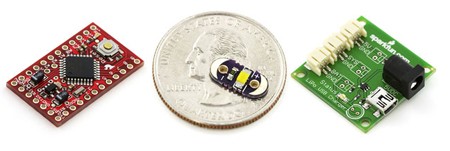
The first board that caught our attention is the Wee. It is a compact Arduino compatible controller that features a small size, low voltage, and many other minimalist attributes. It is built around an ATMega 168V and uses all SMD parts.

For even tinier fun, check out the LilyPad LED. It is a LED designed to be incorporated into clothing, featuring large holes for threading, a thin and extremely small PCB and a very bright 250mcd light. It is also washable, meaning that one or many can permanently be incorporated into clothing without fear of losing them. You can see these in the turn signal jacket we covered earlier.

The last one we’ll discuss is the LiPoly Charger, a USB lithium ion battery charger. Based on the Max 1555 IC, the LiPoly can use USB bus power or a 2.1mm center positive wallwart power(it uses the more high-powered wall-wart if both are connected). It can’t charge NiMH batteries, but it is still compact, efficient, and very useful.

Aurora Open Source Hardware Mixer


We’ve seen some fairly impressive mixer projects this year, and the Aurora mixer is no exception. It is a dual channel USB-powered mixer with two linear faders, one crossfader, eight backlit buttons and 24 potentiometers, all built around a PIC 18LF4525 microcontroller. That’s all pretty typical for a mixer, but this one is very visually attractive, featuring a clean and stylish form factor and controllable lighting both under the board and in the LEDs backlighting the buttons and knobs.

Whether you want to buy one now or build one yourself, the Aurora team has made both possible. You can contact them for pricing if you are ready to buy. If you prefer to build, this is an open source project with full assembly instructions, schematics, drivers, patches and all other source code and information you should need available here. See more photos of the Aurora mixer here, or see it in action after the break.

Continue reading “Aurora Open Source Hardware Mixer”

Laser Tattoo


We’re amazed we didn’t stumble across this ill advised burnination sooner. Earlier in the week [tetranitrate], of LED chess set fame, posted his experiences using a laser cutter to scarify his own skin. It’s very painful, not to mention the discomfort of smelling your own burning flesh. He’s using an Epilog with a magnet over the safety switch. To get the positioning right, a layer of painters tape was put down and then etched. For a less painful version, you could try Bre’s fingernail calendar from last Fall. Video of multiple tattoos embedded after the break.

Continue reading “Laser Tattoo”

LED Battery Level Indicator

[Kc7fys] came up with a this simple battery level indicator. It uses a single LED to display a battery’s voltage; if the voltage exceeds 12V, it glows green. If it is below 11V, the LED glows red. Anything in between generates an orange glow. The meter is built around an LM358 chip per this schematic, but his actual build looks pretty sloppy because of the dead-bug assembly (check out NASA’s pretty version). Nonetheless, it works, so clean it up and build one if you want to put it (or your batteries) to the test.

LED Painter


The people at Brilldea have come up with LED Painter, a 16-channel RGB LED controller capable of controlling up to 48 independent LEDs. It uses a Texas Instrument TLC5940 to control the LEDs and can be connected to more LED Painter boards, creating a large array of RGB lights. The TLC5940 itself has been modified to make connecting independent LEDs easier.

The team strung together nine of these along with a Propeller-based controller called a Prop Blade and fitted the lights into three windows with semi-opaque glass to create a display of dancing randomized RGB lights. If all the dancing lights have inspired you, the TLC5940s are fairly inexpensive, but you’ll need both through-hole devices and some SMT components to get if off the ground.

Continue reading “LED Painter”

Tom’s RGB Mood Lamp


[Tom] has been refining a board that drives a high power RGB LED for applications like this moodlight. It’s based around an ATmega8 microcontroller. The goal was to make an RGB LED easy to work with: It can cycle between colors in standalone mode. You can control it via a serial interface. It also has a pin header to hooking up three potentiometers for manual color mixing. Boards aren’t available yet, but he’s already posted a build tutorial. The board looks straightforward enough that it shouldn’t be too hard to layout if you really want to.

Turn Signal Jacket How-to


[Leah Buechley], whose work we’ve been covering since way back when, has built this lovely turn signal jacket. The project photos were posted in March, but she’s just added a well illustrated project guide. The jacket is based around a LilyPad Arduino, a lightweight Arduino board with radial pads designed to be used in wearable projects. You make your connections by sewing conductive thread through the pads. The how-to covers attaching the LilyPad parts properly and then insulating the wires with fabric paint after you’ve verified they work.

The guide has an interesting discussion about placing the power supply. The 4-ply silver coated thread used has a resistance of approximately 14ohms/foot. So, if you place the power supply one foot from the LilyPad, the two wires combine for 28ohms, causing a 1.4V drop. The power supply is only 5V, which means the LilyPad will be 3.6V. A voltage of 3.3V will cause the Arduino to reset. If your resistance is too high, you’ll have to add more thread.

The power supply on this jacket is under the collar. Each cuff has a single button plus an LED. The button will make the jacket flash the direction for 15 seconds (also indicated on the sleeve LED). If you press both buttons at the same time, it switches to night mode by flashing both directions at the same time to make you more visible.