Acoustic Wayfinder For The Visually Impaired

Ideally, technology is supposed to enhance our lives. [Shane and Eileen], two seniors at Cornell have found a great way to enhance the lives of visually impaired individuals with their acoustic wayfinding device. In brainstorming for their final project, [Shane and Eileen] were inspired by this Hackaday post about robots as viable replacements for guide dogs. They sought to provide wearable, hands-free guidance and detection of (primarily) indoor obstacles—namely chairs, benches, and other inanimate objects below eye level.

The wayfinder comprises two systems working in tandem: a head-mounted navigation unit and a tactile sensor worn on the user’s finger. Both systems use Maxbotix LV-MaxSonar-EZ0 ultrasonic rangefinder modules to detect obstacles and vibrating mini-disc motors to provide haptic feedback at speeds proportionate to the user’s distance from an obstacle.

The head unit uses two rangefinders and two vibrating motors. Together, the rangefinders have a field of view of about 120 degrees and are capable of detecting obstacles up to 6.45 meters away. The tactile sensor comprises one rangefinder and motor and is used in a manner similar to a Hoover cane. The user sweeps their hand to detect objects that would likely be out of the range of the head unit. Both parts are ergonomic and  size-adjustable.

At power up, [Shane and Eileen]’s software performs a calibration of the tactile sensor to determine the distance threshold in conjunction with the user’s height. They’ve used an ATMega 1284 to drive the system, and handled real-time task scheduling between the two subsystems with the TinyRealTime kernel. A full demonstration video is embedded after the break.

Continue reading “Acoustic Wayfinder For The Visually Impaired”

POV Display With An Element Of Danger

FZKU6SCHPFZR2KV.LARGE

Persistence of vision displays are always cool, although we must admit this one looks like it could very well explode at high speeds…

Safety concerns aside, this desk fan based display provides a great starting point for learning about making POV displays. It makes use of an old cellphone battery, an ATmega8, some LEDs, Veroboard, assorted wires and solder and of course, a high-speed desk fan.

[shparvez001] also provides the full code on his blog for the project, making it very easy to replicate. Though we might also suggest you keep it small enough that the original fan cage still fits on top.

From an aesthetic point of view, the display looks fine in the dark — but when the lights are on you might get some odd looks. We can see this project being greatly improved by mounting the LEDs through one of the fan blades, and the control electronics on the back side of the other blades. Maybe throw in some wireless charging for the battery while the fan is off too?

Anyway, stick around after the break to see the display in action. If you want a more permanent fan POV try adding display hardware to a ceiling unit.

Continue reading “POV Display With An Element Of Danger”

Vibe Mirror

FLRGC76HP7M9BLI.LARGE

We love a good art-related project here at Hackaday, and [Wolfgang’s] vibrating mirror prototype is worth a look: into its distorting, reflective surface, of course.

[Wolfgang] began by laser cutting nine 1″ circles from an 8″ square mirror, then super glued a 1/4″ neoprene sheet to the back of the square, covering the holes. Each circular cutout received some custom acrylic backings, glued in place with a short piece of piano wire sticking out of the center. The resulting assemblage pushes through the neoprene backing like a giant thumbtack, thus holding all nine circular mirrors in place without restricting movement. The back end of the piano wire connects to yet another piece of acrylic, which is glued to a tiny vibrating motor.

He uses some shift registers and an Arduino Uno to control the motors, and although there’s no source code to glance it, we’re guessing [Wolfgang] simply designed the nine mirrors to buzz about in different patterns and create visually interesting compositions. Check out a quick video of the final effect after the break, and if you can help [Wolfgang] out with a name for his device, hit us up with your suggestions in the comments.

Continue reading “Vibe Mirror”

LED Matrix Mask Will Scare Up Holiday Cheer

[Davide] sent us this fun LED matrix mask he built using an ATMega8 and 74LS595N shift registers. Each of the eyes is an 8×8 LED matrix, and the mouth is made from two 8x8s. [Davide] used a ULN2803A Darlington transistor array to drive the matrices.

When the user steps behind the mask, an IR sensor detects that a face is within range and activates the facial features. The code randomly runs the eye and mouth patterns. If the user starts speaking, a microphone element detects his voice and a separate speaking mouth pattern is executed.

The mask body and stand are découpaged with pages from Dylan Dog comics. [Davide] says he built the mask years ago, but decided to submit it to the 2013 Inverart Art Fair in Milan. As you can probably imagine, the mask has been a big hit with the kids so far. Stick around to see [Davide]’s Santa-fied demonstration after the jump. [Davide] didn’t give us any details on that sweet hat, unfortunately.

If you require a better degree of protection or more LEDs, check out this LED helmet.

Continue reading “LED Matrix Mask Will Scare Up Holiday Cheer”

IR Theremin Speaks In Four Voices

infraredTheremin

At the end of every semester, we get a bunch of cool and well-documented student projects from Cornell’s ECE4760 class. [Scott] and [Alex]’s infrared theremin is no exception.

The classic theremin design employs each of the player’s hands as the grounded plate of a variable capacitor in an LC circuit. For the pitch antenna, this circuit is part of the oscillator. For the volume antenna, the hand capacitor detunes another oscillator, changing the attenuation in the amplifier.

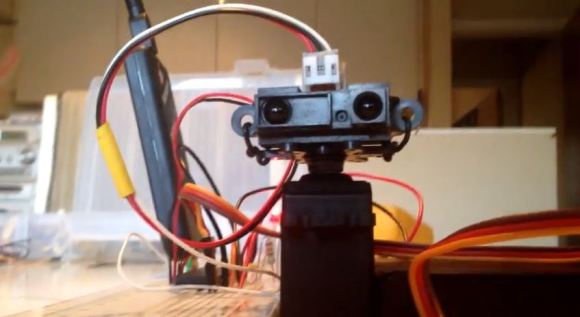
[Scott] and [Alex] put a twist on the theremin by using two IR sensors to control volume and pitch. The sensors compute the location of each hand and output a voltage inversely proportional to its distance from the hand. An ATMega1284P converts the signal to an 8-bit binary number for processing. They built four voices into it that are accessible through the push-button switch. The different voices are created with wave combinations and modulation effects. In addition to Classic Theremin, you can play in pure sine, sawtooth, and FM modulation.

If you’re just not that into microcontrollers, you could build this digital IR theremin instead. If you find IR theremins soulless or plebeian, try this theremincello.

Continue reading “IR Theremin Speaks In Four Voices”

Automated Drink Mixer Is The Life Of The Party

Hosting a New Year’s Eve party, but don’t want to be stuck behind the bar all night? You could set out a bowl or two of spiked punch, but where’s the hack? Free yourself from drink slinging duties with the Automated Drink Mixer created by Cornell University students [Justin] and [Austin]. Their design uses a 14″ diameter lazy Susan powered by a 12V bi-directional motor attached to a 2″ rubber wheel. The motor is capable of 70RPM, so the glass ultimately rides around at 10RPM. Orders are entered on a push-button menu. As this is a school project that should adhere to IEEE standards, all libations are non-alcoholic.

The software uses an overarching state machine, so the system polls for input from the menu at idle. When it receives an order, the lazy Susan rotates the glass to the right spout or series of spouts and then returns it to the starting point. [Justin] and [Austin] controlled the position of the glass with an IR emitter and phototransistor. This pair detects the black strips of tape around the edge which are spaced 60° apart. A comparator digitizes the signal and triggers an interrupt in the software, which counts the number of 60° slices. A full demonstration is waiting for you after the jump. Before you jump: drink responsibly, kids. If you aren’t up to that particular challenge, make yourself an alcohol-aware LED ice cube. If you need more LEDs in your life, whip up the Inebriator.

Continue reading “Automated Drink Mixer Is The Life Of The Party”

Hacking Digital Scales For The Disabled

analphabeticscale

[Jan] works with both physically and mentally disabled individuals, some of whom cannot read, making many of their tasks more difficult. Although [Jan] is not in a position to teach reading or writing skills, he was able to build an add-on device for the scales used in repackaging sweets to provide simple feedback that the user can interpret.

The device has three LEDs—red, green, and yellow—to indicate the package does not weigh enough (red), weighs too much (yellow), or lies within an acceptable range (green). The industrial scales at [Jan’s] workplace each have a serial output to connect to a printer, which he used to send data to the device. An ATMega8 controls the lights and an attached LCD, with the usual trimpot to change the display’s contrast and a rotary encoder to adjust the device’s settings. Everything fits snugly into a custom-made frosted acrylic enclosure, laser-cut at a local hackerspace.

[Jan] provides a rigorous guide to approaching each step on his Instructables page, along with source code and several pictures. See a video overview below, then enjoy another scale hack: building one from scratch.

Continue reading “Hacking Digital Scales For The Disabled”