Frustromantic Box, A Reverse Geocache

One of the best feelings in the world is when one of our posts inspires a fellow hacker to plan, create, and execute his or her own project.

[Russ] let us know about his Frustromantic Box which he gained inspiration from the original Reverse Geochache we posted about. For those out of the loop, the box is locked and will only open in a certain location. The current distance to the  location is displayed on the screen when a button is pressed, and usually there is a limited number of button presses (3 presses for those that know geometry, 50 for everyone else). As soon as the box is at location, it will open.

The Frustromantic Box uses an Arduino, classic HD44780 display, a servo, and the pièce de résistance EM406 GPS. All built in time to frustrate his wife for Christmas.

Live High Altitude Balloon Launch

[Terry] is planning to launch his high altitude balloon within the next few days. As we’ve seen before he has gone for a general setup – GPS tracking, environment sensors including temperature and humidity and pressure, and 2 on board cameras – all with an expected height of about 100,000 feet. What makes this project unique is the transmission of live telemetry data to a Google Maps or Google Earth interface.

The planned launch date is Sunday the 24th about 00:00 UTC so long as the Civil Aviation Safety Approval for the launch is passed.

As a final note [Terry] wanted to let inspiring balloon launchers to check out the UK High Altitude Society – who have been an invaluable source of information.

Servo Hacked Linear Actuator

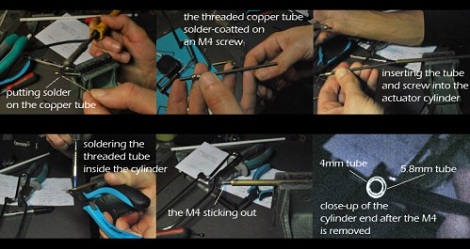
[AntonB] has modified a servo into a powerful linear actuator (think: changing rotational motion into linear motion). The process is simple enough, modify a servo for continuous rotation and then add the custom built actuating shaft. You do of course lose the precision of the servo, but a small price to pay to be able to lift ~20 pounds straight up. Inspiration for such a cheap solution came from his Planetary Surface Exploration Rover. Check out a video of both after the break.

[Thanks Eric]

Continue reading “Servo Hacked Linear Actuator”

Engineering With Magnetic Spheres

We would imagine these experiments were spawned by a devastatingly boring day at the office. [Sparr] found himself the proud owner of one thousand rare-earth magnets and decided to see what geometric shapes he could build with the spheres. These are gold-plated N35 Neodymium magnets that measure just 6mm across. He discovered that every structure is built from rings of magnets with shapes dependent upon what sequence of increasing or decreasing members are used. What he’s done is visually pleasing but we’d like to try it ourselves to see how resilient each structure ends up being.

[Sparr’s] post is from the Freeside Atlanta blog, a hacker space collective. [Curbob], a regular with the group, tipped us off that a few hacker conventions are coming up in their area and they’re looking for speakers for one-hour talks about projects. If you’re near Raleigh or Atlanta this is your chance to show off that ridiculously complicated project you’ve been risking your marriage to complete.

ProtoDeck – MIDIBOX Based Controller

[Julien] let us know about his ProtoDeck. A MIDIBOX based controller for Ableton Live using a Big Max for live patch interface.

One thing that we have seen is less and less hacks for are MIDIbox projects. It is no wonder, considering now a days we have touch screen and multiple other interfaces and sound creation tools – MIDI almost seems like a dying art.

The ProtoDeck uses 87 pots, 90 buttons, and 81 RGB LEDs all controlled by 2 PIC 18F4620s. [Julien] says his main goals where to have lots of color and buttons. We think he succeeded.

Vacuum Tube Tesla Coil

[xellers] may have been in 8th grade when he built this vacuum tube tesla coil, but he did a fantastic job. Unlike most of the tesla coils we have shown, this one doesn’t use a high current transformer from a neon sign. Instead, he’s gone the direction of vacuum tubes. He spent a total of about $125 which isn’t too bad. Most of us could reduce that cost by scrounging from our parts bin.

Neon Lamp And Other Crazy Clocks

Quick quiz, what came before transistors? Why vacuum tubes of course. If this clock doesn’t make you thankful for the luxury of integrated circuits, nothing will.

We had never heard of using Neon Lamps as logic circuits, and they definitely produce a much cooler effect when counting.
[Thanks Philippe]

And finally, we’re just suckers for a good Nixie Clock. The scope clock is also pretty interesting.