Workshop Tour Makes Us Drool; Ache With Envy

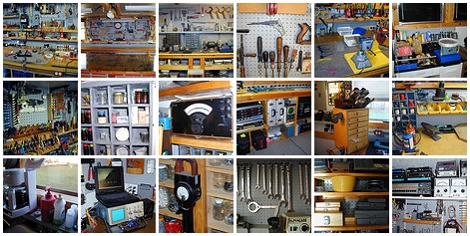
[Mtneer_man] has a workshop to die for. The slide show that he set up covers the different workbenches and shop setups that he’s had over the years. He’s got a core set of beliefs when it comes to his work area. He prefers to have several different work areas for varying degrees of dirty, greasy, stick, or precision projects. These are luxuries that most don’t have the opportunity to enjoy.

With a setup this nice and this clean it’s amazing he does any projects at all. Wait a sec,his workshop IS a hack. The more recent collections of his prolific Flickr sets he details the building and outfitting of yet another workshop in a new structure on his property.  We’re going to keep our eyes on this and see where it ends up.

[via YourlTronics]

FAT Support For Any Microcontroller

[Rahul Sapre] sent us a guide to porting EFSL to any microcontroller (PDF). The Embedded Filesystems Library adds FAT support to C compiled microcontrollers. It is targeted at the AVR line of chips but can be adapted to any architecture that works with a C compiler. [Rahul’s] guide will take you through the process of adapting the latest stable 0.2.8 version to new hardware by using a PIC uC as the working example. The non-stable development branch of EFSL is working toward multiple-platform support so consider lending a hand if this interests you.

Altoids Upstaged By Gift Card Tins

Nothing Earth-shattering here. Just, dare we say it, really cute!

The venerable Altoids mint tin has become an icon of the maker culture. Browsing through past articles on Hack a Day, Adafruit or Instructables, you’ll find project after project for which these pocket-sized enclosures provided just the right fit. Eminently practical, affordable, but the aesthetics have occasionally left something to be desired.

We recently stumbled upon these nifty gift card holders that resemble miniature versions of current-generation game consoles. They might be the perfect housing for your next microcontroller project…

Continue reading “Altoids Upstaged By Gift Card Tins”

Pre-spun Hard Drives

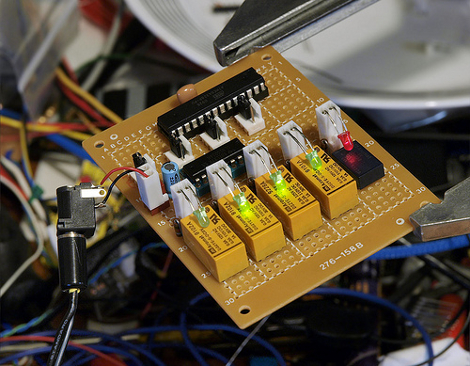
This device is lovingly called the SPINmaster. [Linux-works] built it to spin up multiple hard drives before the motherboard starts up. It detects the power-up from the PSU and uses a relay to hold the motherboard in reset, indicated by the red LED. Each of four relays then spins up a hard drive and illuminates the green LED when ready. Once all green lights come on the reset relay shuts off and the bios starts up. This type of staggered startup takes a lot of the load off of an under-powered PSU. He’s posted firmware and there’s a schematic available too. We took a look at his video but there’s not much to see as it’s just the inside of the machine while it boots up.

The Mechanical Diode

A diode allows current to travel in only one direction. With that in mind, [Alex] built a mechanical diode that will only allow gear rotation in one direction to be transmitted through the system. But wait, by connecting two of these devices together he’s built something of a mechanical rectifier. An electrical rectifier converts alternating current to direct current and this mechanical version outputs clockwise rotation no matter what direction of rotation is coming into the device.

There’s video which we’ve embedded after the break as well as many pictures on his site but not much explanation. Here’s what we’ve deduced. The two large gears are inputs. Mounted on top of them is a smaller ratcheting gear that will only turn in one direction. This ratcheting gear selects whether the smallest gear on the left or right will rotate, which then feeds the output gear at the top of this image. Continue reading “The Mechanical Diode”

PHP Runtime Rewritten, By Facebook?

Yes, its true. Facebook has completely rewritten the PHP runtime to make it faster and more efficient, and its completely open source. Named HipHop, its described as a source code transformer, changing PHP into optimized C++ which is then compiled using g++. Thus keeping the best aspects of PHP while taking advantage of the performance of C++. Using HipHop, the Facebook web server CPU usage has been decreased by about fifty percent! And who would have thought that this and many other cool advances in programming, started at a Hackathon.

Beginner Concepts: 555 Push Button Toggle

PIC, AVR, and Arduino are ubiquitous in projects these days and a lot of the time it’s easy to over-complicate things with their use. In this case, [Tod] wanted to use a momentary tactile switch to turn something on and off. Instead of going with a microcontroller he built the circuit around a 555 timer. What he really needed in this case is a flip-flop but lacking a chip for that he went with the 555 because it has one built-in. Three resistors and a capacitor later he’s in business, adding another resistor and a transistor to deal with the load switching. We’ve embedded video of the circuit controlling an LED after the break. This IC ends up in a lot of projects so dig through your parts bin and give this circuit a try.

Continue reading “Beginner Concepts: 555 Push Button Toggle”