Chiptune Instrument From NES

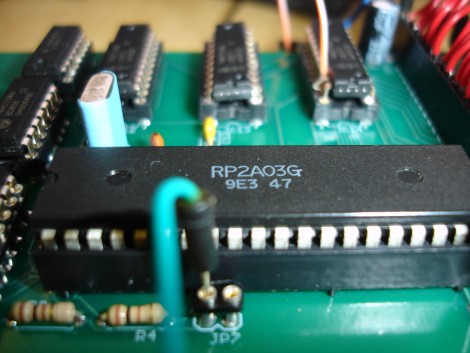
[Jarek Lupinski] wanted an instrument that would let him play chiptunes live, without a need for pre-programming a cartridge for playback during a concert. His preferred hardware is an original Nintendo Entertainment System because of its familiar nostalgic sound. After picking up a lot of 5 broken NES units he set out to build a midi-compliant device.

The five NES units he bought had nothing wrong with them other than the 70-pin cartridge connector. He fixed them all, then de-populated the board on one and tried to build out a circuit on a breadboard. After much trial and error, forum searching, and conversations with others who were familiar with the hardware he got the circuit working. He’s posted a schematic and had a board fabricated which takes the transplanted chips and transforms them into an instrument. Check out the test notes being played by an Arduino Mega after the break.
Continue reading “Chiptune Instrument From NES”

Disco Drumming With Piezo Sensitive Lighting

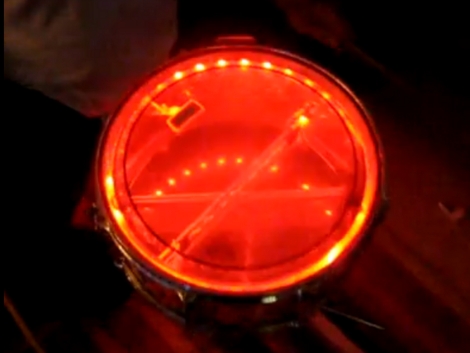
[Wilfred’s] brother outfitted a snare drum with LEDs for Dutch Carnival. They faded through different colors randomly and were a nice addition to the normal looking instrument, but [Wilfred] suggested that the LEDs change color with each drum stroke. He set out to design a controller circuit to provide the functionality and ended with a small package based around an ATtiny2313 microcontroller. A piezo buzzer is used to detect the vibrations inside the drum, each hit triggering a different color combination. The LEDs fade to off after each impact as if dying along with the sound, and when not struck for 30 seconds the system defaults to a red heartbeat pattern. See for yourself after the break.

We’d love to see this feature added to each drum in one of those robotic drumsets. Continue reading “Disco Drumming With Piezo Sensitive Lighting”

Single String Servo Electric Guitar

its a catchy tune!

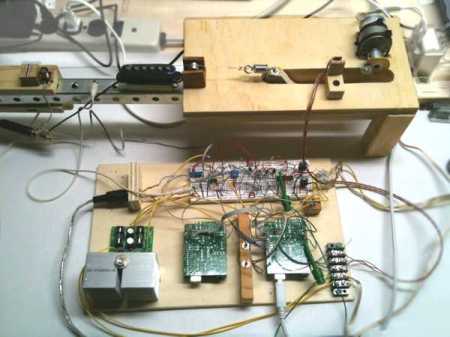
Ah, we love musical hacks that actually play music.  [Mike Baxter] is back again with a new servo electric guitar. This one, called the physical string synthesizer, and has only one string.  He’s using two Arduinos to control the unit. One to change the midi file to a note within the string’s limits and the second to actually control the servo. It seems like that could be simplified a little bit, but we’re pretty sure his end goal was to build an instrument quickly, not learn to be a circuit ninja. Last time we saw Mike Baxter, he had built a servo electric guitar that used a keypad for control. You can see a video of the single string one after the break.

Continue reading “Single String Servo Electric Guitar”

Analog Stylophone

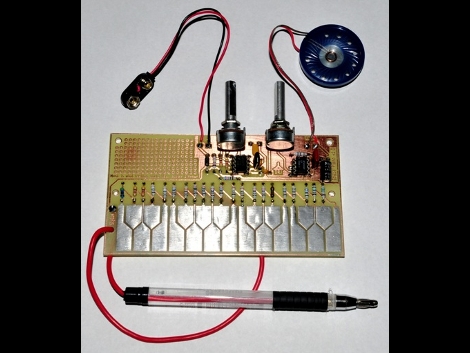
[Doug Jackson] just finished building an analog Stylophone. We’ve seen this instrument a few times before, most recently with an Arduino-based controller, but this one makes use of 555-timer, resistors, and potentiometers to generate the waveform for each note. If you’ve got the copper-clad and the means to etch the board everything else should be pretty easy to come by. We did note that since this is a single-sided board you’ll be soldering on the same side as the components, which can get a bit hairy but manageable. We just wish that [Doug] has posted a demonstration video so we could hear what this sounds like. But it can’t be too much different from that electronic vuvuzela that used a 555 timer as well.

Darbuka Band

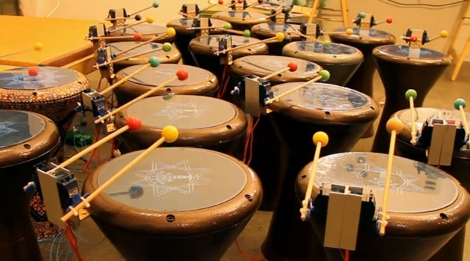
This robotic band has just the right amount of drums. [Liat] and her colleagues fit a group of Darbuka drums with a pair of servo-driven mallets. We’re quite surprised that the servo motors achieve such a successful strike and rebound without dampening the vibrations of the drum head. This is more often accomplished with solenoids because of their quick response and relative strength.

You can listen to a performance of this work-in-progress in the video after the break or make plans to see it live. The installment was built for the Bat-Yam international biennale of landscape urbanism. It will be attached to, and powered by alternative energy producers like solar cells and wind turbines. Continue reading “Darbuka Band”

76 Flaming Trombones Led The Big Parade

[Jonathan Crawford] is ready and willing to fire things up with his flaming trombone. A couple of years back his band teacher was going through the storage room triaging instruments. This trombone suffered from a bad case of red rot and would never function well again so [Jonathan] was able to get his hands on it and get to work.

He started by sanding down the instrument and painting it with high-temperature spray paint. Flexible copper tubing intended for an ice maker was used to relocate the propane outlet inside the bell of the instrument. A barbecue igniter, controlled with the player’s left thumb, lights the flame.

The torch that [Jonathan] is using would only allow a small amount of gaseous propane to come out the nozzle. He ended up drilling out the aperture, and using a short piece of vinyl tubing to bridge the gap between the nozzle and the supplementary copper tubing. At full blast this allows liquid propane to escape so be warned.

You can see him demonstrating this indoors in the video after the break. He mentioned to us that the first time he tried this out he set off the smoke detector. You’ve got to be careful when playing with fire, whether it’s a musical instrument, or a wearable flamethrower. So, you know, don’t try this at home. Continue reading “76 Flaming Trombones Led The Big Parade”

Self Playing Bayan Built Nearly 22 Years Ago

The year is 1988, where a Russian engineer [Vladimir Demin] has combined a Bayan, or button accordion, with several (we lost count at about 96) solenoids. If that alone doesn’t blow your mind the computer, also hand built by [Vladimir], controls the whole process leaving the operator to only work the bellows. Putting truth to the fact in Soviet Russia, accordion plays you. We wish we could find some more information about the instrument, but curse our inability to read Russian. Alas check after the break for a shorter version of the video in the link above.

Related: Electronic accordion doesn’t compare.

Continue reading “Self Playing Bayan Built Nearly 22 Years Ago”