Guitar Tube-amp From Junk Hi-fi

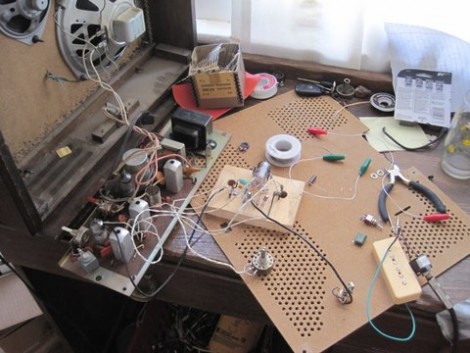
[Tristan Chambers] picked up an old speaker box some friends acquired at a yard sale. It didn’t have any inputs, and there weren’t any tuning knobs like a radio would have, so it’s a mystery what this was originally used for. [Tristan] traced out the circuit and figured out where he could input audio signals which allowed him to hook up an iPod, but it was mono and not very loud. He ended building his own vacuum tube preamp from a schematic he found on the Internet so that he could use it with an electric guitar. As the video after the break shows, the box not only puts out some pretty good sound but it’s nice and loud too.
Continue reading “Guitar Tube-amp From Junk Hi-fi” →

Audio Crossover Back In Service


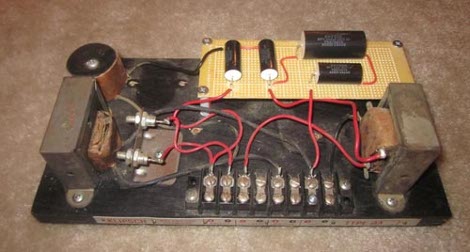
Audio Crossovers are an essential tool for any high end speaker system. Because most individual loudspeakers are unable to cover the entire spectrum of audible sound as well as multiple drivers are, it is necessary to split the input signal into low and high frequency parts. When a friend of [Anthony]’s was about to send off a classic Klipsch AA Crossover to be repaired professionally, [Anthony] insisted it was possible to save some money and do it himself.

The oil can capacitors of the Crossover had gone bad, so a new set of metalized polypropylene capacitors were ordered to pick up the task. After carefully removing the old caps, [Anthony] assembled the new set on a breadboard, and mounted the board to the old Crossover base (along with some tasteful McDonalds straw spacers). The entire process is detailed on his blog, and we are sure his friend saved a good deal by this home repair method. Capacitor issues are a common problem in repairing electronics new and old alike, and always a great place to start looking when devices start acting funny.

Quit Your Job And Build A Pipe Organ

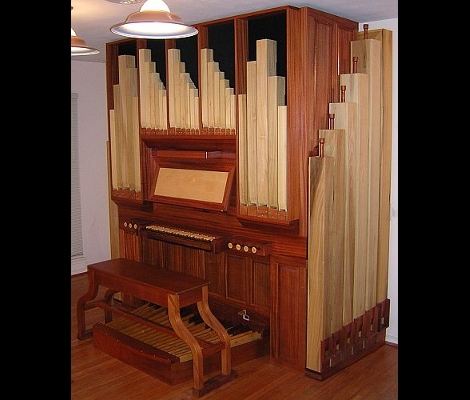
[Raphi Giandiulio] grew tired of designing expensive things for Texas Instruments, so he quit his job and built this organ. Now there is some back story here, [Raphi’s] dad was a professional musician and [Raphi] played trumpet through college. He is a mechanical engineer by trade and that’s where a lot of the expertise for the instrument design came from. The project and the website that documents it are very large in scope, detailing the design process (including CAD drawings), the build, and a tour of his woodshop. The instrument includes 250 pipes and took about four years to finish, concluding in 2007. We weren’t surprised to learn that [Raphi] now has a new job… building organs.

Perhaps you’d be more interested in hacking an existing pipe organ?

[Thanks M]

Intro To Circuit Bending

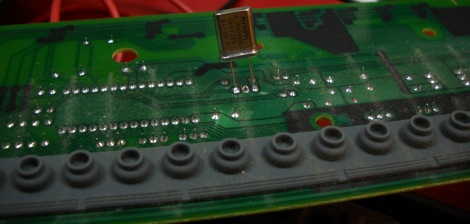
Electronic musical instruments are a lot of fun for a hacker because, with a small palette of tools, know-how and curiosity, they are easily modified. As with any hack, there is always the chance that the subject will be ruined, so it’s not necessarily worth the risk to muck about inside your thousand-dollar pro synthesizer. Luckily for all of us, there are shovel-fulls of old electronic musical toys littering the curbs and second-hand shops of the world. These fun little devices provide ample opportunity to get familiar with audio electronics and circuit bending techniques.

A note on definitions: the term “circuit bending” can be synonymous with “hardware hacking” in the world of audio electronics, and we have seen some debate as to which term is better suited to a given project. We welcome you to share your viewpoints in the comments.

Keep reading to get started.
Continue reading “Intro To Circuit Bending” →

Digitizing Player Piano Rolls

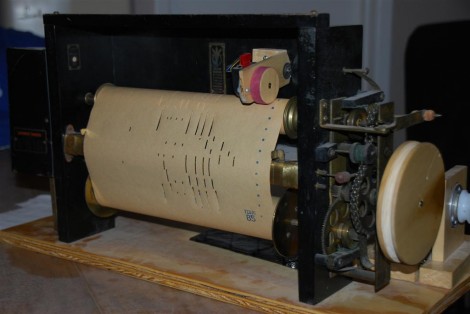
What do you do with 100 player piano rolls but no player piano? You come up with a way to digitize the information for MIDI playback. The rolls have 90 columns worth of holes, 88 for the keys and two more for pedals. Voids in the paper cause a note or pedal to be played, so an optical sensor can be used to transform the analog data into digital information. Simple enough, you’ll just need 90 sensors. But this brings up quite an alignment issue. The solution is to use fiber optic cable to position the IR light source in a hand-made 0.2″ spaced jig. At least the spacing meshes nicely with standard 0.1″ protoboard, which is what was used for mounting the sensors.

[Thanks Mike]

Singing: With Plasma!

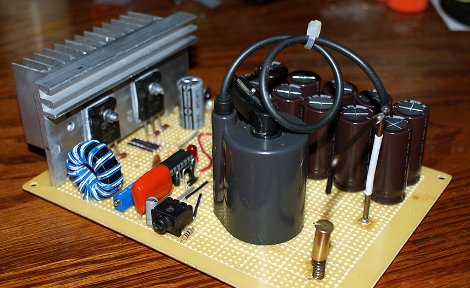
While there are many ways to produce audible sound, Plasma Speakers have to be one of the coolest. Usually very complex and expensive, we received a tip for a beginners guide to making one of these impressive novelties. Handily included are a set of schematics (one very simple schematic, the other with a few artistic illustrations). There are also a set of warnings, which include sound advice to mind the heat generated by the MOSFETs, as well as making sure that your input signal isn’t too strong. The finished product is fun to listen to, so be sure to check out the example video after the break.

Continue reading “Singing: With Plasma!” →

Building A Germanium Fuzz Face Guitar Pedal

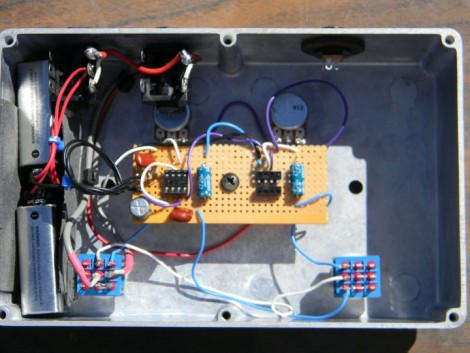
Rock in the new year with a guitar pedal you built yourself. [Doug Kovach] took the time to share his project with us in the video after the break. He starts with a bit of history of the artists that have used fuzz pedals similar to this one. It seems great guitarists have been hacking since way back. [Doug’s] rendition uses the warm sounds of germanium transistors in a design that produces professional results. But if you need something a little bit less serious try the stomp-box.

Continue reading “Building A Germanium Fuzz Face Guitar Pedal” →