Chipophone Plays Video Game Classics

This thrift shop organ gets a new life as an 8-bit music maker. Called the Chipophone, it relies on an ATmega88 to produce sounds that you might associate with classic video gaming. [Linus Akesson] takes us through all of the different sound settings in the video after the break, including performances of your theme music favorites.

The original organ uses transistor logic making it rather easy to patch into the hardware. Thanks to the build log we know that [Linus] used 74HC165 input latches to monitor each of the switches for the 120 inputs. Fifteen of these latches work like a backwards shift register 74HC595, cascading all of the parallel inputs into one serial signal. From there the microcontroller takes over, monitoring the keys, pedals, switches, and potentiometers and outputting the appropriate sounds.

Continue reading “Chipophone Plays Video Game Classics”

Programmable Drum Machine

This sequencer, called Drumssette, uses audio tape to churn out some beats. [Mike Walters] built this around a Tascam four track cassette recorder. The tape inside has a different drum sound on each of the tracks, with a corresponding row of red buttons. Pushing a button adds the drum sound to the loop on that beat. He’s using a series of digital logic gates to patch through the sounds as well as clocking the device from one of the tape’s tracks. It’s pretty  neat  to see the focus selector used in the video after the break to sync up the beginning of the repeated drum patterns. This isn’t the first time we’ve seen [Mike’s] work. If you missed it last year take some time to review the Melloman.

Continue reading “Programmable Drum Machine”

Bassoforte And Other New Instruments

[youtube=http://www.youtube.com/watch?v=lhp6P9Ygsoc]

[Diego Stocco] makes music with instruments he assembled. For instance, his Bassoforte uses piano keys, the neck and strings from an electric bass, and what look like some cymbals. Throw in a hammer from that piano and a double bass bow (plus heavy use of audio software) and he’s in business. Big business actually, his work has been in video games such as The Conduit and in feature films like Sherlock Holmes where he worked with Hans Zimmer. Bassoforte isn’t his only invention, he’s got several more including the Experibass string family on one instrument, the Light Controlled Oscillator, and sand music using the fine aggregate along with some piezoelectric film transducers.

[Thanks LuciusMare]

Audible Tuner For The Blind

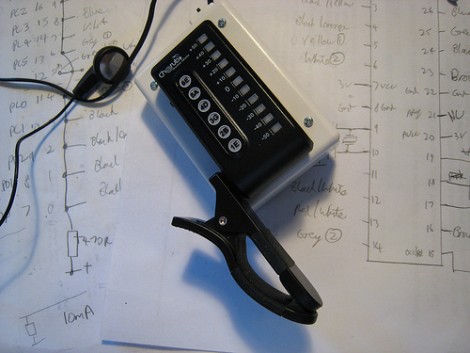
[Lain Sharp] modified this guitar tuner so it can be used by his blind friend. In the picture above you can make out a small white project box that houses the additional electronics. Inside is another battery and an ATmega168 providing a connection for an earphone. The AVR chip connects to each LED on the tuner and converts the visual tuning meter to an audio cue. Check out the demonstration clip after the break to see how it works.

Now if we could just figure out how to get our strings in tune with our built-in keyboard.

Continue reading “Audible Tuner For The Blind”

Radio-Walkman-megaphone Hybrid

[Erich] rethought the use of a megaphone and ended up with this Mega-Tape-O-Phone. His first move was to ditch the megaphone’s amplifying circuitry in order to add his own based on an LM386 chip. From there a radio receiver joined the party followed by the guts of a tape player. He relocated the head of the tape deck to the end of a flexible cable and coated the outside of the megaphone bell with magnetic tape. Now he’s surfing the airwaves and scratching away happily.

The use of the tape head has been seen here before, but it was never in a mobile package like this is. Join us after the break for some video of this in action.

Continue reading “Radio-Walkman-megaphone Hybrid”

Stomp Box Synthesizer

[Brian McNamara] fed the output of his guitar pedal back into its input creating a looped synthesizer. He started with an effects pedal he made but now we think he’s ended up with an electronic stomp box. Check out the results in the video after the break. Now he needs to make the knobs foot-friendly so he can monkey with this while playing guitar.

Continue reading “Stomp Box Synthesizer”

Embedding An Accelerometer And XBee In A Guitar

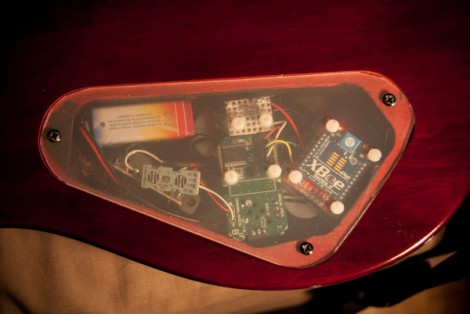
[JP Carrascal] hacked his guitar by adding motion control while removing the need for wires. He’s using a dual-Arduino system with an Mini Pro inside the guitar and a Duemilanova for the receiver connected to a computer. Wireless is provided by the XBee module seen above and a gutted Wii remote accelerometer is in there for motion sensing. Check out the artfully blurry demonstration of the motion effects after the break.

While he added some potentiometer-based controls there is also an automatic power-down feature. [JP] replaced the mono pickup with a stereo one and used the extra conductor as a switch to activate the additional electronics. We wonder if he also winds his own pickups or builds his own effects pedals.

Continue reading “Embedding An Accelerometer And XBee In A Guitar”