Easy, Extensible, Open

I’m a huge DIY’er. I don’t like to buy things when I can build them myself. But honestly, that doesn’t always end up in the optimal allocation of my time, when viewed from a getting-stuff-done perspective. Sometimes, if you’ve got a bigger project in mind, the right way is the quick way, and the quick way is buying something that already works. But when that something is itself not hackable, you’d better be darn sure that it does what you need, and what you could reasonably expect to need in the future, out of the box. And that’s where extensibility comes in.

It’s rare to find products out there that are designed to be both easy to use for the newbie, but extensible for the advanced user. For one, it’s hard work to tick either one of these boxes alone, so it’s twice as hard to nail both. But my other sinking suspicion is that designers tend to have an end user in mind, and maybe only one end user, and that’s the problem. When designing for the newbie, convenience is king. Or if targeting the pro, you maximize flexibility, but perhaps at the expense of designed-in complexity.

There’s a way out, a cheat code, if you will. And that’s making the project open source. Go ahead and hide the complexity from the new user if you want — as long as the pro is able to dive into the schematics or the source code, she’ll figure out how to extend it herself. Openness frees the designers up to worry about making it easy to use, without compromising its flexibility.

I think that this blend of easy and extensible, through openness, is what fundamentally drove the success of Arduino. On the surface layer, there are libraries that just do what you want and drop-down menus with examples to access them. But when you needed to actually use the chip’s hardware peripherals directly, there was nothing stopping you. For the community at large, the fact that all of the code was openly available meant that extending the base was easy — and let’s not beat around the bush, the community’s libraries, tutorials, and example projects are the real reason for the success of the platform.

Look around you, and look out when you’re making that next non-DIY shortcut purchase. Is it easy to use? Can you make it do the things that it doesn’t yet do? Just two simple requirements, yet they seem to knock out so many products if you want both. Then look at those that are both simple and flexible — are they also open? At least in my little world, the answer is almost always “yes”.

Printable Carbide Opens Up Interesting Possibilities

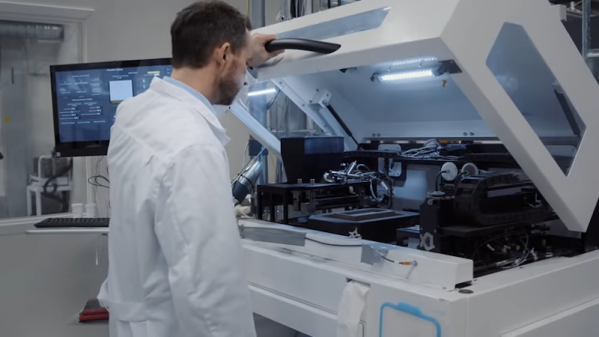
Sandvik, a large company headquartered in Sweden, has apparently been producing cemented carbide for a long time — according to them, since 1932. The material is known for being highly wear-resistant. Now the company says they have a process to 3D print the material. You can see a video about the new material, below.

If you haven’t encountered this material, it is essentially fine carbide particles bound in metal. You’ll find the material widely used in cutting tools. The slogan “Freedom of Design has Never Been Harder” is both clever and confusing, but we took their point.

The process is more or less like other metal binder technology. A powder of tungsten carbide and cobalt mixed with glue creates a green body which you still need to fire to get to the finished part.

What kind of things can you make? Here’s a quote from one of Sandvik’s engineers:

For instance, in wire drawing, productivity is usually limited by how fast the wire can be drawn with maintained quality, which in turn depends on the temperature in the wire drawing die. People have been trying to solve this problem for decades, but it’s been extremely difficult. A 3D printed, cooled wire nib is the answer to this riddle. It took a mere four days to produce, from the first basic sketch to the fully sintered product – thanks to our materials and proprietary process.

Don’t plan on loading up your Ender 3 with cemented carbide filament. This is, after all, a metal material. However, 3D printing can offer geometries that would be difficult to obtain with traditional methods. So even if you have to turn to a professional 3D printing shop, it is good to know you can create in this ultra-hard material.

Printing in metal has a different set of issues than using plastics. If you really want your current printer to do metal, it can, but you’ll have to cheat a bit. Or try electroplating.

Continue reading “Printable Carbide Opens Up Interesting Possibilities”

This Week In Security: OpenSSH, Git, And Sort-of NGINX 0-day

OpenSSH has minted their 9.0 release, and it includes a pair of security changes. Unlike most of the releases we cover here, this one has security hardening to prevent issues, not emergency fixes for current ones. First up, the venerable scp/rcp protocol has been removed. Your scp commands will now use SFTP under the hood. The more interesting security change is the new default key exchange, the NTRU algorithm. NTRU is thought to be quantum-hard.
Continue reading “This Week In Security: OpenSSH, Git, And Sort-of NGINX 0-day”

3D Printing Pills All At Once

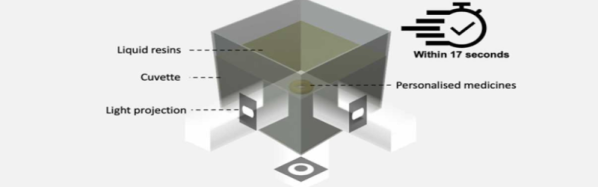
To the uninitiated, it might seem like a gimmick to 3D print pharmaceuticals. After all, you take some kind of medicine, pour it in a mold, and you have a pill, right? But researchers and even some commercial companies are 3D printing drugs with unusual chemical or physical properties. For example, pills with braille identification on them or antibiotics with complex drug-release rates. The Universidade de Santiago de Compostela and the University College London can now 3D print pills without relying on a layer-by-layer approach. Instead, the machine produces the entire pill directly.

According to a recent report on the study, there are at least two things holding back printed pills. First, anything medical has to go through rigorous testing for approval in nearly any country. In addition, producing pills at typical 3D printing speeds is uneconomical. This new approach uses multiple beams of light to polymerize an entire tank of resin at once in as little as seven seconds.

With 3D printed drugs, it is possible to tailor release profiles for individual cases and make hybrid drugs such as a French drug that joins anticancer drugs with another drug to manage side effects. Is this a real thing for the future? Will doctors collect enough data to make it meaningful to tailor drugs to patients? Will regulators allow it? For hybrid medicine, is there really an advantage over just taking two pills? Only time will tell.

Sure, technology can help dispense pills. We know, too, that 3D printing can be useful for prostheses and medical devices. We aren’t so sure about pharmaceuticals, but in the meantime you can already order custom-printed vitamins.

Great Beginnings: The Antikythera Mechanism Gets A “Day Zero”

When an unknown genius sat down more than 2,000 years ago to design and build an astronomical instrument, chances are good that he or she didn’t think that entire academic institutions devoted to solving its mysteries would one day be established. But such is the enduring nature of the Antikythera mechanism, the gift from antiquity that keeps on giving long after being dredged up from a shipwreck in the Aegean Sea.

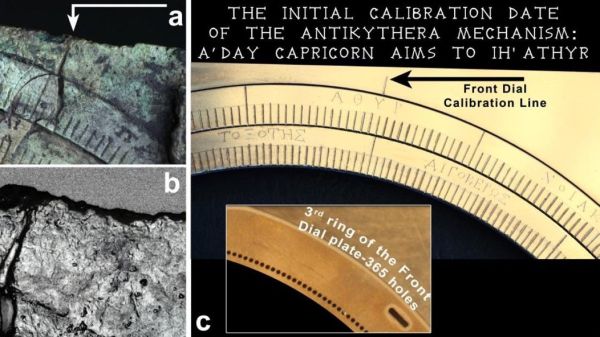
And now, new research on the ancient mechanism reveals that like other mechanical calendars, the Antikythera mechanism has a “day zero,” or a minimum possible date that it can display. The analysis by a team led by [Aristeidis Voulgaris] gets deep into the weeds of astronomical cycles, which the mechanism was designed to simulate using up to 37 separate gears, 30 of which have been found. The cycle of concern is the saros, a 223 lunar month cycle of alignments between the Earth, Sun, and Moon. The saros can be used to predict eclipses, astronomical events of immense importance in antiquity, particularly annular eclipses, which occur when the Moon is at apogee and therefore eclipses less of the Sun’s surface.

The researchers looked at historical annular eclipse data and found that saros cycle 58 had a particularly long annular eclipse, on 23 December 178 BCE. The eclipse would have been visible at sunrise in the eastern Mediterranean, and coupled with other astronomical goodies, like the proximity to the winter solstice, the Sun entering Capricorn, and the Moon being new and at apogee, was probably so culturally significant to the builder that it could serve as the initial date for calibrating all the mechanisms pointers and dials.

Others differ with that take, of course, saying that the evidence points even further back, to a start date in the summer of 204 BCE. In any case, if like us you can’t get enough Antikythera, be sure to check out our overview of the mechanism, plus [Clickspring]’s exploration of methods perhaps used to build it.

Does Your Programmer Know How Fast You Were Going?

News reports were everywhere that an autonomous taxi operated by a company called Cruise was driving through San Francisco with no headlights. The local constabulary tried to stop the vehicle and were a bit thrown that there was no driver. Then the car moved beyond an intersection and pulled over, further bemusing the officers.

The company says the headlights were due to human error and that the car had stopped at a light and then moved to a safe stop by design. This leads to the question of how people including police officers will interact with robot vehicles.

Continue reading “Does Your Programmer Know How Fast You Were Going?”

Warm Up Your Extruders, RepRap Festivals Are Back

Like pretty much every other large gathering, the Midwest and East Coast RepRap Festivals had to be put on hold during the height of the COVID-19 pandemic. But now that the United States is cautiously returning to something that looks a lot like normal, both Festivals have now confirmed they will be back to full-scale live events for 2022.

After experimenting with a virtual event and a scaled-down show in 2021, the Midwest RepRap Festival (MRRF) will be returning to the Elkhart County 4H Fairgrounds in Goshen, Indiana from June 24th to the 26th. No tickets will be required for attendees or exhibitors, everyone is welcome to just show up and have a good time. There will however be sponsorship opportunities for anyone who wants to support this long-running event.

Summer already booked up? In that case, the East Coast RepRap Festival (ERRF) will be taking place from October 8th to the 9th at the APG Federal Credit Union Arena in Bel Air, Maryland. Tickets cost $10 for both exhibitors and attendees, though anyone under 17 gets in for free. Even though ERRF only confirmed their 2022 plans recently, it looks like there are only a few sponsor spots still left open.

Hackaday has attended both events in the past, and we’ve always come back blown away by the incredible variety of printers, projects, and products on display. It seems like there wouldn’t be that many different ways to show off melted plastic, but trust us, these folks always manage to surprise you. Given the amount of time that’s passed since either event was able to operate at normal capacity, we predict these 2022 Festivals are going to be smash hits that you won’t want to miss if you’re even remotely interested in 3D printing.