5G Cellphone’s Location Privacy Broken Before It’s Even Implemented

Although hard to believe in the age of cheap IMSI-catchers, “subscriber location privacy” is supposed to be protected by mobile phone protocols. The Authentication and Key Agreement (AKA) protocol provides location privacy for 3G, 4G, and 5G connections, and it’s been broken at a basic enough level that three successive generations of a technology have had some of their secrets laid bare in one fell swoop.

When 3G was developed, long ago now, spoofing cell towers was expensive and difficult enough that the phone’s International Mobile Subscriber Identity (IMSI) was transmitted unencrypted. For 5G, a more secure version based on a asymmetric encryption and a challenge-reponse protocol that uses sequential numbers (SQNs) to prevent replay attacks. This hack against the AKA protocol sidesteps the IMSI, which remains encrypted and secure under 5G, and tracks you using the SQN.

The vulnerability exploits the AKA’s use of XOR to learn something about the SQN by repeating a challenge. Since the SQNs increment by one each time you use the phone, the authors can assume that if they see an SQN higher than a previous one by a reasonable number when you re-attach to their rogue cell tower, that it’s the same phone again. Since the SQNs are 48-bit numbers, their guess is very likely to be correct. What’s more, the difference in the SQN will reveal something about your phone usage while you’re away from the evil cell.

A sign of the times, the authors propose that this exploit could be used by repressive governments to track journalists, or by advertisers to better target ads. Which of these two dystopian nightmares is worse is left as comment fodder. Either way, it looks like 5G networks aren’t going to provide the location privacy that they promise.

Via [The Register]

Header image: MOs810 [CC BY-SA 4.0].

Mini Vectrex Prototype NVMUSA

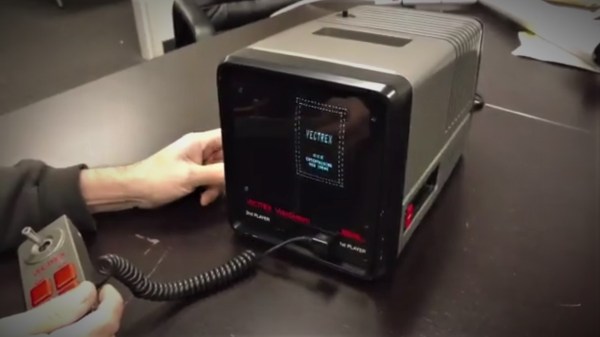
Mini Vectrex Prototype Restored By National Videogame Museum

The crash of the videogame market in 1983 struck down a slew of victims, and unique products such as the Vectrex were not immune to its destructive ways. The all-in-one console featured a monochromatic vector display and offered an arcade-like experience at home complete with an analog joystick controller. It sadly never made it to its second birthday before being axed in early 1984, however, thanks to the [National Videogame Museum] we now how a glimpse of an alternate history for the Vectrex. They posted some photos of an unreleased Vectrex prototype that was restored to working order.

Little was known about this “Mini version” of the Vectrex as its very existence was called into question. The console came into and left the videogame market in such short order that its distributor, Milton Bradley, would have killed any additional model posthaste. Little thought was given to the idea, though a rumor appeared in Edge magazine issue 122. The article detailed a fan’s memory of seeing a Vectrex shaped “like a shoebox” on the president’s desk.

Seven years after the publication of that story, photos of the Vectrex design revision were posted by one of the Vectrex designer’s sons on Flickr. These photos served as the only concrete evidence as to the existence of the machine that were widely available for some time. That was until the [National Videogame Museum] managed to acquire the actual prototype as part of the museum’s collection in Frisco, TX. So for those without plans to swing through the DFW area in the near future, there is the video of the mini Vectrex in action below.

Continue reading “Mini Vectrex Prototype Restored By National Videogame Museum”

Amazon Creates Distributed Satellite Ground Stations

Here’s an interesting thought: it’s possible to build a cubesat for perhaps ten thousand dollars, and hitch a ride on a launch for free thanks to a NASA outreach program. Tracking that satellite along its entire orbit would require dozens or hundreds of ground stations, all equipped with antennas and a connection to the Internet. Getting your data down from a cubesat actually costs more than building a satellite.

This is the observation someone at Amazon must have made. They’ve developed the AWS Ground Station, a system designed to downlink data from cubesats and other satellites across an entire orbit. Right now, Amazon only has two ground stations attached, but they plan to have a dozen in place by the middle of next year. Each of these ground stations are associated with a particular AWS region (there are a total of sixteen AWS regions, which might limit the orbital coverage of the AWS Ground Station system), and consists of an antenna, an alt-az mount, and a gigantic bank of servers and hard drives to capture data from satellites orbiting overhead.

The Amazon blog post goes over how easy it is to capture data from a satellite, and it’s as easy as getting a NORAD ID, logging into your AWS account, and clicking a few buttons.

It should go without mention that this is the exact same idea behind SatNOGS, an Open Source global network of satellite ground stations and winner of the 2014 Hackaday Prize. One of their ground stations is what’s pictured at the top if this article. Right now, SatNOGS has over seventy ground stations in the network, including a few stations that are in very useful locations like the Canary Islands. The SatNOGS network already has a lot more coverage than the maximum of sixteen locations where Amazon has their data centers — made possible by its open nature. Congrats to the SatNOGS team once again for creating something so useful, and doing it four years before Amazon.

Hackaday Assembling At 35C3

Hackaday is going to be at the 35th annual Chaos Communication Congress (35C3), December 27th – 31st, and we’re putting together an assembly. If you’re coming to 35C3, come join us!

If you’ve never been to a Congress before, it’s an amazing scene. This year over 15,000 hackers will take over the Leipzig Congress Hall, bringing whatever they’re working on with them, and showing off their last-minute dazzlers. Congress is awesome in both senses of the word: simultaneously incredible and a little bit intimidating.

With the scale of the Congress approaching absurd proportions, it’s nice to have a home base. “Assemblies”, small-ish gatherings of friends, members of a hackerspace, or even just like-minded folks, join forces and get some table space and Ethernet connections to call their own, and this year we’ll be flying the Jolly Wrencher.

November 28th is the deadline for changing our headcount, so if you’d like to take part, click over to the Hackaday 35C3 Assembly IO project ASAP and leave a comment or join the team so we have a good estimate. If you’ve already got a home away from home, we’ll keep some extra seats warm for you to come by and chat. [Elliot] will also be wearing his press hat, so if you’ve got a project in desperate need of a Hackaday writeup you’ll know where to find him.

Hackaday, assemble!

FCC Gets Complaint: Proposed Ham Radio Rules Hurt National Security

On November 10th, [Theodore Rappaport] sent the FCC an ex parte filing regarding a proposed rule change that would remove the limit on baud rate of high frequency (HF) digital transmissions. According to [Rappaport] there are already encoded messages that can’t be read on the ham radio airwaves and this would make the problem worse.

[Rappaport] is a professor at NYU and the founding director of NYU Wireless. His concern seems to relate mostly to SCS who have some proprietary schemes for compressing PACTOR as part of Winlink — used in some cases to send e-mail from onboard ships.

Continue reading “FCC Gets Complaint: Proposed Ham Radio Rules Hurt National Security”

Five Year Old Bug Spawns Router Botnet Monster

In the news has been yet another router botnet. [Hui Wang] and [RootKiter] of 360Netlab announced their discovery of what they call the “BCMUPnP_Hunter” rootkit. They estimate this botnet to be running on over 100,000 routers worldwide.

There are two elements of this story that I found particularly baffling. First, this botnet infects routers using a vulnerability that was first reported by Defensecode over five years ago, in 2013! The second oddity is the wide range of devices that are vulnerable and are now part of the botnet. Dozens of brands and at least 116 models have been found to be infected.

One of the details of this story hasn’t been reported entirely accurately. The bug is not built into the Broadcom chipset. Unlike Spectre and Meltdown, it’s not actually a hardware fault. Broadcom distributes a Software Development Kit (SDK) that enables device manufacturers like D-Link, TP-Link, and Linksys to quickly develop firmware for routers using Broadcom chips. The vulnerability lies in this code, rather than part of the hardware itself.

Continue reading “Five Year Old Bug Spawns Router Botnet Monster”

Kind Of The Opposite Of A Lightsaber

Lightsabers are an elegant weapon for a more civilized age. Did you ever consider that cutting people’s hands off with a laser sword means automatically cauterized wounds and that lack of blood results in a gentler rating from the Motion Picture Association? Movie guidelines aside, a cauterizing pen is found in some first aid kits, but at their core, they are a power source and a heating filament. Given the state of medical technology, this is due for an upgrade, and folks at Arizona State University are hitting all the marks with a combination of near-infrared lasers, gold particles, and protein matrix from silk.

Cauterizing relies on intense heat, or chemicals, to burn flesh but this process uses less power by aiming the near-IR laser at only the selected areas, and since near-IR can penetrate soft-tissue it goes deep without extra heating. The laser heats the gold, and that activates the silk proteins. Early results are positive but lots of testing remains and it still will not belong in the average first aid kit for a while, lasers and all, but surgery for beloved pets and tolerable humans could have recovery time reduced with this advance.

If this doesn’t sate your need for magical space knight weaponry, we have options aplenty.

Via IEEE Spectrum. Image: starwars.com