When Amazon released the API to their voice service Alexa, they basically forced any serious players in this domain to bring their offerings out into the hacker/maker market as well. Now Google and Raspberry Pi have come together to bring us ‘Artificial Intelligence Yourself’ or AIY.
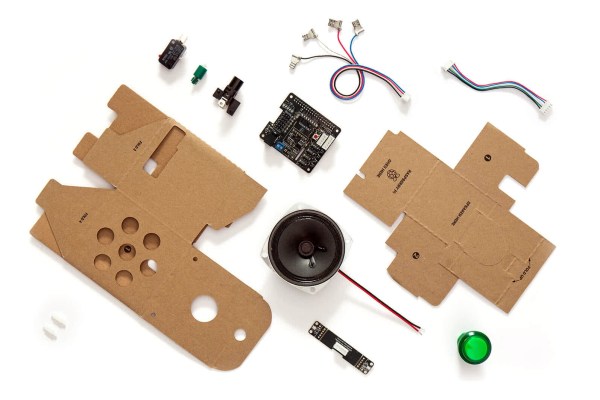
A free hardware kit made by Google was distributed with Issue 57 of the MagPi Magazine which is targeted at makers and hobbyists which you can see in the video after the break. The kit contains a Raspberry Pi Voice Hat, a microphone board, a speaker and a number of small bits to mount the kit on a Raspberry Pi 3. Putting all of it together and following the instruction on the official site gets you a Google Voice Interaction Kit with a bunch of IOs just screaming to be put to good use.
The source code for the python app can be downloaded from GitHub and consists of a loop that awaits a trigger. This trigger can be a press of a button or a clap near the microphones. When a trigger is detected, the recorder function takes over sending the stream to the Google Cloud. Speech-to-Text conversion happens there and the result is returned via a Text-To-Speech engine that helps the system talk back. The repository suggests that the official Voice Kit SD Image (893 MB download) is based on Raspbian so don’t go reflashing a memory card right away, you should be able to add this to an existing install.
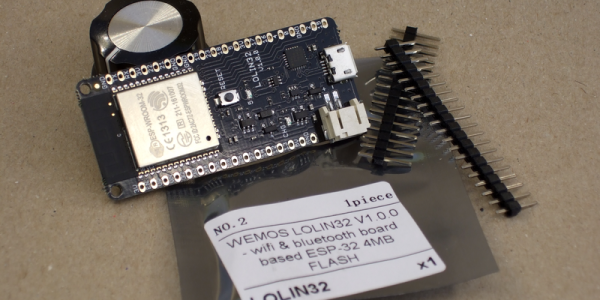
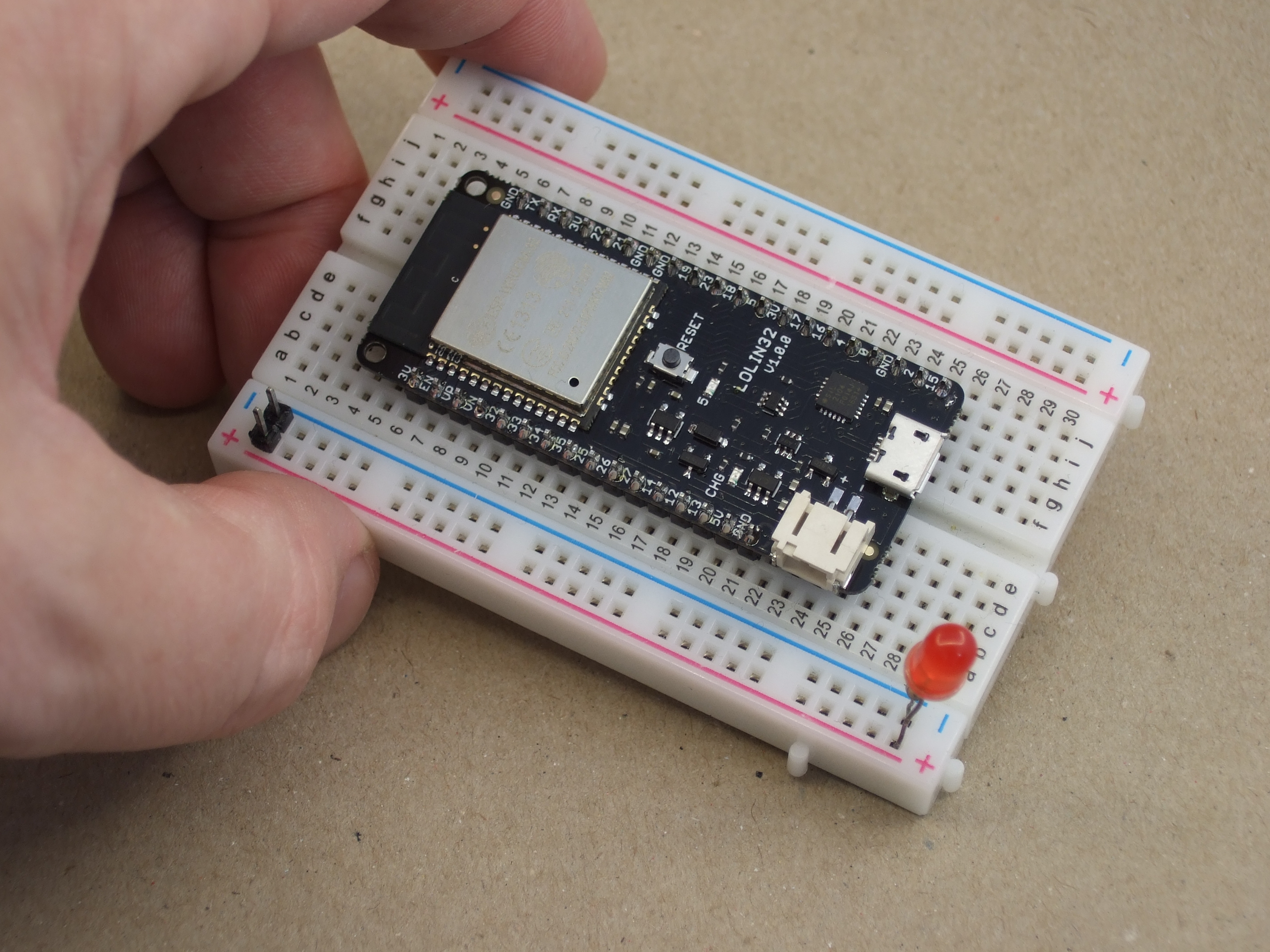
Just two weeks ago our favorite supplier of cheap ESP8266 boards, WeMos, released the long-awaited LOLIN32 ESP-32 board, and it’s almost a killer. Hackaday regular [deshipu] tipped us off, and we placed an order within minutes; if WeMos is making a dirt-cheap ESP32 development board, we’re on board! It came in the mail yesterday. (They’re out of stock now, more expected soon.)
If you’ve been following the chip’s development, you’ll know that the first spin of ESP-32s had some silicon bugs (PDF) that might matter to you if you’re working with deep sleep modes, switching between particular clock frequencies, or using the brown-out-reset function. Do the snazzy new, $8, development boards include silicon version 0 or 1? Read on to find out!
Betteridge’s Law of Headlines states, “Any headline that ends in a question mark can be answered by the word no.” This law remains unassailable. However, recent claims have called into question a black box hidden deep inside every Intel chipset produced in the last decade.
Yesterday, on the Semiaccurate blog, [Charlie Demerjian] announced a remote exploit for the Intel Management Engine (ME). This exploit covers every Intel platform with Active Management Technology (AMT) shipped since 2008. This is a small percentage of all systems running Intel chipsets, and even then the remote exploit will only work if AMT is enabled. [Demerjian] also announced the existence of a local exploit.
Intel’s ME and AMT Explained
Beginning in 2005, Intel began including Active Management Technology in Ethernet controllers. This system is effectively a firewall and a tool used for provisioning laptops and desktops in a corporate environment. In 2008, a new coprocessor — the Management Engine — was added. This management engine is a processor connected to every peripheral in a system. The ME has complete access to all of a computer’s memory, network connections, and every peripheral connected to a computer. The ME runs when the computer is hibernating and can intercept TCP/IP traffic. Management Engine can be used to boot a computer over a network, install a new OS, and can disable a PC if it fails to check into a server at some predetermined interval. From a security standpoint, if you own the Management Engine, you own the computer and all data contained within.
The Management Engine and Active Management Technolgy has become a focus of security researchers. The researcher who finds an exploit allowing an attacker access to the ME will become the greatest researcher of the decade. When this exploit is discovered, a billion dollars in Intel stock will evaporate. Fortunately, or unfortunately, depending on how you look at it, the Managment Engine is a closely guarded secret, it’s based on a strange architecture, and the on-chip ROM for the ME is a black box. Nothing short of corporate espionage or looking at the pattern of bits in the silicon will tell you anything. Intel’s Management Engine and Active Management Technolgy is secure through obscurity, yes, but so far it’s been secure for a decade while being a target for the best researchers on the planet.
Semiaccurate’s Claim
In yesterday’s blog post, [Demerjian] reported the existence of two exploits. The first is a remotely exploitable security hole in the ME firmware. This exploit affects every Intel chipset made in the last ten years with Active Management Technology on board and enabled. It is important to note this remote exploit only affects a small percentage of total systems.
The second exploit reported by the Semiaccurate blog is a local exploit that does not require AMT to be active but does require Intel’s Local Manageability Service (LMS) to be running. This is simply another way that physical access equals root access. From the few details [Demerjian] shared, the local exploit affects a decade’s worth of Intel chipsets, but not remotely. This is simply another evil maid scenario.
Should You Worry?
This hacker is unable to exploit Intel’s ME, even though he’s using a three-hole balaclava.
The biggest network security threat today is a remote code execution exploit for Intel’s Management Engine. Every computer with an Intel chipset produced in the last decade would be vulnerable to this exploit, and RCE would give an attacker full control over every aspect of a system. If you want a metaphor, we are dinosaurs and an Intel ME exploit is an asteroid hurtling towards the Yucatán peninsula.
However, [Demerjian] gives no details of the exploit (rightly so), and Intel has released an advisory stating, “This vulnerability does not exist on Intel-based consumer PCs.” According to Intel, this exploit will only affect Intel systems that ship with AMT, and have AMT enabled. The local exploit only works if a system is running Intel’s LMS.
This exploit — no matter what it may be, as there is no proof of concept yet — only works if you’re using Intel’s Management Engine and Active Management Technology as intended. That is, if an IT guru can reinstall Windows on your laptop remotely, this exploit applies to you. If you’ve never heard of this capability, you’re probably fine.
Still, with an exploit of such magnitude, it’s wise to check for patches for your system. If your system does not have Active Management Technology, you’re fine. If your system does have AMT, but you’ve never turned it on, you’re fine. If you’re not running LMT, you’re fine. Intel’s ME can be neutralized if you’re using a sufficiently old chipset. This isn’t the end of the world, but it does give security experts panning Intel’s technology for the last few years the opportunity to say, ‘told ‘ya so’.
We are once again saddened to report the loss of another great hacker. Patrick Joyce has passed away after a decade-long struggle with ALS/MND. Patrick was the team captain of Eyedriveomatic, the Grand Prize winning hardware from the 2015 Hackaday Prize. The loss of Patrick comes quickly after receiving word on Monday about the death of Patrick’s teammate, Steve Evans.
Despite the challenges Patrick faced in the final years of his life he was a prolific hardware hacker. He and his team won the Hackaday Prize in 2015 for designing a system which allowed electric wheelchairs to be controlled with eye gaze software without altering the chairs themselves (which are often not owned by the user). But he was also a finalist in the Assistive Technologies challenge of the 2016 Hackaday Prize. The Raimi’s Arm project set its goal at creating bionic arms for kids — a noble and worthy challenge for everyone to undertake. Check out Patrick’s profile page and you’ll see he has also built an open source head mouse (an alternative to eye gaze controls) and a headphone robot which allowed him to put on and take off his own headphones.
I find it amazing what he achieved in his work considering the physical limitations placed before him. Patrick had limited use of one hand which he used with a joystick for mouse control. His typing was done using eye gaze. Yet he managed to design and document a number of incredible creations. This is inspiring.
Reflect on this loss to our community, but take comfort in the fact that his work lives on. Cody Barnes, the software developer for the Eyedrivomatic, plans to continue work on the project. If you are interested in helping to make that open source assistive tech available to more people who need it, now is a great time to send a private message to Cody to learn more about getting involved.
Ben Einstein, a product designer and founder at Bolt, a hardware-based VC, recently got his hands on a Juicero press. This desktop juice press that only works with proprietary pouches filled with chopped fruits and vegetables is currently bandied in the tech press as evidence Silicon Valley has gone mad, there is no future in building hardware, and the Internet of Things is a pox on civilization. Hey, at least they got the last one right.
This iFixit-style tear down digs into the Juicero mixer in all its gory details. It’s beautiful, it’s a marvel of technology, and given the engineering that went into this machine, it was doomed to fail. Not because it didn’t accomplish the task at hand, but because it does so with a level of engineering overkill that’s delightful to look at but devastating to the production cost.
It is with great sadness that Hackaday learns of the passing of Steve Evans. He was one of the creators of Eyedrivomatic, the eye-controlled wheelchair project which was awarded the Grand Prize during the 2015 Hackaday Prize.
News of Steve’s passing was shared by his teammate Cody Barnes in a project update on Monday. For more than a decade Steve had been living with Motor Neurone Disease (MND). He slowly lost the function of his body, but his mind remained intact throughout. We are inspired that despite his struggles he chose to spend his time creating a better world. Above you can see him test-driving an Eyedrivomatic prototype which is the blue 3D printed attachment seen on the arm of his chair.
The Eyedrivomatic is a hardware adapter for electric wheelchairs which bridges the physical controls of the chair with the eye-controlled computer used by people living with ALS/MND and in many other situations. The project is Open Hardware and Open Source Software and the team continues to work on making Eyedriveomatic more widely available by continuing to refine the design for ease of fabrication, and has even begun to sell kits so those who cannot build it themselves still have access.
The team will continue with the Eyedrivomatic project. If you are inspired by Steve’s story, now is a great time to look into helping out. Contact Cody Barnes if you would like to contribute to the project. Love and appreciation for Steve and his family may be left as comments on the project log.
[Symantec] Reports Hajime seems to be a white hat worm that spreads over telnet in order to secure IoT devices instead of actually doing anything malicious.
[Brian Benchoff] wrote a great article about the Hajime Worm just as the story broke when first discovered back in October last year. At the time, it looked like the beginnings of a malicious IoT botnet out to cause some DDoS trouble. In a crazy turn of events, it now seems that the worm is actually securing devices affected by another major IoT botnet, dubbed Mirai, which has been launching DDoS attacks. More recently a new Mirai variant has been launching application-layer attacks since it’s source code was uploaded to a GitHub account and adapted.
Hajime is a much more complex botnet than Mirai as it is controlled through peer-to-peer propagating commands through infected devices, whilst the latter uses hard-coded addresses for the command and control of the botnet. Hajime can also cloak its self better, managing to hide its self from running processes and hide its files from the device.
The author can open a shell script to any infected machine in the network at any time, and the code is modular, so new capabilities can be added on the fly. It is apparent from the code that a fair amount of development time went into designing this worm.
So where is this all going? So far this is beginning to look like a cyber battle of Good vs Evil. Or it’s a turf war between rival cyber-mafias. Only time will tell.