Formlabs Form 1+ API Now Available On Github

Since 2014, the Form 1+ has been serving a faithful community of avid resin-oriented 3D printer enthusiasts. With an API now released publicly on Github, it’s time for the Form 1+ to introduce itself to a crew of eager hardware hackers.

Exposing an interface to the printer opens the door to a world of possibilities. With the custom version of PreForm that arrives with this release, a whopping 39 different properties are open for tuning, according to the post on Reddit. Combining these newly-accessible parameters with a sufficient number of hackers, odds are good that the community will be able to quickly converge on stable settings for 3rd party resins. (We’re most excited to see the Homebrew PCBs community start exposing their UV-sensitive PCBs with this hardware setup.)

Heads-up: poking around in this brave new world is almost certain to void your warranty, but if you’re eager to get SpacewΛr up-and-running, it might just be worth it.

Bunnie And EFF Sue US Government Over DMCA 1201

This morning Bunnie Huang wrote about his reasons for suing the US Government over Section 1201 of the Digital Millennium Copyright Act (DMCA).

The DMCA was enacted in 1996 and put in place far-reaching protections for copyright owners. Many, myself included, think these protections became far-overreaching. The DMCA, specifically section 1201 of the act which is known as the anti-circumvention provision, prohibits any action that goes around mechanisms designed to protect copyrighted material. So much has changed since ’96 — software is now in every device and that means section 1201 extends to almost all electronics sold today.

So protecting copyright is good, right? If that were the only way section 1201 was enforced that might be true. But common sense seems to have gone out the window on this one.

If you legally purchase media which is protected with DRM it is illegal for you to change the format of that media. Ripping your DVD to a digital file to view on your phone while on the plane (something usually seen as fair use) is a violation. Want to build an add-on for you home automation system but need to reverse engineer the communications protocol first? That’s a violation. Perhaps the most alarming violation: if you discover a security vulnerability in an existing system and report it, you can be sued under DMCA 1201 for doing so.

Cory Doctorow gave a great talk at DEF CON last year about the Electronic Frontier Foundation’s renewed push against DMCA 1201. The EFF is backing Bunnie on this lawsuit. Their tack argues both that section 1201 is stiffling innovation and discouraging meaningful security research.

If it’s illegal to write about, talk about, or even privately explore how electronics are built (and the ecosystem that lets them function) it’s hard to really master creating new technology. A successful lawsuit must show harm. Bunnie’s company, Alphamax LLC, is developing hardware that can add an overlay to an HDMI signal (which sounds like the continuation of the hack we saw from him a few years ago). But HDCP would prevent this.

Innovation aside, the security research angle is a huge reason for this law (or the enforcement of it) to change. The other plaintiff named in the suit, Matthew Green, had to seek an exemption from the DMCA in order to conduct his research without fear of prosecution. Currently there is a huge disincentive to report or even look for security vulnerabilities, and that is a disservice to all. Beneficial security research and responsible disclosure need to be the top priority in our society which is now totally dependent on an electronically augmented lifestyle.

Making Graphene More Practical

[James Tour] and others at Rice University announced an improved form of graphene that uses nanoscale rivets. The material incorporates carbon nanotubes along with carbon spheres that encase iron nanoparticles. The nanotubes provide strength and higher conductivity overall, while the spheres let the material transfer more easily.

Typically, placing graphene on something involves using chemical vapor deposition on a polymer layer before transferring to another site. The polymer tends to degrade the graphene’s properties. This new material doesn’t require this intermediate step. In addition, the spheres allow interfacing to the graphene more readily.

Continue reading “Making Graphene More Practical”

ArduCAM Introduces A Third Party Raspberry Pi

There are hundreds of ARM-based Linux development boards out there, with new ones appearing every week. The bulk of these ARM boards are mostly unsupported, and in the worst case they don’t work at all. There’s a reason the Raspberry Pi is the best-selling tiny ARM computer, and it isn’t because it’s the fastest or most capable. The Raspberry Pi got to where it is today because of a huge amount of work from devs around the globe.

Try as they might, the newcomer fabricators of these other ARM boards can’t easily glom onto the popularity of the Pi. Doing so would require a Broadcom chipset. Now that the Broadcom BCM2835-based ODROID-W has gone out of production because Broadcom refused to sell the chips, the Raspberry Pi ecosystem has been completely closed.

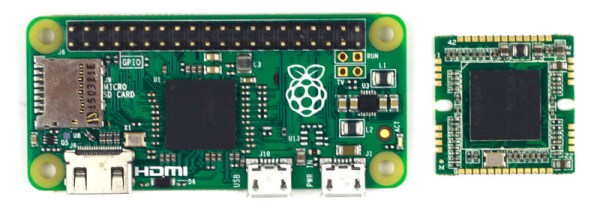
Things may be changing. ArduCAM has introduced a tiny Raspberry Pi compatible module based on Broadcom’s BCM2835 chipset, the same chip found in the original Raspberry Pis A, B, B+ and Zero. This module is tiny – just under an inch square – and compatible with all of the supported software that makes the Raspberry Pi so irresistible.
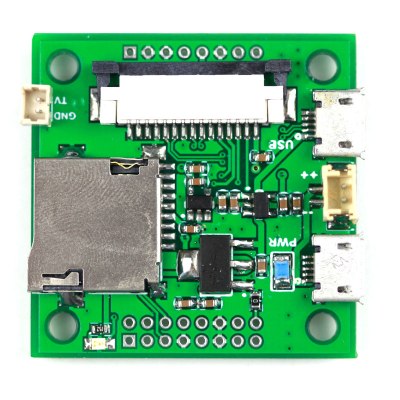
nano-rpi-cmio-backAlthough this Raspberry Pi-compatible board is not finalized, the specs are what you would expect from what is essentially a Raspberry Pi Zero cut down to a square inch board. The CPU is listed as, “Broadcom BCM2835 ARM11 Processor @ 700 MHz (or 1GHz?)” – yes, even the spec sheet doesn’t know how fast the CPU is running – and RAM is either 256 or 512MB of LPDDR2.

There isn’t space on the board for a 2×20 pin header, but a sufficient number of GPIOs are broken out to make this board useful. You will fin a micro-SD card slot, twin micro-USB ports, connectors for power and composite video, as well as the Pi Camera connector. This board is basically the same size as the Pi Camera board, making the idea of a very tiny Linux-backed imaging systems tantalizingly close to being a reality.

It must be noted that this board is not for sale yet, and if Broadcom takes offense to the project, it may never be. That’s exactly what happened with the ODROID-W, and if ArduCAM can’t secure a supply of chips from Broadcom, this project will never see the light of day.


SoftBank Bought ARM

$32 billion USD doesn’t buy as much as it used to. Unless you convert it into British Pounds, battered by the UK’s decision to leave the European Union, and make an offer for ARM Holdings. In that case, it will buy you our favorite fabless chip-design company.

The company putting up 32 Really Big Ones is Japan’s SoftBank, a diversified technology conglomerate. SoftBank is most visible as a mobile phone operator in Japan, but their business strategy lately has been latching on to emerging technology and making very good investments. (With the notable exception of purchasing the US’s Sprint Telecom, which they say is turning around.) Recently, they’ve focused on wireless and IoT. And now, they’re going to buy ARM.

We suspect that this won’t mean much for ARM in the long term. SoftBank isn’t a semiconductor firm, they just want a piece of the action. With the Japanese economy relatively stagnant, a strong Yen and a weak Pound, ARM became a bargain. (SoftBank said in a press release that the Brexit didn’t affect their decision, and that they would have bought ARM anyway. Still, you can’t blame them for waiting until after the vote, and the fallout, to make the purchase.) It certainly won’t hurt SoftBank’s robotics, IoT, or AI strategies to have a leading processor design firm in their stable, but we predict business as usual for those of us way downstream in the ARM ecosystem.

Thanks [Jaromir] for the tip!

Isolated Voltage Measurements Through Frequency

This one’s not a flashy hack, it’s a great piece of work and a good trick to have up your sleeve. Sometimes you’ve got a voltage difference that you’d like to measure, but either the ground potential is at a different level, or the voltages are too high for your lowly microcontroller.

There are tons of tricks with resistive voltage dividers that you can play. But if you want serious electrical isolation from the target, there’s only one way to go — an optocoupler. But optocouplers only really transmit digital signals, and [Giovanni Carrera] needed to measure an analog voltage.

VFC+calibration

Enter the voltage-to-frequency IC that does just what it says: produces a square wave with a frequency that’s proportional to the voltage applied. Pass this square wave through an optocoupler, and you can hit one side with voltages approaching lightning strikes without damaging the microcontroller on the other side. And you’re still able to measure the voltage accurately by measuring the frequency on the digital I/O pins of the microcontroller.

[Giovanni] built up and documented a nice circuit. He even tested it for linearity. If you’re ever in the position of needing to measure a voltage in a non-traditional way, you’ll thank him later.

Obsolescence As A Service

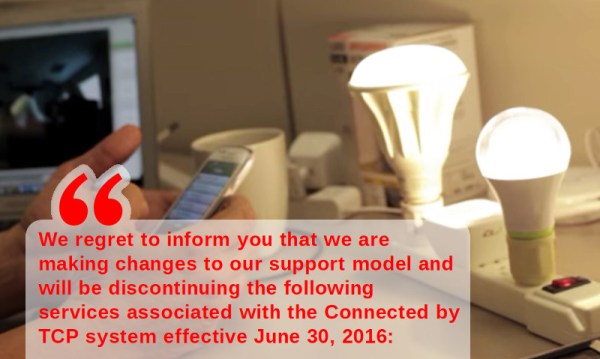
Yet another Internet of Things service has left its customers in the lurch. IoT devices (mostly lightbulbs) made sold by Greenwave Systems stopped talking to the outside world on July 1. More specifically, the server to which they all connected (ahem, “the cloud”) has been turned off, which rules out using the bulbs with Internet-based services like IFTTT, which was a major selling point of the Things in the first place.

[Edit: We were contacted by Greenwave, and they pointed out that they merely sold the IoT devices in question. They are made by TCP, which is also responsible for cancelling the service. And TCP has a history of doing this sort of thing before.]

It’s not the first time we’ve seen IoT companies renege on their promises to provide service, and it’s surely not going to be the last. We’re preaching to the choir here, but when even Google is willing to take the PR hit to effectively brick your devices, the only protection that you’ve got against obsolescence is an open protocol.

At least the users of Greenwave’s TCP’s devices will continue to be able to control them from within the home. That, plus some clever hacking, will make them workable into the future. But it’s not like the convenience that was sold with the devices.

Boo to shady IoT companies! But thanks to [Adrian] for the tip.