The Contrarian Response To Apple’s Need For Encryption

On December 2, 2015, [Syed Rizwan Farook] and [Tashfeen Malik] opened fire at a San Bernardino County Department of Public Health training event, killing 14 and injuring 22. This was the third deadliest mass shooting in the United States in recent memory, and began a large investigation by local, state, and federal agencies. One piece of evidence recovered by the FBI was an iPhone 5C belonging to one of the shooters. In the days and months after the shooting, the FBI turned to Apple to extract data from this phone.

A few days ago in an open letter to customers, [Tim Cook], CEO of Apple, stated they will not comply with FBI’s request to build a backdoor for the iPhone. While the issue at hand is extracting data from an iPhone recovered from the San Bernardino shooting, [Cook] says building a new version of iOS to extract this data would allow the FBI to unlock any iPhone. Needless to say, there are obvious security implications of this request.

Apple does not publish open letters to its customers often. Having one of the largest companies on the planet come out in support of privacy and encryption is nearly unprecedented. There is well-founded speculation this open letter to the public will be exhibit A in a supreme court case. Needless to say, the Internet has gone a little crazy after this letter was published, and rightly so: just imagine how better off we would be if AT&T said no to the NSA in 2002 – [Snowden] might just be another IT geek working for a government contractor.

CalvinThere is a peculiar aspect of public discourse that doesn’t make any sense. In the absence of being able to say anything interesting, some people have just decided to add a contrary viewpoint. Being right, having a valid argument, or even having evidence to support assertions doesn’t matter; being contrary is far more interesting. Look at any comment thread on the Internet, and you’ll find the longest comment chain is the one refuting the parent article. Look up the ratings for a cable news channel. You’ll find the highest rated show is the one with the most bickering. When is the last time you saw something from the New York Times, Washington Post, or LA Times on Facebook or your favorite news aggregator? Chances are, it wasn’t news. It was an op-ed, most likely one that was espousing a view contrary to either public opinion or public policy.

As with any headline event on the Internet, the contrarians have come out of the woodwork. These contrarians are technically correct and exceedingly myopic.

Continue reading “The Contrarian Response To Apple’s Need For Encryption”
5D Glass Disc Can Store 360TB!

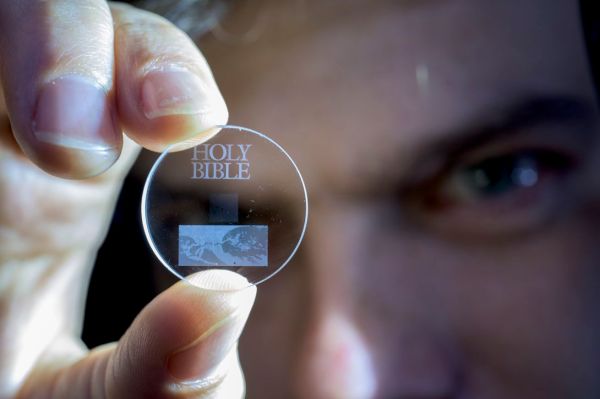
There’s a small subset of hackers out there concerned with the end of the world. What if our entire existence vanished? How would an alien race learn not to do what we did, what resulted in our demise? We’ve all heard of laser etching metal disks with the Bible, accounts of history, and even just names — pretty sure we’ve sent quite a few into space. But researchers at the University of Southampton’s Optical Research Center have come up with an even superior storage method. They call it the 5D Disc.

According to the researchers, each disc could hold a theoretical 360TB. They can withstand temperatures of up to 1000C, and it’s believe that they could last up to 13.8 billion years at room temperature without degrading — if that’s true, our sun would be long dead before the disc degraded! Continue reading “5D Glass Disc Can Store 360TB!”

About Those Gravitational Waves

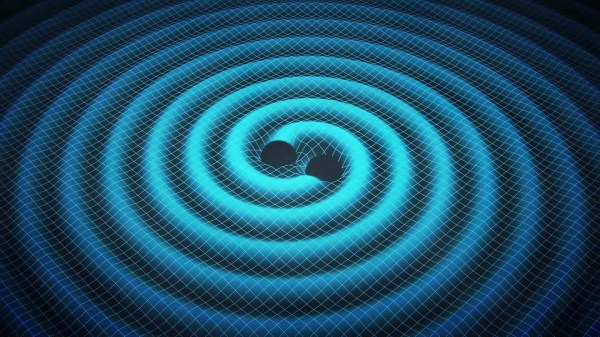
It was the year of 1687 when Isaac Newton published “The Principia“, which revealed the first mathematical description of gravity. Newton’s laws of motion along with his description of gravity laid before the world a revolutionary concept that could be used to describe everything from the motions of heavenly bodies to a falling apple. Newton would remain the unequivocal king of gravity for the next several hundred years. But that would all change at the dawn of the 20th century when a young man working at a Swiss patent office began to ask some profound questions. Einstein had come to the conclusion that Newtonian physics was not adequate to describe the findings of the emerging electromagnetic field theories.  In 1905, he published a paper entitled “On the Electrodynamics of Moving Bodies” which corrects Newton’s laws so they work when describing the motions of objects near the speed of light. This new description became known as Special Relativity.

It was ‘Special’ because it didn’t deal with gravity or acceleration. It would take Einstein another 10 years to work these two concepts into his relativity theory. He called it General Relativity – an understanding of which is necessary to fully grasp the significance of gravitational waves.

Continue reading “About Those Gravitational Waves”

Microchip Unveils Online MPLAB IDE And $10 Board

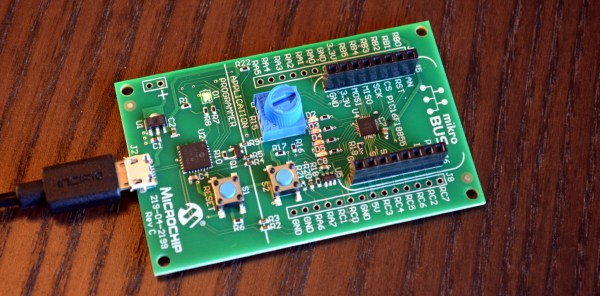
Today, Microchip released a few interesting tools for embedded development. The first is a free online IDE called MPLAB Xpress, the second is a $10 dev board with a built-in programmer. This pair is aimed at getting people up and running quickly with PIC development. They gave us an account before release, and sent over a sample board. Let’s take a look!

Continue reading “Microchip Unveils Online MPLAB IDE And $10 Board”

Suddenly, 4G Feels Slow

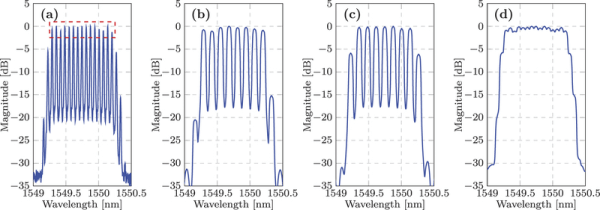
Researchers at University College London successfully transferred data over an optical transmission system at a rate of 1.125 Tb/s. That’s over ten times as fast as typical commercial optical systems, and thousands of times faster than the standard broadband connection. The study appeared in Scientific Reports and takes advantage of encoding techniques usually seen in wireless systems.

The prototype system uses fifteen channels on different wavelengths. Each channel used 256QAM encoding (the same as you see on cable modems, among other things). A single receiver recovers all of the channels together. The technology isn’t commercially available yet. It is worth noting that the experiment used a transmitter and receiver very close to each other. Future tests will examine how the system performs when there are hundreds or thousands of feet of optical fiber between them.

Continue reading “Suddenly, 4G Feels Slow”

Flexible Phototransistor Will Make Everything Subtly Better In The Future

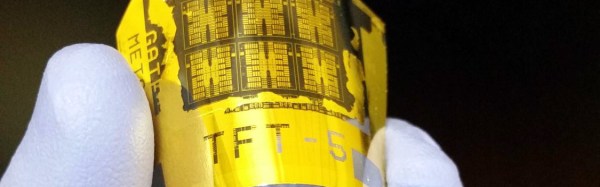
University of Wisconsin-Madison is doing some really cool stuff with phototransistors. This is one of those developments that will subtly improve all our devices. Phototransistors are ubiquitous in our lives. It’s near impossible to walk anywhere without one collecting some of your photons.

The first obvious advantage of a flexible grid of phototransistors is the ability to fit the sensor array to any desired shape. For example, in a digital camera the optics are designed to focus a “round” picture on a flat sensor. If we had a curved surface, we could capture more light without having to choose between discarding light, compensating with software, or suffering the various optical distortions.

Another advantage of the University’s new manufacturing approach is the “flip-transfer” construction method they came up with. They propound that their method produces a vastly more sensitive device. The sensing silicon sits on the front of the assembly without any obstructing material in front; also the metal substrate it was built on before flipping is reflective; also increasing the sensitivity.

All in all very cool, and we can’t wait for phone cameras, with super flat lenses, infinite focus, have no low light capture issues, and all the other cool stuff coming out of the labs these days.

New Efficiency Standards For Wall Warts In The US

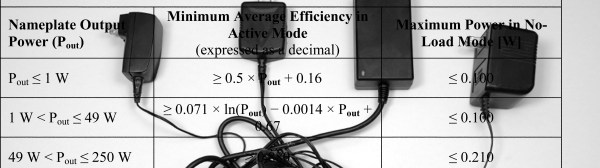
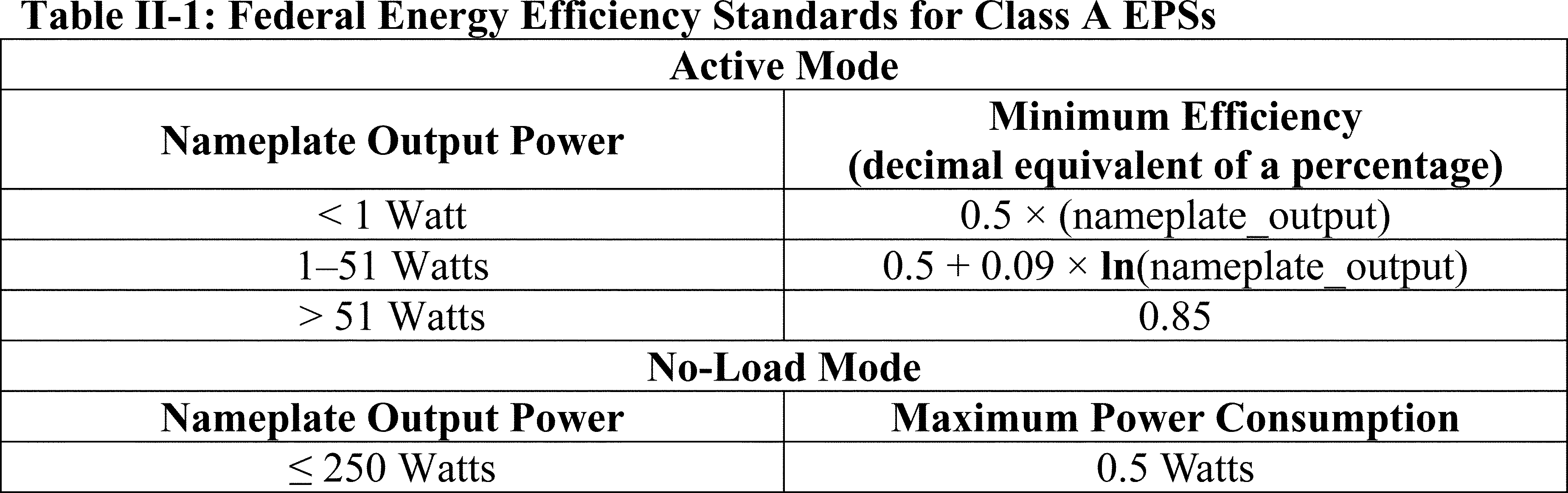
The common household wall wart is now under stricter regulation from the US Government. We can all testify to the waste heat produced by many cheap wall warts. Simply pick one at random in your house, and hold it; it will almost certainly be warm. This regulation hopes to save $300 million in wasted electricity, and reap the benefits, ecologically, of burning that much less fuel.

original
The old standard.

We don’t know what this means practically for the consumer. Will your AliExpress wall warts be turned away at the shore now? Will this increase the cost of the devices? Will it make them less safe? More safe? It’s always hard to see where new regulation will go. Also, could it help us get revenge on that knock-off laptop adapter we bought that go hot it melted a section of carpet?

However, it does look like most warts will go from a mandated 50-ish percent efficiency to 85% and up. This is a pretty big change, and some hold-out manufacturers are going to have to switch gears to newer circuit designs if they want to keep up. We’re also interested to hear the thoughts of those of you outside of the US. Is the US finally catching up, or is this something new?