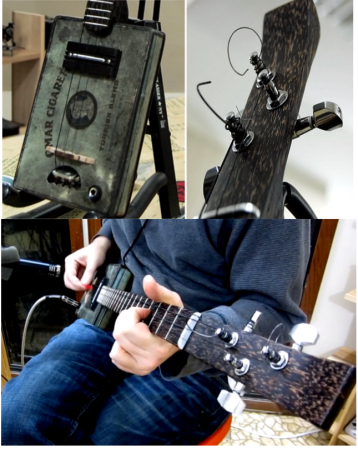
A Guitar From An Old Tin Box

omar-mos

[Atdiy and Whisker], collectively known as  [The Tymkrs] have been busy honing their luthier skills. They’ve created a 10 part YouTube series about the construction of their new cigar box guitar. Instead of a cigar box though, they’ve substituted a 1920’s tin cigarette box. The Omar Cigarette company gave “Project Omar” it’s name. Like [Tymkrs] previous guitar, Omar is a three string affair. The neck was cut from Black Palm, which really shined when polished with a mixture of orange oil and beeswax. They also threw in a couple of new tricks on this build. Omar is an electric guitar, with a pickup custom wound  by [Bob Harrison]. Omar also has frets, which creates a whole new set of complications. Frets are generally installed by cutting slits in the guitar neck with a fret saw. Rather than buy a new tool, [Tymkrs] created a simple jig for their mini table saw. The jig held the guitar neck perpendicular with the saw blade. This made quick work of the many fret slits to be cut. Installed frets must also be dressed and leveled, which is a time-consuming process. 

The tin cigarette box also created a new set of problems. The thin tin proved to be a bit on the weak side when the strings were tightened down. A bit too much pressure on the box while playing would cause notes to bend, much like the tremolo or whammy bar on a standard electric guitar. [Tymkrs] were able to counteract this by adding bracing inside, and a couple of black palm braces to the back of the box.

Hum was also a problem. When [Tymkrs] first plugged in, they found they had more 60Hz mains hum than signal from their strings. Omar uses a classic single coil guitar pickup. Single coils will pick up noise from any magnetic field, including the field created by the studio electrical system. A humbucking pickup uses two coils to counteract this effect. Humbuckers also have a slightly different tone than single coils. [Tymkrs] wanted to stick with their single coil tone, so they counteracted the hum by raising the pickup closer to the strings. Higher pickups receive more signal from the strings, so this is basically a free signal to noise ratio improvement. They also grounded the entire tin box, along with Omar’s metal tail stock. The final build sounds great, as evidenced by the jam session toward the end of Video 10.

Continue reading “A Guitar From An Old Tin Box”

Fire At The Geek Group

Geek Group

The Geek Group, an absurdly large and well stocked hackerspace in Grand Rapids, Michigan caught fire yesterday.

You may recall The Geek Group from their many over-the-top projects that include a quarter shinker, a 200,000 Watt Tesla coil, enough capacitors to kill a demi-god, and a giant robot that crushes TVs. From what TGG has shown on their website and their YouTube, they have an amazing space that could still be the home of quite a few amazing builds.

According to Geek Group head honcho [Chris], the fire was caused by an overheated electric motor. No one was at the space at the time, but the fire was hot enough to crack the exterior brick and melt porcelain insulators in their high voltage lab. To add insult to injury, this was only TGG’s second day of being open to the public.

The folks at The Geek Group are looking for volunteers for their cleanup, so if you’re around the Grand Rapids area and would like to pitch in, head on over around noon today.

DARPA Robotics Challenge Trials Wrap Up

schaft-drive

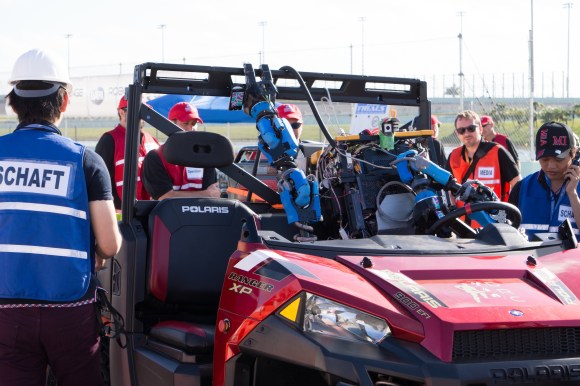
The DARPA robotics challenge trials 2013 are have finished up. The big winner is Team Schaft, seen above preparing to drive in the vehicle trial. This isn’t the end of the line for DARPA’s robotics challenge – there is still one more major event ahead. The DARPA robotics finals will be held at the end of 2014. The tasks will be similar to what we saw today, however this time the team and robot’s communications will be intentionally degraded to simulate real world disaster situations. The teams today were competing for DARPA funding. Each of the top eight teams is eligible for, up to $1 million USD from DARPA. The teams not making the cut are still welcome to compete in the finals using other sources of funding.

The trials were broken up into 8 events. Door, Debris, Valve, Wall, Hose, Terrain, Ladder, and Vehicle. Each trial was further divided into 3 parts, each with one point available. If a robot completed the entire task with no human intervention it would earn a bonus point. With all bonuses, 32 points were available. Team Schaft won the event with an incredible total of 27 points. In second place was Team IHMC (Institute for Human Machine Cognition) with 20 points. Team IMHC deserves special praise as they were using a DARPA provided Boston Dynamics Atlas Robot. Teams using Atlas only had a few short weeks to go from a completely software simulation to interacting with a real world robot. In third place was Carnegie Mellon University’s Team Tartan Rescue and their Chimp robot with 18 points.

The expo portion of the challenge was also exciting, with first responders and robotics researchers working together to understand the problems robots will face in real world disaster situations. Google’s recent acquisition — Boston Dynamics — was also on hand, running their WildCat and LS3 robots. The only real downside to the competition was the coverage provided by DARPA. The live stream left quite a bit to be desired. The majority of videos on DARPA’s YouTube channel currently consist of 9-10 hour recordings of some of the event cameras. The wrap-up videos also contain very little information on how the robots actually performed during the trials. Hopefully as the days progress, more information and video will come out. For now, please share the timestamp and a description of your favorite part with your comments.

Continue reading “DARPA Robotics Challenge Trials Wrap Up”

DARPA Robotics Challenge Trials Day 1

darpa-val1

Today was the first of two days of trials at the DARPA Robotics challenge at Homestead-Miami Speedway in Florida. Created after the Japan’s Fukushima nuclear disaster, The robotics challenge is designed to advance the state of the art of robotics. The trials range from driving a car to clearing a debris field, to cutting through a wall. Robots score points based on their performance in the trials. Much of the day was spent waiting for teams to prepare their robots. There were some exciting moments however, with one challenger falling through a stacked cinder block wall.

Pictured above is Valkyrie from NASA JPL JSC. We reported on Valkyrie earlier this month. Arguably one of the better looking robots of the bunch, Valkyrie proved to be all show and no go today, failing to score any points in its day 1 trials. The day one lead went to Team Schaft, a new robot from Tokyo based startup company Schaft inc. Schaft scored 18 points in its first day. In second place is the MIT team  with 12 points. Third place is currently held by Team TRACLabs with 9 points. All this can change tomorrow as the second day of trials take place. The live stream will be available from 8am to 7pm EST on DARPA’s robotics challenge page.

Continue reading “DARPA Robotics Challenge Trials Day 1”

Staff Update And Philanthropy

staff-update-and-philanthropy

It is my pleasure to welcome two new members of the Hackaday team. [Kevin Darrah] and [Kristina Panos] both have electronics backgrounds, and following in the tradition of the entire team they are long-time readers of Hackaday. Both are already hard at work. You can learn a bit more about them on the Staff Page.

While I have your attention the writers, editors and I would like to thank our parent company. We frequently refer to them as the “Evil Overlords” (actually, they started it!) but it’s turning out to be a really great relationship. I asked them to make a donation to Wikipedia in Hackaday’s name and they were happy to do so. Not only do we often link to Wikipedia in our articles, our writers use it constantly when researching for posts. Thanks SupplyFrame!

Developed On Hackaday: First Version Of The Hardware

mooltipass-schematic-featured

The Hackaday writers and readers are currently working hand-in-hand on an offline password keeper, the mooltipass (click to see the project description). 

Next in our Developed on Hackaday series, we present the first version of our schematics. There’s already been a lot of discussions going on in our dedicated Google group, mainly about the project’s basic functionality. Because our firmware developers wanted to get to work, we decided to send the first version of our hardware into production a few days ago. Before going through the schematics, let’s review the required list of the mooltipass’s core components:

  • an easily-readable screen
  • a read-protected smart-card
  • large flash memory to store the encrypted passwords
  • an Arduino-compatible microcontroller with USB connectivity

We’ve been drowning in component suggestions from motivated hobbyists, so we figured we’d make the mooltipass v1 as simple as possible and then move from there. Given this device is developed on Hackaday, we also wanted future users to modify it, building completely new projects based around these main components. Keep reading for our schematics…

Continue reading “Developed On Hackaday: First Version Of The Hardware”

Developed On Hackaday: Setting Up The Project’s Infrastructure

2013-12_Developed_on_Hackaday

We’re pretty sure that most of our readers already know it by now, but we’ll tell you anyway: the Hackaday community (writers and readers) is currently developing an offline password keeper. In the first post of our first DoH series, we introduced the project and called for contributors. In the comments section, we received very interesting feedback as well as many feature suggestions that we detailed in our second write-up. Finally, we organized a poll that allowed everyone to vote on the project’s name.

The results came in: the project’s name will be mooltipass. We originally had thought of ‘multipass’ but [asheets] informed us that Apple and Canon had both applied for this trademark. [Omegacs] then suggested ‘mooltipass’ as an alternative, which we loved even more. A few days ago we set up a google group which is already very active.

An often under-estimated side of a community driven project is its infrastructure and management. (How) can you manage dozens of motivated individuals from all over the globe to work on a common project? How can you keep the community informed of its latest developments?

Continue reading “Developed On Hackaday: Setting Up The Project’s Infrastructure”