Hackaday Twitter Hits 40,000 Followers!

hackaday-40k-twitter-followers

I’m not sure exactly how many readers keep an eye on our Twitter account: @hackaday. We hit a new milestone today at 40,000 followers. For those of you who have been watching the Twitter feed recently, you’ve probably noticed it’s no longer limited to simply announcing each new post as it hits the front page. Madness, right?

A little over a week ago [Mike] promoted me to the role of Community Editor; a new position here aimed at directly engaging readers. For now, that means helping to guide conversations in the comments toward a degree of helpfulness and productivity. I’ve also sent out a handful of tweets to sort of test the waters, but considering my job is to engage the community, I thought I’d just ask! What can we at Hackaday be doing differently with social media (particularly Twitter) that you would find valuable? Hit up the comments and let us know, or join the conversation on Twitter: #HaDSuggestionBox

Developed On Hackaday: First Feedback From Users

2013-12_Developed_on_Hackaday

Holy cr*p guys… we were amazed by the quantity of positive feedback that was left in the comments section of our last article. We have been featured by Slashdot ! We got plenty of project name suggestions, therefore we organized a poll located at the end of this post to let you decide which one is best. I also received many emails from people eager to start contributing to this offline password keeper project. If you missed the call and want to get involved, it’s still not too late. You can get in touch with me @ mathieu[at]hackaday[dot]com. So far, we have many beta testers, several software developers, one security assessor and a few firmware developers. Next step is to create a mailing list and a Hackaday forum category once the project’s name has been chosen.

Obviously, the very first post of our “Developed On Hackaday” series was to gauge your initial reactions to this ‘new’ project. Notice here the double quotes, as when someone has a new idea there usually are only two possibilities that may explain why it doesn’t exist in the market yet: either it is completely stupid or people are already working on it. In our case, it seems we are in the second category as many readers mentioned they wanted to work/were working/had worked on a similar product. As we’re selfish, we offered them to contribute to this new device.

To ensure that all of our readers are on the same page as to how the device will work we embedded a simple block diagram after the break, as well as a list of all new functionalities that we want to implement given the feedback we received. So keep reading to see what the future holds, as well as to vote on this new project’s name…

Continue reading “Developed On Hackaday: First Feedback From Users”

Meet The Teensy 3.1

[Paul Stoffregen] just released an updated version of his Teensy 3.0, meet the oddly named Teensy 3.1. For our readers that don’t recall, the Teensy 3.0 is a 32 bit ARM Cortex-M4 based development platform supported by the Arduino IDE (using the Teensyduino add-on). The newest version has the same size, shape & pinout, is compatible with code written for the Teensy 3.0 and provides several new features as well.

The Flash has doubled, the RAM has quadrupled (from 16K to 64K) allowing much more advanced applications. The Cortex-M4 core frequency is 72MHz (48MHz on the Teensy 3.0) and the digital inputs are 5V volts compatible. Pins 3 and 4 gained CAN bus functions. The new microcontroller used even has a 12 bits Digital to Analog Converter (DAC) so you could create a simple signal generator like the one shown in the picture above. Programming is done through the USB port, which can later behave as host or slave once your application is launched. Finally, the price tag ($19.80) is in our opinion very reasonable.

Embedded below is an interview with its creator [Paul Stroffregen].

Continue reading “Meet The Teensy 3.1”

Oculus Rift Goes From Virtual To Augmented Reality

[William Steptoe] is a post-doctoral research associate at University College London. This means he gets to play with some really cool hardware. His most recent project is an augmented reality update to the Oculus Rift. This is much more than hacking a pair of cameras on the Rift though. [William] has created an entire AR/VR user interface, complete with dockable web browser screens. He started with a stock Rift, and a room decked out with a professional motion capture system. The Rift was made wireless with the addition of an ASUS Wavi and a laptop battery system. [William] found that the wireless link added no appreciable latency to the Rift. To move into the realm of augmented reality, [William] added a pair of Logitech C310 cameras. The C310 lens’ field of view was a bit narrow for what he needed, so lenses from a Genius WideCam F100 were swapped in. The Logitech cameras were stripped down to the board level, and mounted on 3D printed brackets that clip onto the Rift’s display. Shapelock was added to the mounts to allow the convergence of the cameras to be easily set.

Stereo camera calibration is a difficult and processor intensive process. Add to that multiple tracking systems (both the 6DOF head tracking on the Rift, and the video tracker built-in to the room) and you’ve got quite a difficult computational process. [William] found that he needed to use a Unity shader running on his PC’s graphics card to get the system to operate in real-time.  The results are quite stunning. We didn’t have a Rift handy to view the 3D portions of [William’s] video. However,  the sense of presence in the room still showed through. Videos like this make us excited for the future of augmented reality applications, with the Rift, the upcoming castAR, and with other systems.

Continue reading “Oculus Rift Goes From Virtual To Augmented Reality”

Stealing $100 Million In Bitcoins

In early October of this year, online Bitcoin marketplace and ‘the eBay of drugs’ The Silk Road was taken down by the FBI. Just after the black vans took Silk Road head honcho [Dread Pirate Robberts] away, a new Bitcoin marketplace came onto the scene called Sheep Marketplace. Sheep Marketplace closed after revealing that 5400 bitcoins – or $5.8 million USD were stolen by the user EBOOK101 by exploiting a bug in the Sheep site.

Over this last weekend, it was revealed this bug in the Sheep Marketplace site wasn’t responsible for the loss of 5,400 coins, but instead 96,000 BTC, or $100 million USD, making this one of the largest thefts of all time.

Whoever was responsible for this theft didn’t make a clean getaway. Because the Bitcoin block chain records the history of every transaction, laundering bitcoins is harder than it seems. The most common method is to ‘tumble’ the bitcoins – sending them through multiple wallets, combining and recombining them, until tracking groups of bitcoins just becomes too hard.

[sheeproadreloaded2] over on Reddit managed to track these bitcoins to this bitcoin address, an amazing feat that also means there are 96,000 coins in a wallet somewhere that can’t be spent or cashed out without the thief telling the world who he is.

As far as crimes of the century go, this one is at least in the top ten. Unless the thief behind this heist is extraordinarily smart, though, his identity will most likely be found out eventually.

UK Cops Fear Gun; Pointlessly Seize 3D Printer

quoteGUNquote

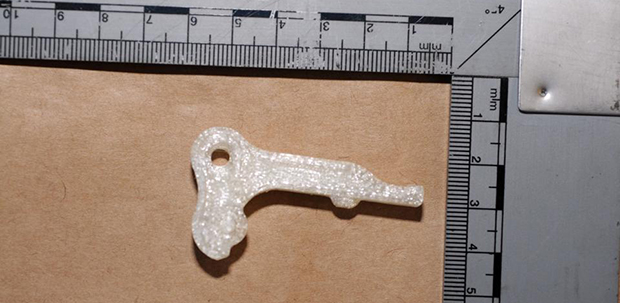
Above, according to the greater Manchester Police force, is a 3D printed gun. Well, the rozzers say it’s merely a trigger for a gun. In part they’re actually correct; it is a trigger. For a spring-loaded extruder for the Makerbot Replicator.

For the past few days, the media has been abuzz about the first seizure of a 3D printer (a Makerbot Replicator 2) in Manchester, UK during a raid on suspected gang members. Despite numerous complaints and comments by makers across the UK (thanks, guys), Assistant Chief Constable [Steve Heywood] says, “We need to be absolutely clear that at that this stage, we cannot categorically say we have recovered the component parts for a 3D gun.” The seized 3D printer parts are being sent to ballistics experts to determine if a random piece of plastic can be used in the manufacture of handguns.

Alright kiddos, editorial time. We’re quite aware that the UK is a little…. different… than the US when it comes to firearms regulation. Nevertheless, we feel the need to defend anyone with a 3D printer, in a handy Q&A format:

What this has also done is open up a wider debate about the emerging threat these next generation of weapons might pose.

No, it doesn’t. I don’t know what the British equivalent of a Home Depot is, but I could go to that store, buy some stuff, and build a zip gun. Of course I wouldn’t, because that’s not safe. I could also use a mill and lathe to make a proper gun.

But it’s made of plastic and thus undetectable

Bullets aren’t. Also, I could machine some Delrin. You should really watch In the Line of Fire.

But plans for 3D printed guns are available, making it easy for anyone to fabricate their own gun

Yeah, and Hackaday made one. There were a lot of problems with those 3D printer files. The spring wouldn’t slice, the hammer wouldn’t print, every part was out of scale, and you’d need a lot of experience in 3D modeling and design to turn those ‘plans available on the Internet’ into something you can send to a printer.

Your posting this article further sensationalizes the role of 3D printers in gun control.

You’re right. Here’s what you do: every time someone mentions 3D printed guns, say, “You can build an even better gun with a combo mill/lathe that costs the same as a 3D printer. Equal skill is required to operate both machines. Do you intend to ban the sale or use of machine tools?”

But UK gun laws are weird.

Then print a knife.

via reddit

CAN Hacking: The In-vehicle Network

Last time, we discussed how in-vehicle networks work over CAN. Now we’ll look into the protocol and how it’s used in the automotive industry.

The Bus

On the hardware side, there’s two types of CAN: differential (or high-speed) and single wire. Differential uses two wires and can operate up to 1 Mbps. Single wire runs on a single wire, and at lower speeds, but is cheaper to implement. Differential is used in more critical applications, such as engine control, and single wire is used for less important things, such as HVAC and window control.

Many controllers can connect to the same bus in a multi-master configuration. All messages are broadcast to every controller on the bus.

An oversimplified in-vehicle network

Continue reading “CAN Hacking: The In-vehicle Network”