SOAP Drama: An Interview With The SOAP Creators

A few days ago, we caught wind of SOAP, a Kickstarter project for an Android-based home automation router. With a quad-core ARM, quad gigabit Ethernet ports, 802.11ac, SATA, and every radio under the sun – all for $100 (sans display, $170 with display), it seemed too good to be true. At the time, it probably was: the images from the PCB prototype were taken from [Bunnie Huang]’s open source laptop, there weren’t enough Ethernet ports for a router, and the hardware just seemed all wrong.

The guys behind SOAP have decided to respond to these accusations by posting a huge update on their Kickstarter page and answering a few questions from me. Interview follows below.


HaD: There’s a BOM/cost analysis breakdown for the Essentials package (the SOAP sans display) that puts the total cost at about $130. This is the reward for pledging at the $100 level. How accurate is this cost analysis, and how do you plan on meeting that reward level?

SOAP: This cost analysis that you mention is very accurate. We will not profit on the early release pricing of $60.00 we have taken the loss leader pricing to attract backers and press (and we think we have done a good job). We are working with a large router manufacturer and this is really the link that makes the pricing possible without them we couldn’t do this.

HaD: You’re using a Quad Core Freescale i.MX processor for SOAP, and putting a four port Gigabit router in there. The Quad core i.MX chips only have one Gigabit port, and that’s limited to 470 Mbps. How are you solving this problem, and what are you using as a MAC/PHY?

SOAP: First off let me state that we are very aware of the CPU limitations and we have done a lot of work on finding a solution and we do have a unique solution. We have support from a big player in the router industry that has offered us a unique solution that we have been working on to bypass this issue. We will post more on this after our trip to San Jose. This is our fallback method and yes its benchmarks are not as pretty as we want them but they are getting there and we feel with enough tweaks we can get this to decent level.

This is from our layout guy: We are planning I.mx processor’s gigabit port will be connected to external IC working as a switch. 1Gb ethernet -> 1 to 4 switch -> 4x Gb Ethernet ports. Possible  http://www.ti.com/lit/ds/symlink/tnetx4090.pdf. Use 4 ports from there plus put RGMII Ethernet transceiver from Marvell  for each ETH port and we will have on board Ethernet switch.

HaD: What WiFi chipset/chipsets are you using? Will that/they be able to do 802.11ac at full speed, and how are you doing this with (I think) only one antenna on the updated board images?

SOAP: The speeds have varied greatly on the chipset and how buggy the software was for the day but we have clocked speeds over 1 gigabyte per second and we will continue to develop this further to achieve maximize speeds this is where our new Union with the guys over at Droidifi will help.

In our prototype we tested Avastar 88W8864, Broadcom 4360 , and a couple more that failed to actually work.  We didn’t get those all functioning like we would have wanted as there is little support for android and router chipsets to date. We demo with a Broadcom chipset.

We want to use Quantenna QAC2300 but at current funding we will be using the Broadcom we have received a lot of suggestions from our backers and a new big player behind us that thinks they have the right match we are waiting to announce this after our meeting in San Jose.

We have one antenna on the most current design but we are planning on adding two more for the final design. We didn’t place them on the most recent design because we are waiting to see how much funding we get to finalize the wifi chipset. We didn’t want antenna design that worked best with a Broadcom when we switch to Marvel or Quantenna.

HaD: What is the status of the software? Do you have a repo somewhere that people could look over?

SOAP: We have been working with a new player from the older kickstarter project called Droidifi. We will be working with them on the software. This is a something we haven’t been able to announce till we lock it down but you are the first to know about this union. Check out our update later today.

HaD: Finally, do you have a functional prototype with the quad-core i.MX, four Ethernet ports, and WiFi? Can we see a video?

SOAP:  If you mean a mass production ready device that can be used by an end user then no. We have a solid functioning proof of concept prototype. We have a lot of Demo videos of our POC that show  what we have developed so far.  We  have to have the current PCB design manufactured to get down to the more rigorous testing and qualifying. All the specs listed on our kickstarter are what we currently are planning and we hope to fulfill the tech specs.

HaD: There are some other questions in the Kickstarter comments section, but honestly I don’t care about how many Twitter followers you have.

SOAP: Twitter was our marketing company. We thought people actually were following us but we have  since found out that half of them are not real. Check this out though.

All in all we understand how ambitious this project looks and we also know that it technology development can run into roadblocks and things but we want to be clear we are not a scam and we are quite aware where these attacks have originated. We will continue to work hard on this project, we will not be running off to Costa Rica and we plan on seeing everyone at CES next year.


The TL;DR for everyone without an attention span:

Yes, the $100/$170 price is too good to be true. It’s called a loss leader to generate interest. This part was a success. The SOAP guys are partnering with the DroidFi guys for the operating system. The Gigabit Ethernet will probably work, and the WiFi is limited by *nix chipset support. No complete functional prototypes yet.

So there you go. It’s not the ideal update with the SOAP crew showing off a shipping container of units ready to be shipped, but the project isn’t in as bad a shape as I originally thought.

Welcome To Droning On

droning-on-logo

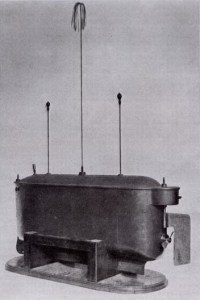
Tesla_boat1Welcome to Droning On, Hackaday’s new column covering all things unmanned. In this column we will primarily focus on aerial vehicles, both fixed and rotary wing. Expect to see traditional R/C, as well as First Person View (FPV) models, computer controlled autopilot systems, as well as anything new that shows up on our radar.
First, a little bit of history. The earliest radio control vehicle in history was designed by a man known well to Hackaday, Nikola Tesla. Tesla presented a radio controlled boat at an electrical exhibition in New York in 1898. Tesla called the system “Teleautomaton” and said the craft utilized a borrowed mind. In addition to cruising around a man made pond, the boat could solve equations by blinking lights atop two of its masts. Tesla would encourage viewers to call out math equations, then flash the lights from the boat’s control panel.

For many years R/C as well as its cousins Free Flight and control line were hobbies occupied solely by hackers. One needed to have metal machining skills to build engine parts, draftsman skills to read plans, and carpentry skills to build airframes. Radios were built from tubes. Control, if it may be called such, was all or nothing – so-called “bang-bang” systems. Much like their model railroad compatriots, R/C plane modelers built with the parts they had on hand. Several early DIY R/C planes were controlled by rotary telephone dials. Dial 1 to pull up, 2 to turn left, etc. Control surfaces were moved by rubber powered escapements rather than the servos we’ve come to know and love. Aerodynamics also came into play. With such rudimentary control systems, planes were designed to be inherently stable. Thankfully there were numerous proven air frame designs available from the free flight arena. Slow flight, high dihedral, and docile stall behavior were the rule of the day. Early R/C planes could be thought of as free flight vehicles with occasional suggestions via radio control. Click past the break to find out more about drone history, and to read about the recent FAA judgement.

Continue reading “Welcome To Droning On”

Web Controlled Servo From A BeagleBone Black

bbb_servo

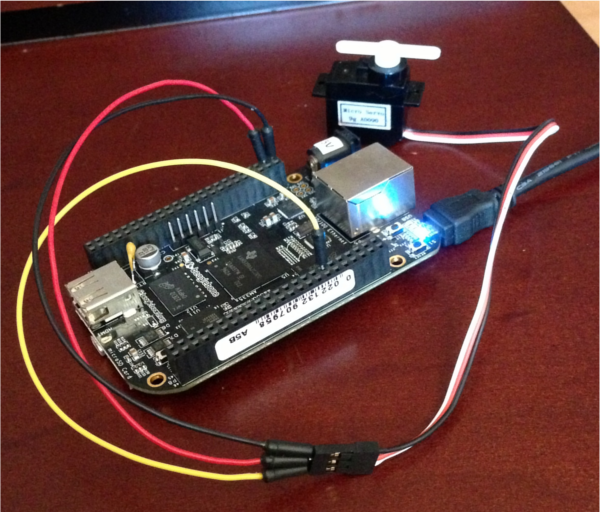
[Babak] created an in-depth tutorial on how he got his BeagleBone Black to control a servo from a web browser.

[Babak] configured a pin on his BeagleBone Black (BBB) as a PWM line and connected it to the control line on a micro hobby servo. The BBB is running a Node.js web server that displays a simple web page to control the servo. The browser sends a WebSocket request to a small WebSocket node server also running on the BBB that then writes the appropriate PWM value to the pin connected to the servo.

The code for node WebSocket server and web server can be found on his GitHub page. There is also a small node library to control PWM lines on the BBB. Though the end result is simple, controlling the servo can be done from any browser that can make a network connection to the BeagleBone Black. Check out the video after the jump for a description and demonstration.

Continue reading “Web Controlled Servo From A BeagleBone Black”

Using An NRF24L01 For Air Bootloading

nrfboot_small

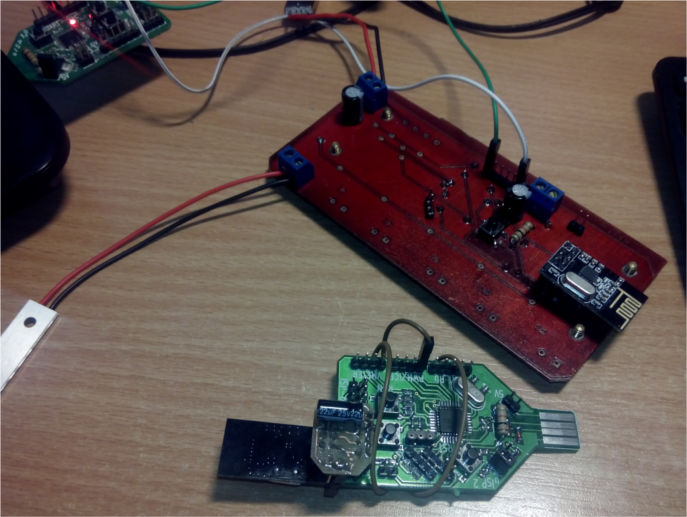
[Necromant] wrote a library to flash his microcontroller over an RF link using an NRF24L01 wireless communication module. The NRF24L01 is a cheap RF module that can be easily integrated into many microcontroller projects. Though there are Arduino libraries for driving the NRF24L01, [Necromat] decided to make a port of one with no Arduino dependencies.

The resulting bootloader fits into 4K of RAM flash with packet loss and recovery along with user-configurable hardware or software SPI. Programming speeds are not the highest, but [NecromatNecromant] believes this to be a property of the VUSB rather than the transfer rate from the NRF24L01 or the target microcontroller.

To program the target AVR chip, [NecromatNecromant] used another NRF24L01 module connected to his uISP dongle over USB.  Using a custom tool to interface with the uISP, the target board can be programmed in a similar fashion as avrdude. Check out the code for the ISP dongle and the AVR bootloader on his GitHub page.

TI Launches “Connected LaunchPad”

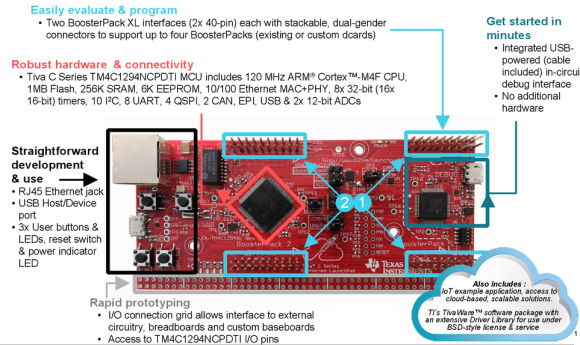
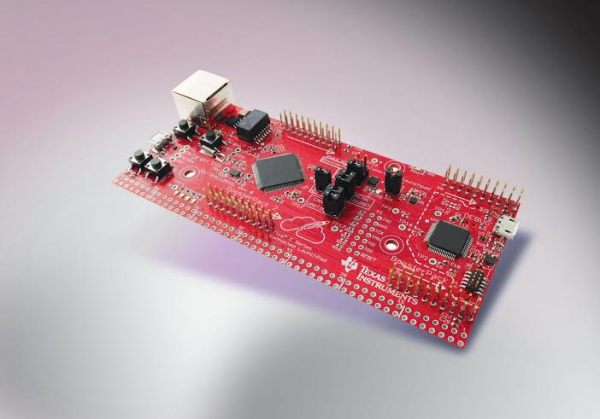
TI’s LaunchPad boards have a history of being both low cost and fully featured. There’s a board for each of TI’s major processor lines, and all of them support the same “BoosterPack” interface for additional functionality. Today, TI has announced a new LaunchPad based on their new Tiva C ARM processors, which is designed for connectivity.

The Tiva C Series Connected LaunchPad is based on the TM4C129x processor family. These provide an ethernet MAC and PHY on chip, so the only external parts required are magnetics and a jack. This makes the Connected LaunchPad an easy way to hop onto ethernet and build designs that require internet connections.

This development board is focused on the “Internet of Things,” which it seems like every silicon manufacturer is focusing on nowadays. However, the real news here is a low cost board with tons of connectivity, including ethernet, two CANs, 8 UARTs, 10 I2Cs, and 4 QSPIs. This is enough IO to allow for two BoosterPack connectors that are fully independent.

Connected Launchpad Details

For the launch, TI has partnered with Exosite to provide easy access to the LaunchPad from the internet. A pre-loaded demo application will allow you to toggle LEDs, read button states, and measure temperature over the internet using Exosite. Unlike some past LaunchPads, this one is designed for easy breadboarding, with all MCU pins broken out to a breadboard compatible header.

Finally, the price is very right. The board will be release at $19.99 USD. This is less than half the price of other ethernet-ready development boards out there. This makes it an attractive solution for hackers who want to put a device on a wired network, or need a gateway between various devices and a network. 

Searching For Makers In Washington DC

makeDC

Despite there being an inordinate amount of techies and tech companies in the Washington, DC/Northern Virginia area, there aren’t really that many hacker/makerspaces, or really anywhere else for tinkering, building, and generally futzing around with a soldering iron. [Zach] thought it was time for a change and is now organizing the second Make DC an informal get together to show off your latest projects and builds. Here’s the best part: Hackaday is coming, and we’re bringing some sweet swag.

Right now [Matt] has two talks lined up focused on bringing APIs into the physical world. There’s space for plenty more speakers, so if you have something to show off be sure to sign up.

The event is scheduled for Wednesday, March 19, 6:30 PM, half a block away from the Dupont Circle Metro station. Be there. You’ll get a sticker at least.

Atmel Announces SmartConnect WiFi Modules

Atmel SmartConnect

This week we talked with Atmel about their new WiFi solutions targeting Internet of Things applications. Back in 2012, Atmel acquired Ozmo, a company focused on point-to-point WiFi solutions using WiFi Direct. These devices are known as SmartDirect, and have been available for some time.

Atmel has just announced a new product line: SmartConnect. This moves beyond the point-to-point nature of WiFi Direct, and enables connections to standard access points. The SmartConnect series is designed for embedding in low cost devices that need to connect to a network.

The first devices in the SmartConnect line will be modules based on two chips: an Atmel SAMD21 Cortex-M0+ microcontroller and an Ozmo 3000 WiFi System on Chip. There’s also an on-board antenna and RF shielding can. It’s a drop in WiFi module, which is certified by the FCC. You can hook up your microcontroller to this device over SPI, and have a fully certified design that supports WiFi.

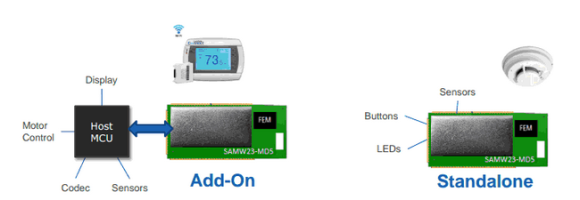
There’s two ways to use the module. The first is as an add-on, which is similar to existing modules. A host microcontroller communicates with the module over SPI and utilizes its command set. The second method uses the module as a standalone device, with application code running on the internal SAMD21 microcontroller. Atmel has said that the standalone option will only be available on a case to case basis, but we’re hoping this opens up to everyone. If the Arduino toolchain could target this microcontroller, it could be a great development platform for cheap WiFi devices.

SmartConnect Architectures
The Add-On and Standalone Architectures

At first glance, this module looks very similar to other WiFi modules, including the CC3000 which we’ve discussed in the past. However there are some notable differences. One major feature is the built in support for TLS and HTTPS, which makes it easier to build devices with secure connections. This is critical when deploying devices that are connected over the internet.

Atmel is claiming improvements in power management as well. The module can run straight from a battery at 1.8 V to 3.3 V without external regulation, and has a deep sleep current of 5 nA. Obviously the operating power will be much higher, but this will greatly assist devices that sporadically connect to the internet. They also hinted at the pricing, saying the modules will come close to halving the current price of similar WiFi solutions. SmartConnect is targeting a launch date of June 15, so we hope to learn more this summer.

We’re always excited to see better connectivity solutions. If Atmel comes through with a device allowing for cheaper and more secure WiFi modules, it will be a great part for building Internet of Things devices. With a projected 50 billion IoT devices by 2020, we expect to see a lot of progress in this space from silicon companies trying to grab market share.