Upverter: It’s Like Github For Hardware

If there’s one thing we’ve noticed about hardware hackery and electronics project, it’s that all the resources to build a project are scattered about the Internet on forums, blogs (heh), and personal web pages. Enter Upverter. The fellows who started Upverter had the same observation, and after some Y Combinator funding, launched what they hope to be “The Github of electronics” and the “Google Docs of hardware design.”

Upverter has the features we would expect – forking, versioning, and integration with Github for a project’s code. Already there’s a few cool projects, like a PIC programmer, a TV-B-Gone, and a tiny version of Conway’s Game Of Life.

We’re not ready to wave the banner of an Upverter fanboy quite yet. There’s quite a number of components available in the schematic editor, but from our experience the component library could use some refinement both by weeding out duplicates and increasing the number of parts. We’d also like to put a zoom control for the schematic view on our wish list. Upverter doesn’t have a PCB editor either, but from this post from a VC rag, the team is working on one. While this is really just nitpicking – Upverter launched less than 24 hours ago – we’ll be happy to see the some projects roll in on the tip line that are hosted on Upverter.

EDIT: link to the Google cache, because we probably Slashdotted it. It’s up for now.
Recycled Clock Spins Round And Round To Tell Time

pop_bottle_recycled_clock

[duckcrazy] recently shared the details on a clock he built, using recycled components to tell time.

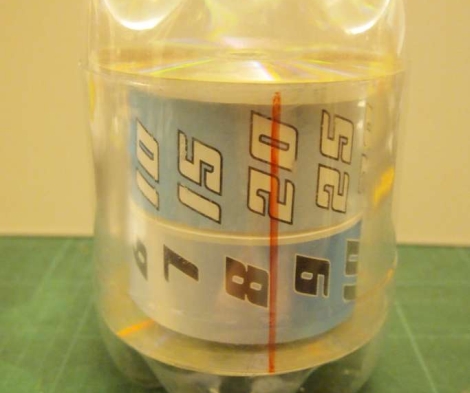
He began his project by dismantling a handful of carefully selected pop bottles and an old clock. The bottom and midsection of the bottles were saved, and he verified that they could be easily inserted within one another. The base of the clock is made up of a CD, on which the clock’s motor components were mounted.

He constructed two open paper cylinders bearing hour and minute designations, then glued the respective clock hands inside. The cylinders and clock hands were re-mounted onto the clock’s motor, and the entire thing was enclosed within the pop bottles.

It’s a novel way to build a clock, and moving beyond the plastic bottles and paper for a moment, there’s a lot of potential for some even cooler designs based on his work. We imagine that laser-etched cylinders powered by a micro and a continuous rotation servo would be pretty sweet, though that’s just the tip of the iceberg.

Digging Deep Into The Neato’s LIDAR Module

[Hash] is going to great lengths to learn about the parts used in his Neato XV-11 LIDAR (dead link; Internet Archive). We looked in on his work with the XV-11 platform recently, where he used the dust bin of the vacuum as a modular hardware housing. This hack is a hardware exploration aimed at figuring out how an equivalent open hardware version can be built.

The LIDAR module is made of two big chunks; the laser and optic assembly, and the sensor board seen above. [Hash] put it under the microscope for a better look at the line scan imager. The magnification helped him find the company name on the die, this particular part is manufactured by Panavision. He figured out the actual model by counting the bonding wires and pixels in between them to get a pretty good guess at the resolution. He’s pretty sure it’s a DLIS-2K and links to an app note and the datasheet in his post. The chip to the right of the sensor is a TI digital signal processor.

Putting it back together may prove difficult because it will be impossible to realign the optics exactly as they were–the module will need to be recalibrated. [Hash] plans to investigate how the calibration routines work and he’ll post anything that he finds. Check out his description of the tear down in the video after the break.

Continue reading “Digging Deep Into The Neato’s LIDAR Module”

Weekly Roundup 9/10/11

In case you missed them, here are the most popular posts from the previous week.

Our most popular post was one of our Engine Hacks about a remote control airplane built by [Bruce Simpson] that has a pulse jet attached to it. It’s noisy and fast! Want to wake up the whole neighborhood, fly one of these around early in the morning.

Next up is this post about an unique window display that [Alex] built which draws onto the glass using a pair of stepper motors and a felt tipped pen. He is using processing and an arduino to control the motors. The end effect is that this device can draw gray scale images.

After that is another one of our Engine Hack posts where we show a lawn mower that has been converted to run on steam. This one is most definitely a hack and seems somewhat dangerous to boot.

This post shows off a working PIP-Boy 3000 created by [MyMagicPudding]. If you are a fan of Fallout, this is one to check out.

Finally, this post shows off a very large 3D printer that can print items as large as 15.8″ x 15.8″ x 12.7″. This is a custom built device and has a very nice writeup showing how it is put together.

Engine Hacks – Tesla Turbines

Engine Hacks Theme banner

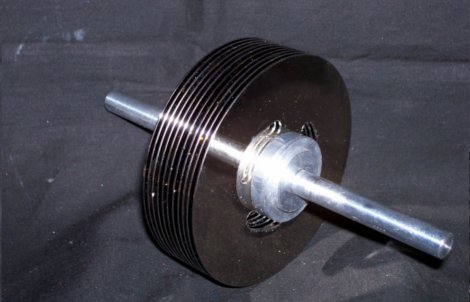
You probably weren’t expecting a project based on [Nikola Tesla’s] work to show up during the Engine Hacks theme. Most people know of him because of his pioneering work with high voltage equipment. Never the less, [Tesla] designed a device that later became known as the Tesla Turbine. Tesla turbines are made out of a series of thin disks attached to a central rotor. Air or steam is injected into the closed turbine housing at the outer edge of the disks. It swirls around through the turbine blades and eventually exits near the rotor. This type of turbine can achieve very high rotational speeds but doesn’t have a lot of torque, which limits their usefulness. Check out this instructable that shows you how to build your own Tesla turbine out of hard drive platters.

We have featured a Tesla turbine in the past on Hackaday. In this previous post, [Rick] shows us how to carve a pumpkin with a skill saw blade that is powered by one of these turbines.

DIY Portable Charger/generator

portable_charger_generator

[Glenn] from The Back Shed has built a lot of windmills and stationary generators over the years, but recently decided to try his hand at building something a bit more portable.

The charger is based of a relatively simple design, employing a 5.2 HP Kubota 4 stroke motor and a 12v car alternator to provide power. While you might be inclined to point out that his charger does exactly what an alternator and motor are built to do, there was a bit more to it than simply slapping the two parts together.

A laser cut adapter plate holds the motor and alternator together, but once [Glenn] wrapped things up and gave the motor a spin, he realized that he was driving the alternator backwards. This would eventually cause the alternator to overheat since the cooling fan was running the wrong way. He removed the fan and reversed the fins with a hammer so that he could get the cooling he needed without having to reinstall the alternator in the opposite orientation.

The whole kit was mounted on a hand truck for portability, and [Glenn] says that the charger/generator only needs to run about 5 minutes before a dead battery has enough juice to crank an engine.

[via HackedGadgets]

Need Something In A Pinch? SparkFun Products Now At Micro Center

sparkfun_available_in_microcenter

If you happen to live near a Micro Center retail store, you are now lucky enough to have another choice when it comes to purchasing DIY electronics components – SparkFun is selling their products at all Micro Center retail outlets.

While it seems SparkFun announced this change in June, we’re seeing quite a bit of buzz on the topic today. We’re pretty sure their entire catalog won’t be available in store, but they are promising a “wide-range of SparkFun products at all 23 Micro Center locations across the country.”

Known for being very DIY-friendly when it comes to building your own PC, Micro Center was a logical choice for SparkFun. There are definitely times when you need/want a part right away rather than waiting for it to ship, so this seems to be an ideal situation for hackers and makers within range of a Micro Center retail store.

This announcement definitely has us wondering if this will be one of the final nails in the Radio Shack coffin. While Micro Center doesn’t have nearly the market penetration Radio Shack does, a wider selection of components and a friendly, knowledgeable staff makes the SparkFun/Micro Center combination is a compelling one.

What are your thoughts? Let us know in the comments.