Nokia Booklet And N900

21nokia-booklet-3g-group

Nokia is currently one of the leading phone providers and intends to jump higher on the scale with the Nokia N900 powered by Maemo. But what wasn’t expected was for Nokia to step into the netbook pool. Called the Booklet 3G, it sports 10.1 inch high(er) resolution display with HDMI output. For connectivity you can take your pick of 3G, WiFi, and Bluetooth. All wrapped up in Windows 7 with a whopping 12 hour battery! However, the problem with all these features is the price tag might eat a hefty hole into your pocket book. That’s not going to stop us from trying to get our hands on one, of course. Anyone have any hacks planned yet?

Autogiro POV Nostalgia

blade_screen (Custom)

This bit of nostalgia really caught our attention. A german hacker or “inventor” as we were called back then, came up with this interesting concept. He would project an image on to the moving blades of an Autogiro, relying on the POV effect to make it appear complete. While this is not the same system of utilizing POV that we currently use, it relies on the same principles. It looks like he’s hanging the projector or “magic lantern” from below the Autogiro, using the length of the rope to hang it as a focusing system. Were this to have actually gone into production, it probably would have really freaked people out. If only he had had access to something along the lines of the ceiling fan POV system.

[thanks itay]

[update: Why didn’t we look around for this earlier. It was brought up in the comments, there is in fact a POV system for R/C helis. http://www.nightgraphix.de (translated)]

CBS To Advertise Using Video-in-Print Technology

[youtube=http://www.youtube.com/watch?v=fgJ6DA50thw]
In what seems like another move to blur the line between digital and print media, CBS has announced that they will be introducing something called Video-in-Print technology in next month’s issue of Entertainment Weekly. Video-in-Print, or ViP, technology consists of a small LCD screen and circuit board that can be inserted into print media and play video and audio content. CBS is using the ViP technology to promote their fall prime-time television lineup. Video-in-Print technology is the brainchild of Americhip, a company that claims to specialize in multisensory marketing. The ViP player in next month’s issue of Entertainment Weekly incorporates a 320×240 resolution TFT LCD screen and a rechargeable battery lasting 50-60 hours. The battery can be recharged via the player’s on-board mini USB port. While this isn’t the first time that we’ve seen a magazine do something like this, as far as we know this is the first time that anyone has put a video player into a magazine. That being said, there seems to be no indication whether or not CBS will make it easy for us to modify the ViP player’s software like Esquire did with their e-ink display. We’re not entirely sure what we’re going to do with the ViP player, but the fact that it has a mini USB port gives us some interesting ideas. Juicebox, anyone?

Hacking At Random

504x_camplikeapirate

The 20th Hacking At Random has recently come to a finish. For the unititiated, Hacking At Random or HAR is a massive hacker festival that happens every four years in the Netherlands. Four days of technology obsessed hacking with roughly 2500 people definitely piques our interest. The event is riddled with classes and people speaking on subjects such as censorship and robotics. Quickly built networks sprawl across the entire area, with shacks set up for location of servers. We think there should be an official Hack A Day tent there next time. We mentioned HAR when we were talking about impromptu DECT networks and DECT phone modification. Be sure to browse through the multitudes of pictures located on the HAR website.

Teardown Of The Barista

main

iFixit has done a tear down on the symbolic do-it-yourself Espresso machine, the Starbucks Barista. Believe it or not, there is not a single circuit board in the works. There doesn’t seem to be much to the Barista; A few switches, some solenoids, a heater, and one way spring valve among other things. The assembly of the device is very simple. It is noted that in a pinch it may be torn down with a pair of pliers and washer; in place of a flat head screw driver. We have pondered the possibilities of this machine numerous times, while enjoying a cup of cappuccino. Though most conversations end at the bottom of the cup, many survive such as this Silvia PID looped expresso machine. The very name “Mecha turbo crazy coffee roaster” seems to encapsulate the effects of caffeine quite adequately.

Adafruit Releases New TV-B-Gone Kit

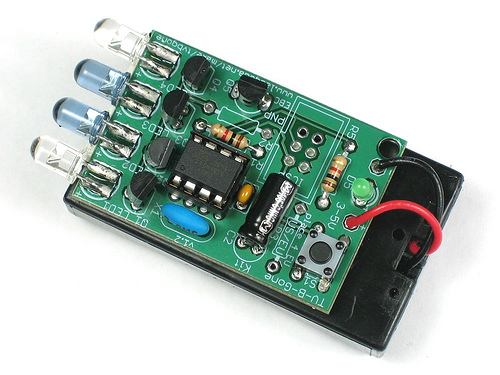
Recently, our friends over at Adafruit released a new version of their popular TV-B-Gone kit. Built in cooperation with [Mitch Altman], the inventor of the TV-B-Gone, the new kit sports four high power IR LEDs, two wide beam and two narrow beam. The four LEDs give the new TV-B-Gone increased range, with a maximum distance of over 150ft. One of the most impressive features of the kit is the fact that the new TV-B-Gone is universal and can now work in Europe and Asia in addition to the US. Users are able to select which region they want to use during the build process by soldering a resistor into the board at their region’s corresponding spot as seen in the picture above. The new TV-B-Gone kit is now available in the Adafruit store for $19.95 plus shipping.

EEVblog: The Electronics Engineering Video Blog

[youtube=http://www.youtube.com/watch?v=v1YrANSmOGY&fmt=18]
Have you ever wanted to see what it’s like inside of a PCB assembly factory? Have you ever wondered how digital storage oscilloscopes work? If so, be sure to check out the EEVblog podcast. The Electronics Engineering video blog podcast, hosted by [Dave Jones], was created for anyone interested in learning more about electrical engineering. While some knowledge of electronics definitely helps, [Dave]’s thorough explanations and firsthand knowledge in the field of electrical engineering make the video blog easily accessible to beginners in the field. The EEVblog covers a wide range of electronics related topics, offering everything from multimeter reviews to GSM mobile phone audio design advice. In the latest episode (shown above), [Dave] discusses and demonstrates how to solve the infinite resistor problem, involving measuring the resistance at different points of an infinite grid of resistors that all have the same resistance. In addition to giving a detailed explanation, [Dave] created a 14 x 14 grid of 420 10ohm resistors to demonstrate how to solve the problem. While we’ve only mentioned a few episodes here, be sure to check out all 25 episodes of the EEVblog podcast and subscribe to the RSS feed so you’ll never miss an episode.