Raspberry Pi Goes Public

We’ve heard rumors for the last few months, and now it looks like they’ve come true: the business side of Raspberry Pi, Raspberry Pi Holdings has become a publicly listed company on the London Stock Exchange.

We heard rumblings about this a while back, and our own [Jenny List] asked the question of what this means for the hobbyist and hacker projects that use their products. After all, they’ve been spending a lot of money making new silicon, and issuing stock helps them continue. Jenny worried that they’d forget that what sells their hardware is the software, but ends up concluding that they’ll probably continue doing more of the same thing, just with better funding.

Raspberry Pi CEO [Eben Upton] said basically the same when we asked him what a floatation would mean for the Raspberry Pi Foundation, which is the non-profit arm of the Raspberry Empire, and which is responsible for a lot of the educational material and outreach that they do. (Fast-forward to minute 40.) Before the share issue, the Foundation wholly owned Holdings, and received donations to fund its work. Now that there has been a floatation, it looks like the Foundation will owns 70% of Holdings, and will use this endowment to finance its educational mission.

We don’t have a crystal ball, but we suspect this changes not much at all. Raspberry Pi Holdings Ltd is doing great business by producing niche single-board computers that appeal both to the hacker and industrial markets, and the Raspberry Pi Foundation now has a more concrete source of funding to continue its educational goals. But the future will tell!


Scrapping The Local Loop, By The Numbers

A few years back I wrote an “Ask Hackaday” article inviting speculation on the future of the physical plant of landline telephone companies. It started innocently enough; an open telco cabinet spotted during my morning walk gave me a glimpse into the complexity of the network buried beneath my feet and strung along poles around town. That in turn begged the question of what to do with all that wire, now that wireless communications have made landline phones so déclassé.

At the time, I had a sneaking suspicion that I knew what the answer would be, but I spent a good bit of virtual ink trying to convince myself that there was still some constructive purpose for the network. After all, hundreds of thousands of technicians and engineers spent lifetimes building, maintaining, and improving these networks; surely there must be a way to repurpose all that infrastructure in a way that pays at least a bit of homage to them. The idea of just ripping out all that wire and scrapping it seemed unpalatable.

With the decreasing need for copper voice and data networks and the increasing demand for infrastructure to power everything from AI data centers to decarbonized transportation, the economic forces arrayed against these carefully constructed networks seem irresistible. But what do the numbers actually look like? Are these artificial copper mines as rich as they appear? Or is the idea of pulling all that copper out of the ground and off the poles and retasking it just a pipe dream?

Continue reading “Scrapping The Local Loop, By The Numbers”

This Week In Security: Recall, Modem Mysteries, And Flipping Pages

Microsoft is racing to get into the AI game as part of Windows 11 on ARM, calling it Copilot+. It’s an odd decision, but clearly aimed at competing with the Apple M series of MacBooks. Our focus of interest today is Recall, a Copilot+ feature that not only has some security problems, but also triggers a sort of visceral response from regular people: My computer is spying on me? Eww.

Yes, it really sort of is. Recall is a scheme to take screen shots of the computer display every few seconds, run them through character recognition, and store the screenshots and results in a database on the local machine hard drive. There are ways this could be useful. Can’t remember what website had that recipe you saw? Want to revisit a now-deleted tweet? Is your Google-fu failing you to find a news story you read last week? Recall saw it, and Recall remembers. But what else did Recall see? Every video you watched, ever website you visited, and probably some passwords and usernames you typed in.

Continue reading “This Week In Security: Recall, Modem Mysteries, And Flipping Pages”

Building And Testing A 1912-style Radio

A glimpse at a high-end radio set, for 1912. (Credit: [glasslinger], YouTube)
Doing electronics in the 1910s was rather rough, with the radio probably the pinnacle of hi-tech. Despite this, with some know-how and basic wood- and metal-working skills you could get pretty far with DIY-ing a radio set. As [glasslinger] demonstrates in a YouTube video, you can even build your own set with your own crafted tube-amplifier. With items like a hand-crafted resistor and capacitor – as well as tuning elements and period-correct point-to-point wiring – it definitely has that retro vibe to it.

Such DIY projects used to be very commonly featured in electronics magazine, even after the transistor came onto the scene by the 1950s. The fancier designs use a regenerative design, like this one by [Dick Whipple] which provides not only some background theory, but also the full schematic and how-to in case you feel like giving it a shake yourself.

Even if you’re not into crafting your own basic electronic components, radios like these are a great introduction to a lot of RF theory and amplification basics.

Continue reading “Building And Testing A 1912-style Radio”

A screenshot of the release page, showing the headline and a crop of the release notes

MicroPython 1.23 Brings Custom USB Devices, OpenAMP, Much More

MicroPython is a wonderful Python interpreter that runs on many higher-end microcontrollers, from ESP8266 to STM32 to the RP2040. MicroPython lets you build devices quickly, and its latest release, 1.23, brings a number of improvements you should be aware of.

The first one is custom USB device support, and it’s a big one. Do you want to build HID devices, or play with MIDI, or do multiple serial streams with help of PIO? Now MicroPython lets you easily create USB devices on a variety of levels, from friendly wrappers for creating HID or MIDI devices, to low-level hooks to let you define your own USB descriptors, with user-friendly libraries to help all the way through. Currently, SAMD and RP2040 ports are supported in this part of code, but you can expect more in the future.

Hooray to 10 years of MicroPython!

There’s more – support for OpenAMP, an inter-core communication protocol, has received a ton of improvements for systems where MicroPython reigns supreme on some of the CPU cores but also communicates with different systems on other cores. A number of improvements have made their way through the codebase, highlighting things we didn’t know MicroPython could do – for instance, did you know that there’s a WebAssembly port in the interpreter, letting you run MicroPython in your browser?

Well, it’s got a significant overhaul in this release, so there’s no better time to check it out than now! Library structure has been refactored to improve CPython compatibility, the RP2040 port receives a 10% performance boost thanks to core improvements, and touches upon areas like PIO and SPI interfaces.

We applaud all contributors involved on this release. MicroPython is now a decade old as of May 3rd, and it keeps trucking on, having firmly earned its place in the hacker ecosystem. If you’ve been playing with MicroPython, remember that there are multiple IDEs, graphics libraries, and you can bring your C code with you!

This Week In Security: Operation Endgame, Appliance Carnage, And Router Genocide

This week saw an impressive pair of takedowns pulled off by law enforcement agencies around the world. The first was the 911 S5 botnet, Which the FBI is calling “likely the world’s largest botnet ever”. Spreading via fake free VPN services, 911 was actually a massive proxy service for crooks. Most lately, this service was operating under the name “Cloud Router”. As of this week, the service is down, the web domain has been seized, and the alleged mastermind, YunHe Wang, is in custody.

The other takedown is interesting in its own right. Operation Endgame seems to be psychological warfare as well as actual arrests and seizures. The website features animated shorts, a big red countdown clock, and a promise that more is coming. The actual target was the ring that manage malware droppers — sort of middlemen between initial shellcode, and doing something useful with a compromised machine. This initial volley includes four arrests, 100+ servers disrupted, and 2,000+ domains seized.

The arrests happened in Armenia and Ukraine. The messaging around this really seems to be aimed at the rest of the gang that’s out of reach of law enforcement for now. Those criminals may still be anonymous, or operating in places like Russia and China. The unmistakable message is that this operation is coming for the rest of them sooner or later. Continue reading “This Week In Security: Operation Endgame, Appliance Carnage, And Router Genocide”

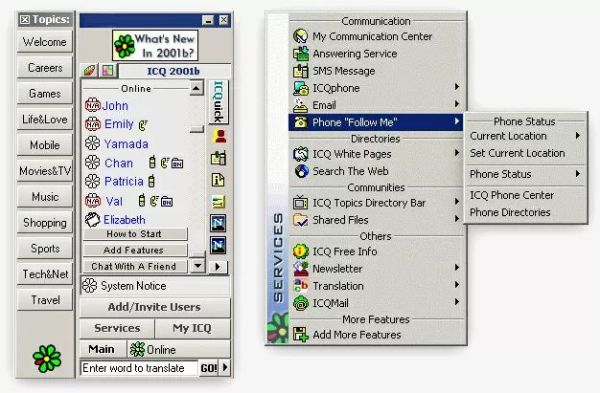
ICQ Will Shut Down On June 26 This Year

In many ways, ICQ has always been a bit of a curiosity. It was one of the first major instant messenger clients of the 1990s. It saw broad uptake alongside the likes of AOL Instant Messenger and MSN Messenger. Yet, it outlasted both of them despite not being attached to an industrial juggernaut like AOL or Microsoft. After 27 years, however, it seems that the last petal will drop, with the shutdown of ICQ announced on the ICQ website for June 26, 2024.

Originally launched by an Israeli company, Mirabilis, in June of 1996, it took the Internet by storm, leading to AOL buying Mirabilis in June of 1998. Under the wing of AOL, ICQ kept growing its user base until it was sold to Digital Sky Technologies (now VK, which operates Mail.ru) in 2010. Around this time, the likes of Facebook and Google, with their own messaging solutions, came onto the scene, leaving ICQ to flounder. Ultimately, ICQ found a new home in the Russian market as a mobile messaging system until its imminent shutdown. Users are urged to move to the VK Messenger instead.

The demise of ICQ obviously led to a blast of nostalgia on sites like Hacker News, even though it has lost relevance in the West for many years. We’re sad to see this chapter end and will mourn the demise of our UINs (RIP, 61007952) along with our fellow compatriots in the usual IRC channels.

This is what happens when you depend on the grid. Going off the grid doesn’t have to look homemade, either.