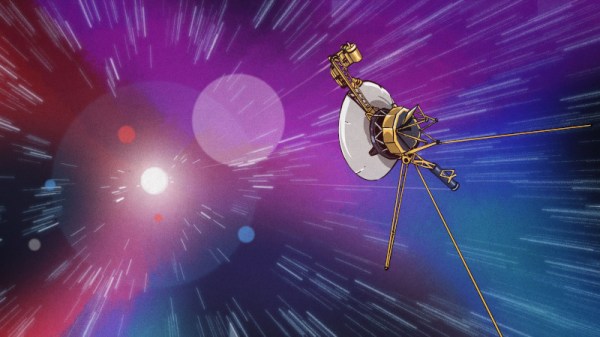
In what is probably the longest-distance tech support operation in history, the Voyager mission team succeeded in hacking their way around some defective memory and convincing their space probe to send sensor data back to earth again. And for the record, Voyager is a 46-year old system at a distance of now 24 billion kilometers, 22.5 light-hours, from the earth.
While the time delay that distance implies must have made for quite a tense couple days of waiting between sending the patch and finding out if it worked, the age of the computers onboard probably actually helped, in a strange way. Because the code is old-school machine language, one absolutely has to know all the memory addresses where each subroutine starts and ends. You don’t call a function like do_something(); but rather by loading an address in memory and jumping to it.
This means that the ground crew, in principle, knows where every instruction lives. If they also knew where all of the busted memory cells were, it would be a “simple” programming exercise to jump around the bad bits, and re-write all of the subroutine calls accordingly if larger chunks had to be moved. By “simple”, I of course mean “incredibly high stakes, and you’d better make sure you’ve got it right the first time.”
In a way, it’s a fantastic testament to simpler systems that they were able to patch their code around the memory holes. Think about trying to do this with a modern operating system that uses address space layout randomization, for instance. Of course, the purpose there is to make hacking directly on the memory harder, and that’s the opposite of what you’d want in a space probe.
Nonetheless, it’s a testament to careful work and clever software hacking that they managed to get Voyager back online. May she send for another 46 years!