Printing With Pressure

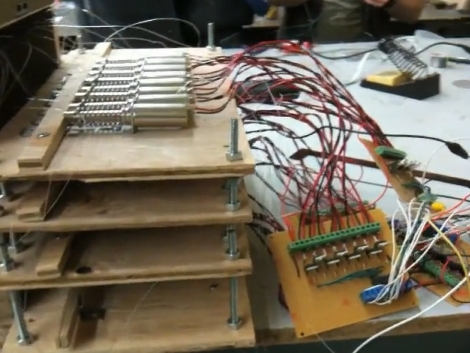
The video of [Thibault Brevet’s] printer makes it look like he’s actually designed a vinyl cutter (watch it after the break). But at the end of the printing process you see that the top layer was actually a piece of carbon copy paper and the magic was happening underneath. The print head applies enough pressure to transfer the blue-ish printing ink onto the paper giving the result seen above. He’s driving this with an Arduino and feeding data using Processing.

[Thibault] left this link in the comments from the LEGO printer post. Shame on him for not tipping us off as soon as he posted info on this hack. Don’t underestimate yourselves, if you hack it we want to hear about it!

Continue reading “Printing With Pressure”

HID Crafting With A PIC And A Joystick

[Amr Bekhit] converted his gameport joystick to use as a USB joystick. Much like a universal USB joystick interface, this uses an additional microcontroller to talk to the serial bus while monitoring the controls on the stick. [Amr’s] discussion about creating HID descriptors is clear and easy to understand. What he’s laid out can be translated to any custom HID your heart desires. Give it a try with that old peripheral that’s been gathering dust in the corner.

LEGO Printer Built Without NXT parts

[youtube=http://www.youtube.com/watch?v=zX09WnGU6ZY]

[Squirrelfantasy] built a printer using LEGO pieces. It’s not a Mindstorm project but instead depends on some type of development board and some auxiliary components on a protoboard. We couldn’t get a good enough look to tell exactly what makes up the electronics so start the debate in the comments. We feel this is a printer and not a plotter because the stylus moves on just one plane while the paper feeds past it but that’s open for debate as well.

Guess this answers the question of why aren’t we building our own printers? Some folks are.

[Thanks Haxorflex and many others, via DVICE]

USB Morse Code Keyboard

Looking for motivation to practice morse code [BenB] built this morse code keyboard. It uses USB and is recognized as a standard keyboard thanks to the V-USB stack running on the ATmega168. The project is rounded out with a clean look thanks to the chewing gum container that serves as an enclosure.

His design is simple enough that any morse key you have on hand can be used. You could even adapt that glove coder you built a couple of years back.

One-armed Coding Using A Half-qwerty Hack

[Matthew Daughtrey] is going to have one of his paws out of service for a while following some hand surgery. Making a living as a coder seems a bit harder with one hand but he was able to find some solutions online only to balk at price tags reaching $600. He came up with a way have similar functionality on a standard keyboard with creative key mapping and a few auxiliary buttons.

The product he’s trying to mimic is the half-qwerty keyboard produced by Matias Corporation. It sounds crazy, but you can easily use your right hand to type all of the letters the left hand normally would just by mirroring the key locations. That big gray thing you store in your mellon and frequency put at risk handles this automatically. You should give the demo a try. We found that we’re quite good at it and only get confused when switching between the two halves of the keyboard.

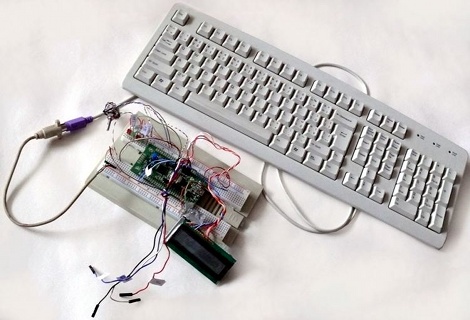
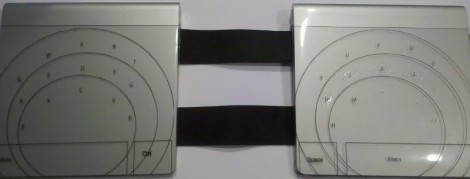
But we digress. [Matthew] wrote a script that will mirror all the key mappings when he holds down the Windows key. He then hacked a second keyboard to extend momentary push sensors as seen above. He plans to use them with a partially mobile thumb after the surgery, or to build a foot pedal (we say build the pedal). An elegant hack that is a pittance compared to the official hardware.

Keyboard Input For PlayStation

Anyone who has tried their hand at RPG Maker 1 (or any text input with a controller) knows how difficult it can be typing long paragraphs into the console. [Thutmose] is here to save the day with Kupid 1.0 (2.0 in production). A PICAXE takes ps/2 keyboard input and converts it to a series of d-pad button presses for PS1 and PS2 controllers, providing quick data entry compared to the previously monotonous task.

We’re happy to learn that the source code and hardware is released, meaning it has the potential to be easily adapted to any controller/console.

Shredding To Street Fighter

Strumming to punch and changing frets to move, [Alan Chatham] plays Street Fighter using his guitar. It’s been modified to use OpenChord, an open source guitar controller package he developed. This was originally meant to be used with Guitar Hero and the like but as he mentions in the video after the break, it is open source so you can do whatever you want with it. In this case, he’s patched into a PS3, showing yet another way to use your own hardware on that console. Unlike alternative guitar-like interfaces you won’t have to relearn how to play. You just need to adapt your favorite songs to fall in line with butt-kicking controller combos. For the adventurous you can build your own but [Alan’s] got kits available too. Continue reading “Shredding To Street Fighter”