Teensy Credit Card Reader

Here’s a hack that makes business sense. [PT] recalls last year’s HOPE conference when their booth was using a virtual credit card terminal for purchases that required manual entry of card information. This year they’ll have the same virtual terminal but this magnetic stripe reader will fill it out automatically.

A magstripe reader (reading only, no funny business here) from Mouser grabs data from the card. A Teensy microcontroller board, which identifies itself as a USB keyboard, automatically fills out the virtual terminal from the parsed data. The real question, are his customers comfortable sliding their plastic through a hacked reader?

Hands-free Input

This is a concept input device that [Tech B] built for disabled users. The device uses an accelerometer along with a piezo sensor (right click) and a push button (left click) to function as a mouse. The Arduino that resides in a breadboard on the side of the hat communicates with the computer over a serial connection, using PySerial to translate the microcontroller data into cursor commands with the power and ease of the Python programming language.

During development [Tech B] made a proof-of-concept video using a Basic Stamp which you can watch after the break. He found that this input device was less complicated, more accurate, and much less resource intensive than his webcam IR tracking system.

OpenWRT On A Seagate FreeAgent Dockstar

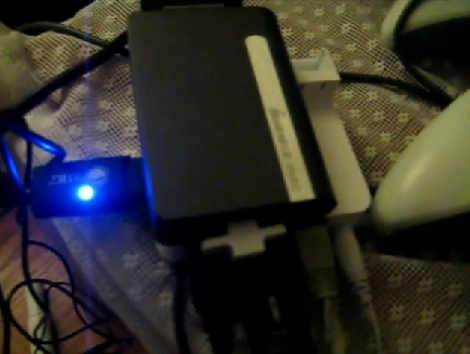
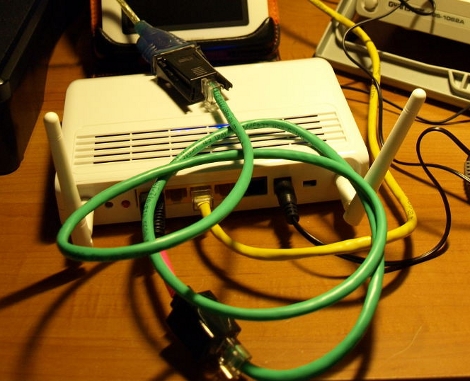
The Seagate FreeAgent Dockstar aims to make all of your stuff available online. It serves that purpose but sometimes you just want more options for controlling your hardware and running some scripts. [Eric Cooper] put together a guide for installing OpenWRT on the Dockstar by building your own kernel and loading it onto the internal storage. Once you have a kernel that will play nicely with the hardware, you can install it by tunneling in through SSH; the same method you would use if you wanted to run Linux on this hardware. If you have problems along the way, [Eric’s] also included a guide for cracking the Dockstar open and connecting a serial cable.

Connecting A Nokia 3310 LCD Using An AVR

In this instructible, [wkter] takes us through the process of running a Nokia 3310 LCD display using an ATmega8.  This instructible isn’t a beginners project as he assumes you already have a strong understanding of how to work with these components and their programming languages. He is very thorough with information though, providing datasheets, pinout diagrams, and source code. Once you get this down, you could go a little further and make  Conway’s game of life.

Microcontrollers Access The Web

[youtube=http://www.youtube.com/watch?v=ExoJDxBGEBU]

[Kenneth Finnegan] is back with another video showing some cool stuff he’s doing to connect his microcontrollers to the internet. Usually, we see this done with a prebuilt module like an iobridge. [Kenneth] is using a Microchip ENC28j60 module for the communication and he’s managed to stuff it all onto a tiny Electroboards piece.  [Kenneth] is starting to become a regular around here.

[via HackedGadgets]

Live Fire Half-life

We don’t know how we missed this when it first came out, but there is a hack out there that combines a .22 caliber pistol with the video game Half-life. Simple is best and that motto is in use here. A wall was built down range to use as a projection screen. Accelerometers mounted on the drywall report vibration data from the bullet strike which is used to triangulate its location. This targeting data is then sent to the game interface.

As you can see in the video after the break this works like a charm. The [Waterloo Labs] personnel that developed this are also responsible for that iPhone controlled car. The antics we witnessed in that project carry over to this one as they illustrate using the setup to play Half-life with a couple of shovels at 2:12 into the clip. Continue reading “Live Fire Half-life”

USB Hub Used For In System Programming

Did you order that 4-port USB hub because it was almost free but now it’s just sitting in your junk box? Why not turn it into an In System Programmer for AVR chips? [Paul] came up with HUB ISP as an answer to the chicken-or-egg problem we’ve seen with other diy programmers. It uses the data wires from four different USB cables to program AVR chips, enlisting the help of a 74HC00 NAND gate along the way. You do not need to have a programmed microcontroller as all the magic happens on the software end of things. The one caveat is that [Paul’s] method currently only works on Linux machines.