Very Simple PC Frequency Counter Works Up To 100MHz

We all use 74 logic in our projects as general purpose logic interfacing glue. These chips have become as ubiquitous as a general-purpose op-amp, or even as passive components. In most cases we’re not demanding much of them, and power requirements aside an original 74 chip from the dawn of the series could probably do the same job that we’re putting a more modern variant to work on.

It is easy therefore to forget that 74 logic is a field that has seen continuous improvement and innovation reflecting the developments elsewhere in electronics, and the most modern 74 versions hide some impressively high specifications.

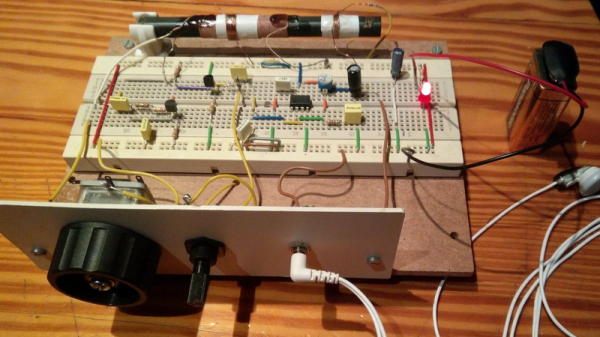
A good example comes via a project from [Scott, AJ4VD], a very simple frequency counter that uses a single 74 series chip at its business end, and counts to over 100MHz. The chip in question is a 74LV8154 dual 16-bit counter which he is using as a prescaler to deliver a rate more acceptable to an ATMega328 microcontroller that does the counting. As he points out, the accuracy of a frequency counter is only as good as its gate timing, and he ensures as accurate a seconds-worth of pulses as he can with a 1PPS signal derived from an inexpensive GPS receiver. The 328 makes its counting available to a host computer via a serial port, and can be easily read through a terminal. He’s built it dead-bug style on a piece of unetched PCB, on which the simplicity of the circuit is evident.

There was a time when a project like this one would have required multiple integrated circuits including a probably quite expensive purpose-built prescaler. Cheap glue logic has now advanced to a stage at which it can be done instead at commodity prices, and we like that.

We’ve featured a few 74-series counters before, including this old-school one and this one also using a 74LV8154.

Raspberry Pi Radio Streaming Service Guts Yamaha Shelf System

There are dozens — dozens! — of options to meet your music and streaming needs these days.  Looking to make something of his own that retains that 90’s vibe of having a dedicated stereo system but with modern wireless integration, [thk4711] turned an old Yamaha hifi into a Raspberry Pi streaming client.

As far as the case goes, a few modifications allowed [thk4711] to use all of the existing buttons, and a quick-swap of the back-plate and screen gave him a better enclosure than one he could fabricate himself. The power supply proved to be the most difficult part of the project due in part to some “digital noise” interference between the digital and analog components while they were wired to a common ground. This was solved by implementing two transformers, a LM2596 voltage regulator and a LT1084 low-noise power supply to smooth things out.

The Raspberry Pi 2-centered device supports internet radio, Spotify connect, Airplay, USB and auxiliary inputs.

Continue reading “Raspberry Pi Radio Streaming Service Guts Yamaha Shelf System”

Tracking Airplanes From An Autonomous Boat

Airplane tracking systems like FlightRadar24 rely on people running radios that receive the ADS-B signal and forward the data on to them. That doesn’t work so well in the middle of the ocean, though: in spots like the mid-Atlantic, there are no islands to speak of.

So, the service is now experimenting with a new approach: putting an ADS-B radio onto an autonomous boat. The boat is a Wave Glider from Liquid Robotics, an autonomous boat that harvests the power of the waves to run propulsion, guidance, and its payload. In this case, that payload includes an ADS-B receiver and a satellite transmitter that uploads the plane data to the service, where it is added to their mix of data sources. The boat is planned to spend the next six to eight weeks cruising about 200 miles off the coast of Norway, listening to the broadcasts of planes flying overhead and relaying them back to HQ. They will then be plotted on the live map in blue.

If you’re interested in building your own plane-trackers, we’ve got you covered, at least on land.

Would You Like A Satellite Dish?

Satellite dishes are a common site these days, although admittedly most of them are Ku- and Ka-band dishes. The older C-band dishes are still around, though, just less frequently in people’s yards. [Greenish Apple] decide to cut the cable and start watching free TV so he built a C-band dish. The trick is, he made the dish out of wood.

The design is the offset type, not a prime focus dish–that is, the electronics are not in the center of the dish but on the side. Wood isn’t particularly good at reflecting RF, of course, so over the wooden skeleton, he used flashing.

Continue reading “Would You Like A Satellite Dish?”

Make Your Own Simple VHF Tuning Capacitor

If you enjoy building radio projects you may have noticed something slightly worrying over the last few years in your component supply. Variable capacitors are no longer as plentiful as they used to be. There was a time when all radio receivers contained at least one, now with the advent of the varicap diode and the frequency synthesiser the traditional tuning capacitor is a rare breed. They are still made, but they’re not cheap and they won’t appear so readily in your junk box any more.

Fortunately a variable capacitor is a surprisingly simple device, and one you can make yourself if you are of a mind to do so. [Patrick] did just that with his home-made capacitor, in this case of a few tens of pF and suitable as a low-power trimmer capacitor or in a single-chip FM radio.

Rather than make a set of interlocking vanes as you’d find in a commercial design, he has gone for a screw in a tube. The capacitance is set by the length by which the screw is inserted into the tube. And his tube is not a tube in the traditional sense, instead he has used a coil of enamelled copper wire wound on the screw thread, whose insulation forms the dielectric. It looks wrong to use a coil in this way as you’d expect a similar coil to form the inductive part of a tuned circuit, but this coil is shorted out to prevent its inductance becoming a factor at the frequency in question.

It’s evidently not the answer to all variable capacitor problems, but it’s a neat piece of lateral thinking and it will make a simple working capacitor from readily available parts.

We’ve featured a couple of more traditional style home-made variable capacitors in the past on these pages, one made from thin aluminium sheet cut with scissors, and another one designed for use in higher power transmitters.

Thanks [PeterF] for the tip.

Build A Tiny (Unstable) Bugging Device

We don’t know who the [amgworkshop] wanted to listen in on, but they apparently went searching for a small FM wireless transmitter. There’s plenty of circuits around, but they wanted something smaller. The original circuit had a variable capacitor to tune the output frequency. The new design uses a fixed capacitor and a spring for an antenna. You can see the build steps in the video below, but don’t expect a lot of frequency stability or fidelity out of a single transistor transmitter.

The parts list is minimal. In addition to a coin cell holder (which serves as the construction base), you need a transistor, two resistors, three capacitors, a homemade inductor (very easy to make with some wire and a drill bit), and an electret microphone. Of course, you need a battery, too. The whole thing is potted with hot glue.

Continue reading “Build A Tiny (Unstable) Bugging Device”

Bombing The Sky For The Sake Of Radio

If you are familiar with radio propagation you’ll know that radio waves do not naturally bend around the earth. Like light and indeed all electromagnetic radiation if they are given a free space they will travel in a straight line.

At very high frequencies this means that in normal circumstances once a receiver moves over the horizon from a transmitter that’s it, you’re out of range and there can be no communication. But at lower frequencies this is not the case. As you move through the lower end of the VHF into the HF (Short Wave) portion of the spectrum and below, the radio signal routinely travels far further than the horizon, and at the lower HF frequencies it starts to reach other continents, even as far as the other side of the world.

Of course, we haven’t changed the Laws Of Physics. Mr. Scott’s famous maxim still stands. Radio waves at these frequencies are being reflected, from ionised portions of the atmosphere and from the ground, sometimes in multiple “hops”. The science of this mechanism has been the subject of over a hundred years of exploration and will no doubt be for hundreds more, for the atmosphere is an unreliable boiling soup of gasses rather than a predictable mirror for your radio waves.

Radio amateurs have turned pushing the atmosphere to its limits into a fine art, but what if you would prefer to be able to rely on it? The US military has an interest in reliable HF communications as well as in evening out the effects of solar wind on the ionisation of the atmosphere, and has announced a research program involving bombing the upper atmosphere with plasma launched from cubesats. Metal ions will be created from both chemical reactions and by small explosions, and their results on the atmosphere will be studied.

Of course, this isn’t the first time the upper atmosphere has been ionised in military experiments. Both the USA and the USSR exploded nuclear weapons  at these altitudes before the cessation of atmospheric nuclear testing, and more recently have directed high power radio waves with the aim of ionising the upper atmosphere. You may have heard of the USA’s HAARP project in Alaska, but Russia’s Sura Ionospheric Heating Facility near Nizhniy Novgorod has been used for similar work. It remains to be seen whether these latest experiments will meet with success, but we’re sure they won’t be the last of their kind.

We’ve looked at radio propagation in the past with this handy primer, and we’ve also featured a military use of atmospheric reflection with over-the-horizon radar.

Fishbowl Starfish Prime upper atmosphere nuclear test image via Los Alamos National Laboratory. As an image created by an officer or employee of the United States government as part of their official duties this image is in the public domain.