Decoding NOAA Weather Radio With An Arduino

The National Oceanic and Atmospheric Administration is responsible for broadcasting the signals used in weather radios. They use a protocol called Specific Area Message Encoding (SAME) and [Ray Dees] recently published an Arduino library that lets you decode the SAME message packets.

He doesn’t provide a method of tuning the radio signal, but at first you can use the audio samples he points to. The actual broadcasts happen on one of seven frequencies between 162.400 MHz and 162.550 MHz but the tones are also broadcast on TV and Radio alerts. Once you have the audio it is fed into a pair of XR-2211 Tone decoders. This provides just three interface pins for the Arduino to watch.

The annoying noise that grabs your attention at the beginning of a weather alert, or test of the alert system is actually what the SAME data packets sound like. From those tones this system will be able to decode what type of alert is being issued, and the geographic locations it affects. If you interested in more info about SAME head over to the Wikipedia article on the topic.

Building A Custom Interface For Surplus HF Radios

[PRC148] picked up a Motorola Micom radio from eBay. These are US State Department surplus, but apparently the 125 Watt HF units are top-of-the-line at a tenth of the sticker price. The one hangup is that they’re headless; you can’t control them without additional hardware. But the Internets are often kind to the hobbyists, and this is no exception. You can get software to run the radio from a PC thanks to the Micom Yahoo Group. [PRC148] took that software as an example and built his own stand-alone interface. [Cached version of the page]

The head unit is an Arduino driving a four-line LCD display and a rather large array of buttons. The forum thread linked above shows his humble beginnings on a breadboard. During the project [PRC148] learned a lot of skills to end up with what you see above. Hiding behind the reused bezel is a PCB he designed in Eagle CAD and etched himself. It allowed him to cram the tactile switches close enough to work with the button overlay on this keypad.

UPDATE: The traffic from this feature took down the forum hosting the content. They requested that we do not link to them because of this. A cached version without images can be found above thanks to [Termm].

Retrotechtacular: The Miracle Of Vacuum Tubes

We take our digital life for granted these days, but back in 1943 it was vacuum tubes, not transistors, which made it all possible. This video on the types and industrial uses of vacuum tubes was sent into the tips line by [Polar Bear]. The nearly 70-year-old video is part of a collection preserved by the New Jersey Amateur Radio Club.

The video was underwritten by Westinghouse, and as you can expect it has a bit of propaganda spin for the company. The time period in which the reel was produced is also telling. Coming about two years after the attack on Pearl Harbor, the applications for technology of the time are almost all military in focus. But we’re sure you’ll be entertained by both the film style and the tech explanation. It’s something of a How It’s Made of yesteryear. All twenty-one minutes of it are found embedded after the break.

Continue reading “Retrotechtacular: The Miracle Of Vacuum Tubes”

Retrotechtacular: The Birth Of Satellite Communications

Last week was the fifty year anniversary of the launching of Telstar 1, the first communications satellite. Take a look back at the marvel of the early technology as shown in this newsreel footage about the first broadcast. The first formal use was a speech by President Kennedy allowing most of Europe to “witness democracy at work”. You’ve got to love that cold war era propaganda.

In addition to this electronics-filled marvel there were other experiments going on at the time that used passive devices as satellites. Project Echo sought to put reflective balloons at an altitude where they could be used to bounce signals around the curvature of the earth. This came almost exactly two years before the advent of Telstar 1.

There was a lot of media coverage of this anniversary, but the most interesting for us was an NPR interview with [Walter Brown], one of the engineers who helped build the device. Apparently nuclear weapons testing in space the day before the launch caused the initial tests to fail.

Continue reading “Retrotechtacular: The Birth Of Satellite Communications”

Re-engineering Some FM Transmitter Firmware

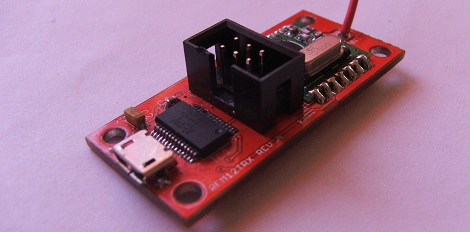
[Furrteck] had a little adventure with this FM transmitter he picked up on eBay. It worked alright, but he wanted to be able to scan through the frequencies, and to have the device return to the same settings after power cycling. He cracked it open and got to work to achieve all of his goals.

The device is driven by an ATmega48, and there’s a 6-pin ISP header on the board. An initial read of the chip wouldn’t work, and he soon discovered the unstable power supply was to blame. After connecting his own regulated source he could read the chip id without a hitch, but the code is locked so no dumping was possible. Fortunately he managed to trace out the board, and includes a full schematic in his write up. With this in hand he erased the chip and started programming his own firmware from the ground up.

The video after the break shows off the completed project. He can now scan through frequencies with audio feedback to let he know when he’s found a station to hijack. The new code will also write a tuned station to EEPROM for use the next time the rig is powered up.

Continue reading “Re-engineering Some FM Transmitter Firmware”

Need A Quadcopter Transmitter? Use A PS2 Controller!

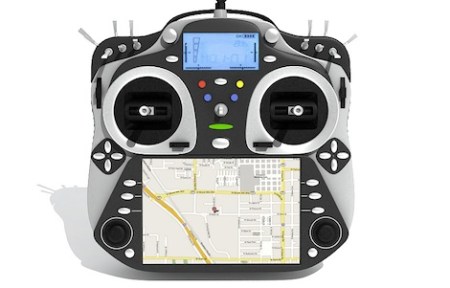
After [Pyrofer] built a quadcopter, he purchased a cheap 6-channel transmitter made in China. Unfortunately, that transmitter was terrible so he took an old PS2 controller and built his own.

For his build, [Pyrofer] broke out the analog sticks and wired them to an AVR housed in the handle of the controller. The AVR sent commands to a 2.4 GHz radio transmitter powered by a small LiPo battery. With the addition of a few tact switches behind the shoulder buttons of the controller, [Pyrofer] has four axes of control with a few buttons for changing modes on his quadcopter.

This build really doesn’t hold a candle to some of the awesome DIY RC transmitters we’ve seen, but we’ve got to give [Pyrofer] credit for coming up with a very simple and easy build. Just about everyone has a PS2 or XBox controller lying around, and with a few extra hardware bits it’s easy to bodge up a decent remote control.

[Pyrofer] used a project called Funkenschlag to generate PPM signals, so if you feel the need to replicate this project send it in when you’re done.

Software-Defined Radio Remotely Using A Linux Wall wart

Here’s a interesting idea; if the hardware seen above is dropped at a location, you can monitor radio signals remotely via the Internet. [MS3FGX] has been toying with the idea for a little while now. He wanted to use a DVB dongle with a portable Linux solution to offer Software-Defined Radio (SDR) capability without the need to actually be there.

The white box is a PWN Plug, a branded version of the SheevaPlug. The black dongle that plugs into it is a DVB tuner dongle. It’s meant to receive television signals over the radio, but recently the hardware has been used as a simple way to implement SDR. Combine the two (along with the antenna), stir in a network connection, and you’ve got a remote listening post. What can you listen to? Just about anything that’s within the dongle’s bandwidth range. [MS3FGX] mentions walkie-talkie traffic and pager signals, to name just two.

He even wrote an installation script that gets you up and running in no time.