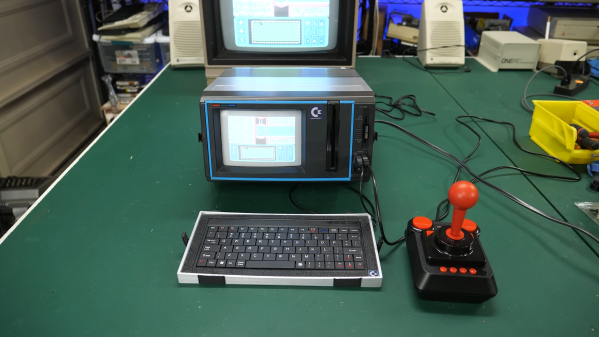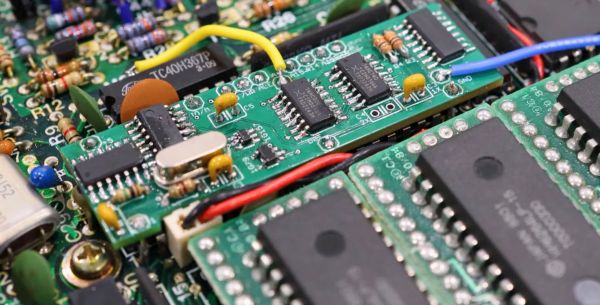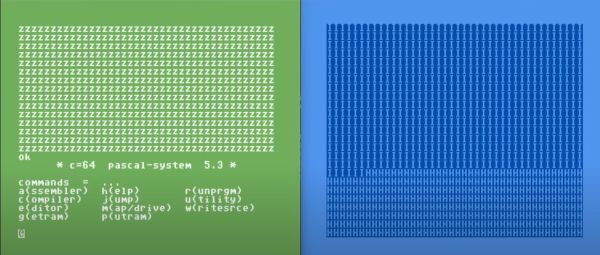
Modern computers are so fast and complex that we would seldom try and fix them on a component level with simple DIY tools. Working on an early 1980s computer is much easier by comparison, with the fastest signals often in the single-MHz range. [Sayaka] demonstrates this by using a cheap $20 oscilloscope to troubleshoot and repair a Commodore 64.
After powering it up for the first time, the C64 displays a BASIC prompt, but none of the keys seem to work. [Sayaka] did what good hackers do, and immediately disassembled it to try and figure out the problem, suspecting the CIA chip as a likely culprit.
[Sayaka] elected to purchase a cheap DS0138 oscilloscope kit to help troubleshoot the C64. It’s not the most capable thing, with a bandwidth of just 200 KHz, but it’s enough to do some work on an old retro machine. After probing around to check a number of signals, she noted that the CIA’s pins seemed to be very oxidized and suffering poor conductivity. All it took from there was a resolder job, and the computer was repaired.
The more accomplished 8-bit microcomputers of the late 1970s and early 1980s had a dedicated display chip, a CRT controller. This took care of all the jobs associated with driving a CRT display, generating the required timing and sequencing all the dots to make a raster. With a CRT controller on hand the CPU had plenty of time to do other work, but on some cheaper machines there was no CRT controller and the processor had to do all the work of assembling the display itself.
[Dr. Matt Regan] had a Sinclair ZX81 which relied on this technique, and he’s put up the first of what will become a series of videos offering a deep dive into this method of creating video. The key to its operation lies in very careful use of timing, with operations executed to keep a consistent number of clock cycles per dot on the display. He’s making a very low resolution version of the display in the first video, which he manages to do with only an EPROM and a couple of 74 logic chips alongside the Z80. We’re particularly impressed with the means of creating the sync pulses, using opcodes carefully chosen to do nothing of substance except setting a particular bit.
This method of assembling a display on such a relatively slow microprocessor has the drawback of no means of creating a grayscale, and of course it’s only available in glorious black and white. But it’s the system which gave a first experience of computing to millions, and for that we find the video fascinating. Take a look, below the break.
[Ken Shirriff] is looking inside chips again. This time, the subject is the MK4116 — a 16 Kbit DRAM chip. Even without a calculator, you know that’s a whopping 2 Kbytes, and while that doesn’t sound impressive, in the late 1970s, it was a modern miracle.
The chip showed up in computers ranging from the TRS-80 to the Xerox Alto and was even a mainstay of arcade video games. While [Ken] thought it would be a pretty predictable teardown, he found several surprises.
Static RAM chips use flip flops and retain their state as long as power is on. That’s convenient, but each flip flop takes multiple transistors, so there is a limit to how many bits you can put on a particular size chip. Dynamic RAM increases that limit because it is nothing more than a capacitor and a single transistor. This increases memory density, but the problem is that the capacitor doesn’t hold charge indefinitely. The computer or an associated circuit had to refresh the memory periodically to maintain the contents.
One of the key innovations for this chip was the use of multiplexed address lines so it could use a smaller package. Inside, two banks of capacitors store the bits, and, usually, a computer would use eight chips to store a byte. Of course, each memory bit is made to be as compact as possible. This chip is also made to be very low power when idle. The secret is that it doesn’t use load transistors but instead uses an active pull-up tied to the system clock. Another interesting feature is the sense amplifier, which has to measure the tiny noisy voltage from the capacitors.
You’ll see all this and more in [Ken’s] write-up. Chips from that era were relatively easy to take apart compared to today’s devices. Want to know how it’s done? [Ken] can tell you. He is well-known for doing a lot of cool stuff, with ICs and even old mainframe and space hardware.
When you’ve been a fact-sponge for electronics trivia for over four decades, it’s not often that an entire class of parts escapes your attention. But have you seen the Skiatron? It’s a CRT that looks like a normal mid-20th-century tube, until it’s switched on. Then its secret is revealed; instead of the glowing phosphor trace we’d expect, the paper-white screen displays a daylight-readable and persistent black trace. They’re invariably seen in videos of radar installations, with the 360 degree scans projected onto large table-top screens which show the action like a map. It’s like e-ink, but from the 1940s. What’s going on?
The tenebrescent mineral Hackmanite, before and after UV exposure. Leland Green…, CC BY-SA 2.0 and CC BY-SA 2.0.
The phosphor coating on a traditional CRT screen is replaced by a halide salt, and the property on which the display relies is called tenebrescence, changing colour under the influence of radiation. This seems most associated online with UV treatment of some minerals and gemstones to give them a prettier look, and its use a s a display technology is sadly forgotten.
A high-school physics understanding of the phenomenon is that energy from the UV light or the electron beam in the case of the tube, places some electrons in the crystal into higher energy levels, at which they absorb some visible light wavelengths. This is reversible through heat, in some substances requiring the application of heat while in others the heat of room temperature being enough. Of course here at Hackaday we’re hands-on people, so into the EPROM eraser went a small amount of table salt in a makeshift dish made of paper, but sadly not to be rewarded by a colour change.
On a real dark-trace CRT the dark trace would be illuminated from behind by a ring light round the glass neck of the tube. An interesting aside is that, unlike phosphor CRTs, they were more suitable for vertical mounting. It seems that small amounts of phosphor could detach themselves from a vertically mounted screen and drop into the electron gun, something that wasn’t a problem for tenebrescent coatings.
This display tech has shuffled off into the graveyard of obsolescence, we’re guessing because CRT technology became a lot better over the 1950s, and radar technologies moved towards a computerised future in which the persistence of the display wasn’t the only thing keeping the information on the screen. It seems at first sight to be a surprise that tenebrescent coatings have never resurfaced in other displays for their persistence, but perhaps there was always a better alternative whether it was ultra-low-power LCDs or more recently e-ink style devices.
For more bleeding-edge 1950s radar displays, we’ve previously brought you Volscan, a radar with an early form of GUI, which no doubt was one of those which consigned dark-trace CRTs to history.
If you ask your neighbor who Bill Gates or Steve Jobs is, they’d probably know. But mention Gary Kildall, and you are likely to get a blank stare unless you live next door to another Hackaday reader. [Al’s Geek Lab] has a great three-part documentary on Gary Kildall who, in case you didn’t know, was the man behind CP/M, a very influential operating system in the early days of computing and one that set the stage for the PC revolution.
You probably know the folktale that when IBM was looking for an operating system, Bill Gates took the meeting, and Gary Kildall went surfing instead. But like most capsule histories, there is plenty more to the story, and it isn’t as simple as people make it out.
We forget, sometimes, how innovative Digital Research — Kildall’s company — was for the time. We think of CP/M as the venerable CP/M 2.2, which was fine. But there was multitasking CP/M and GEM — a precursor to the graphical user interface found everywhere today. Sure, it looks antiquated now, but it was light years in front of everyone else.
If you watch the whole series, you’ll learn that the IBM story isn’t totally apocryphal, but the truth is much different. Kildall didn’t want the IBM deal, and for what seemed like good reasons at the time. Of course, Gates negotiated a deal with IBM that would build a huge company, so it is easy to look back and say that not taking the deal was a mistake, but we would have probably made the same decision as Kildall at that time.
This isn’t the first time we’ve wondered what a world where CP/M won would have looked like. If you want to look inside CP/M, you can. Of course, it still powers many retrocomputers and even has some surprising clones.
In a wonderful ode to tech nostalgia, The Taylor and Amy Show, comprised of YouTubers [Taylor] and [Amy], have released a new video “THE 6502 SONG”. This song had me singing along in roughly six clock cycles, possibly a little dancing around may have occurred as well. This isn’t just any chip they’re singing about; it’s the venerable 6502 microprocessor, the silicon heart behind iconic machines like the Apple II, Commodore 64/128, and the Atari 2600.
Their lyrics reminds me of when I lived for assembly language mnemonics and counting clock cycles, the “feeling” of a processor coming out of tristate to pronounce what it had learned in the last 500ns, and the undulations of the DRAMs like speed bumps. To top it off, portions of the song were actually recorded live at the Vintage Computer Festival Midwest 2023, where fans and computing history aficionados alike were treated to an impressive display of vintage tech.
What sets “THE 6502 SONG” apart isn’t just its catchy, melodic tune; it’s the expert blend of historical detail and genuine enthusiasm that resonates with everyone from grizzled assembly-language programmers to youngsters newly fascinated by the allure of 8-bit computing. With guest appearances from other female tech YouTubers like [Veronica Explains] and [Evie’s Revue], [AJ], [Jeri and Amy- Tilt5] and [FuzzyBad].
I believe [Chuck Peddle] father of the 6502, would be proud to see his creation live on and be appreciated so.
You may not have heard, but there’s a chip shortage out there. And it’s not just the fancy new chips that are in short supply; the chips that were fancy and new back when you could still buy them from Radio Shack are getting hard to come by, too. For different reasons, of course, but it does pose a problem that requires a little hacking to fix.
The chip in question here is the General Instrument SP0256, a 1980s-era speech synthesizer chip that [Andrew Menadue] relies on. The LSI chip stored 59 unique allophones, or basic sounds the vocal tract is capable of, and synthesized speech by rapidly concatenating these sounds. The chip and its descendants made regular appearances in computers and games throughout the 80s, so chances are good you’ve heard it. If not, think WarGames (yes, we know that wasn’t actually a computerized voice) or [Stephen Hawking] and you’ll be pretty close.
[Andrew]’s need for such a chip stems from his attempts to give voice to his collection of Psion Organisers, another 80s relic that was one of the first pocket computers. Some time ago he built a speech board for the Psion based on the SP0256-AL2, but had to resort to building an emulator for the chip since none were to be had. The emulator uses an RP2040 and lives on a PCB that has the same footprint as the original chip, so it can just plug right in. He dug up WAV files of the allophones and translated those to sequences of bytes, allowing the RP2040 to output the correct sounds as they’re called for. Speaker problems notwithstanding, it sounds pretty good in the video below.