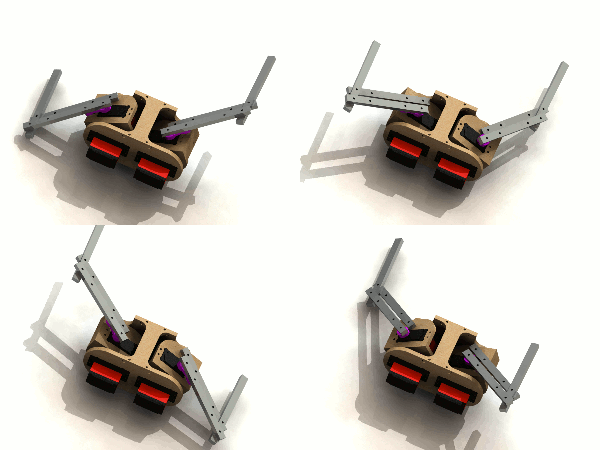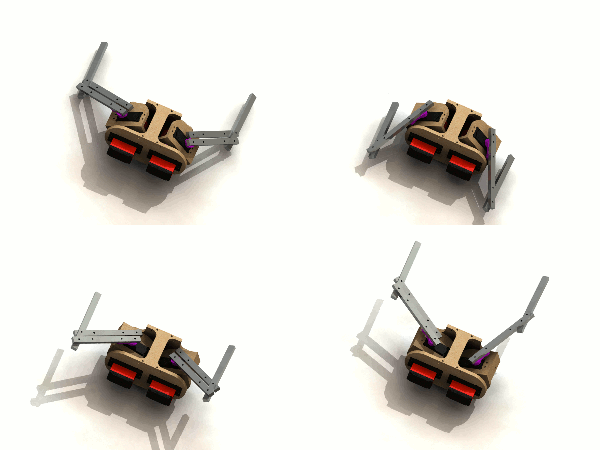
Building A Quadcopter With A CNC Mill And A 3D Printer

Quadcopter

Quadcopters are a ton of fun to play with, and even more fun to build. [Vegard] wrote in to tell us about his amazing custom DIY quadcopter frame that uses a commercial flight control system.

Building a quadcopter is the perfect project to embark upon if you want to test out your new CNC mill and 3D printer. The mechanical systems are fairly simple, yet result in something unbelievably rewarding. With a total build time of 30 hours (including Sketchup modeling), the project is very manageable for weekend hackers. [Vegard’s] post includes his build log as well as some hard learned lessons. There are also tons of pictures of the build. Be sure to read to read the end of the post, [Vegard] discusses why to “never trust a quadcopter” and other very useful information. See it in action after the break.

While the project was a great success, it sadly only had about 25 hours of flight-time before a fatal bird-strike resulted in quite a bit of damage. Have any of your quadcopters had a tragic run-in with another flying object? Let us know in the comments.

Continue reading “Building A Quadcopter With A CNC Mill And A 3D Printer”

Festo Creates Bionic Kangaroo; Steve Austin Unimpressed


festo-roo

[Dr. Wilfried Stoll] and a team at Festo have created an incredible robot kangaroo. Every few years the research teams at Festo release an amazing animal inspired robot. We last covered their smartbird. This year, they’ve created BionicKangaroo (pdf link). While The Six Million Dollar Man might suggest otherwise, Bionics is use of biological systems in engineering design. In this case, Festo’s engineers spent two years studying the jumping behavior of kangaroos as they perfected their creation.

Kangaroos have some amazing evolutionary adaptations for jumping. Their powerful Achilles tendon stores energy upon landing. This allows the kangaroo to increase its speed with each successive jump. The kangaroo’s tail is essential for balancing the animal as it leaps through the air. The Festo team used a thick rubber band to replicate the action of the tendons. The tail is controlled by electric servomotors.

Festo is known for their pneumatic components, so it’s no surprise that the kangaroo’s legs are driven by pneumatic cylinders. Pneumatics need an air supply though, so the team created two versions of the kangaroo. The first uses an on-board air compressor. The second uses a high-pressure storage tank to drive the kangaroo’s legs. An off the shelf Programmable Logic Controller (PLC) acts as BionicKangaroo’s brain. The PLC monitors balance while controlling the pneumatic leg cylinders and electric tail motors. Unfortunately, BionicKangaroo isn’t completely autonomous. The Thalmic Labs Myo makes a cameo appearance in the video. The Kangaroo’s human controller commands the robot with simple arm movements.

While the BionicKangaroo is graceful in its jumps, it still needs a bit of help when turning and taking simple steps. Thankfully we don’t think it will be boxing anytime soon.

Continue reading “Festo Creates Bionic Kangaroo; Steve Austin Unimpressed”

Robot Cage Fighting Is Still A Thing!

1463025_550690488347294_1038503674_n

Remember Battlebots? Turns out it is alive and well in Southern California at the National Tooling and Machining Association (NTMA) Robotics League. That’s right — high school students are getting to build remote controlled weaponized robots to battle to the death inside a poly-carbonate octagon arena. Awesome.

[Bradley Hanstad] wrote to us today to inform us of the 2014 Regional Competition — happening tomorrow at 10AM (PDT). We can’t make it there ourselves, but there is a live stream for everyone to see!

The league started just this fall which currently consists of 15 area high schools, community colleges, and technical schools. The goal of the league is to spark an interest in engineering and manufacturing in young students, while at the same-time providing hands-on education on the applied side of the sciences. It’s sometimes tricky to get students engaged in engineering competitions — but as soon as you say fighting robots you will have most peoples’ attention.

To see a teaser trailer for what is to come at these competitions, stick around after the break!

Continue reading “Robot Cage Fighting Is Still A Thing!”

Fixing Misaligned PVC With Kerf Bends

misalignment-coupler

Our old pal [Jeremy Cook] is doing his own remix of [Theo Jansen]’s Strandbeest, and like the original, he’s using PVC pipe. Unlike the originals, he’s powering it with motors, not wind, and this has caused a few problems in transmitting mechanical power through a piece of PVC. Nothing is perfect, and in a few points in the legs movement the shaft shakes violently. One motor was lost and another nearly so before [Jeremy] came up with a flex coupler made from PVC.

The technique [Jeremy] is using has seen a lot of use with people building laser cut enclosures. It’s called kerf bending, and it works simply by cutting a few slits in a panel that allow it to bend slightly. This technique was replicated by [Jeremy] on a miter saw, cutting eight slots halfway through a one inch PVC pipe, with each successive cut offset 90 degrees.

The new design works well for transmitting power, and he’s not ruining motors any more. Check out the video below.

Continue reading “Fixing Misaligned PVC With Kerf Bends”

Boxing + Arduino + Geometry = Awesomeness

arduino-boxing-blocker

Imagine a machine that [Anderson Silva] could throw a punch at, that would locate his fist in real time and move a punching pad to meet his moving fist. How would you do it? Kinect? Super huge sensor array? Sticking charm? What if we told you it could be done with two electret microphones, an Arduino, and a Gumstix? Yeah, that’s right. You might want to turn your phone off and sit down for this one.

[Benjamin] and his fellow students developed this brilliant proof of concept design that blocks incoming punches for their final project. We’ve seen boxing robots here before, but this one takes the cake. The details are sparse, but we’ve dug into what was made available to us and have a relatively good idea on how they pulled off this awesome piece of electrical engineering.

Continue reading “Boxing + Arduino + Geometry = Awesomeness”

Measuring Magnetic Fields With A Robotic Arm

MagneticArm

Learning how magnets and magnetic fields work is one thing, but actually being able to measure and see a magnetic field is another thing entirely! [Stanley’s] latest project uses a magnetometer attached to a robotic arm with 3 degrees of freedom to measure magnetic fields.

Using servos and aluminium mounting hardware purchased from eBay, [Stanley] build a simple robot arm. He then hooked an HMC5883L magnetometer to the robotic arm. [Stanley] used an Atmega32u4 and the LUFA USB library to interface with this sensor since it has a high data rate. For those of you unfamiliar with LUFA, it is a Lightweight USB Framework for AVRs (formerly known as MyUSB). The results were plotted in MATLAB (Octave is free MATLAB alternative), a very powerful mathematical based scripting language. The plots almost perfectly match the field patterns learned in introductory classes on magnetism. Be sure to watching the robot arm take the measurements in the video after the break, it is very cool!

[Stanley] has graciously provided both the AVR code and the MATLAB script for his project at the end of his write-up. It would be very cool to see what other sensors could be used in this fashion! What other natural phenomena would be interesting to map in three dimensions?

Continue reading “Measuring Magnetic Fields With A Robotic Arm”

The Amazing Ping-Pong Robot Was Fake

Well — you guys were right. As it turns out, it was actually a pair of animators who fooled the internet.

Not sure what we’re talking about? Last month, the [Kuka Robot Group] put out a highly polished video showing an industrial robot playing table tennis against the apparent world champion of the sport — it was extremely well done and entertaining to watch, but unfortunately… also fake. Weeks after the first [Kuka] video came out, someone named [Ulf Hoffmann] released another video, a small table tennis playing robot that looked almost feasible.

As some of our readers pointed out:

The movements seemed unnatural for the size of the servos and arm structure. ~ James

CGI. As others have pointed out, the shadow of the arm disappears when the robot is show from the side, even though they were added in the other shots. ~ Brandon

My cgi tip off was the cable under the table. It stretches instead of sliding around. ~ Aj

Notice it’s running Outlook Express and Internet Explorer – no self respecting hacker/maker would run those apps – lol. ~ vonskippy

Continue reading “The Amazing Ping-Pong Robot Was Fake”