The Auto Parking Mecanum Robot

mecanum

A while back, Hackaday visited the Clark Magnet School in Glendale, California to sneak a peek on their STEM-focused curriculum, FIRST robotics club, awesome A/V classroom, and a shop that puts most hackerspaces to shame. We saw a few builds while we were there, but [Jack]’s auto parking mecanum robot was in a class by itself. It deserves its own Hackaday post, and now that [Jack] is on Hackaday Projects, he’s sharing all the details.

The most impressive aspect of [Jack]’s build is the mecanum wheels; the side plates for the wheels were designed by [Jack] himself and machined on his school’s Haas mill. When the plates came out of the mill they were flat, and each of the fifteen little tabs on the plates needed to be bent at a 45 degree angle. With a CNC jig and a lot of time on his hands, [Jack] bent the tabs for all eight plates.

In addition to the plates, the rollers were custom made from non-expandable polyurethane poured into a CNC milled mold. That’s a one-part mold; [Jack] needed to make sixty of these little parts, one at a time.

The electronics are built around an Arduino Mega communicating with a joystick via an XBee. [Jack] found the relays in the off-the-shelf motor board couldn’t handle the current, so he replaced them with much, much larger ones in a hack job we’d be proud to call our own handiwork. There’s also a little bit of code that allows this motorized cart to pull off the best parallel parking job anyone could ever wish for. You can see that and a few videos of the construction below.

Continue reading “The Auto Parking Mecanum Robot”

A Mini Op-Amp Based Line Following Robot

LineRobot

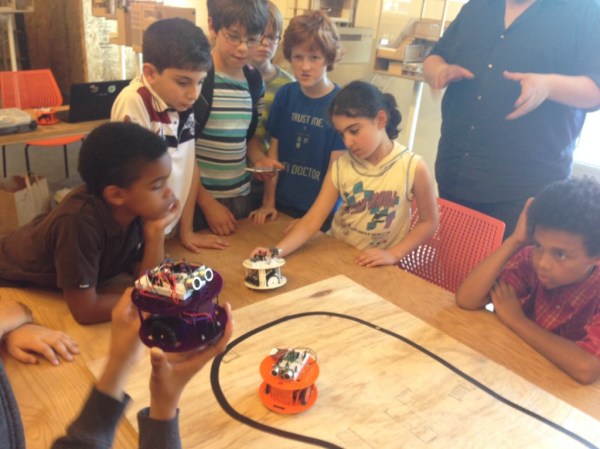
There’s no denying it. Super small robots are just cool. [Pinomelean] has posted an Instructable on how to create a mini line following robot using only analog circuitry. This would make a great demo project to show your friends and family what you’ve been up to.

Analog circuitry can be used instead of a microcontroller for many different applications, and this is one of them. The circuit consists of two op-amps that amplify the output of two phototransistors, which control each motor. This circuit is super simple yet very effective. The mechanical system is also quite cool and well thought out. To keep things simple, the motors drive the wheel treads, rather than directly through an axle. After the build was completed, the device needed to be calibrated by turning potentiometers that control the gain of each op-amp. Once everything is balanced, the robot runs great! See it in action after the break.

While not the smallest line follower we have seen, this robot is quite easy to reproduce. What little robots have you build lately? Send us a tip and let us know!

[via Embedded Lab]

Continue reading “A Mini Op-Amp Based Line Following Robot”

3 DOF Open Source Robot Arm Is Just The Beginning

Arm3-v1

[Dan Royer] of Marginally Clever had a dream. A dream to build an open-source 6 DOF robot that anyone can make! To do so, he’s been learning robotics for the past two years, and has just finished the first step — he’s designed and built an open source 3 DOF palletizing robot!

He’s based this little guy off of the commercial ABB 460 palletizing robot, which is a tried and true industrial robot. It features all laser cut parts, a few nuts and bolts, some stepper motors and an Arduino UNO for the brain. He’s released all of the design files on Thingiverse and the firmware on GitHub — yet another project we’d like to build if only we had a laser cutter!

And don’t worry, the Arduino UNO is only being used for this first prototype — he’s already started writing code for the RUMBA (Reprap Universal Mega Board with Allegro-driver) controller for revision 2.

Stick around to see it write its first greeting with a marker — Hello World!

Continue reading “3 DOF Open Source Robot Arm Is Just The Beginning”

Open Source Humanoid Robot Is Awesom-o

awesome-o

Coming from a lab in France is The Poppy Project, an open source humanoid robot that’s at least as cool as ASIMO.

Poppy was designed as an affordable bipedal robot for use in education and art. It’s a small robot at just over 80 cm in height, but it can walk, move its arms, rotate its torso, and interact with bags-of-meat humans with two cameras and an LCD face.

Although Poppy is open source, that doesn’t mean it’s exactly cheap; the current design includes twenty-one Robotis Dynamixels MX-28 robotic actuators, actually servos with magnetic encoders, temperature sensor, and an ARM microcontroller. These actuators sell for about $200, meaning Poppy contains $4000 in motors alone. The estimated cost of the entire robot is €7500-8000, or about $10,000 to $11,000 USD.

Still, there’s an incredible software platform that comes along with Poppy, and being open source any enterprising engineer can take up the project and attempt to bring the costs down. We’d love to take one out for a walk. Just get rid of the hands. That’s too far down the uncanny valley for us. Video below.


Continue reading “Open Source Humanoid Robot Is Awesom-o”

Soft Robotics, Silicone Rubber, And Amazing Castings

Most of the robotics projects we see around here are heavy, metallic machines that move with exacting precision with steppers, servos, motors, and electronics. [Matthew] is another breed of roboticist, and created a quadruped robot with no hard moving parts.

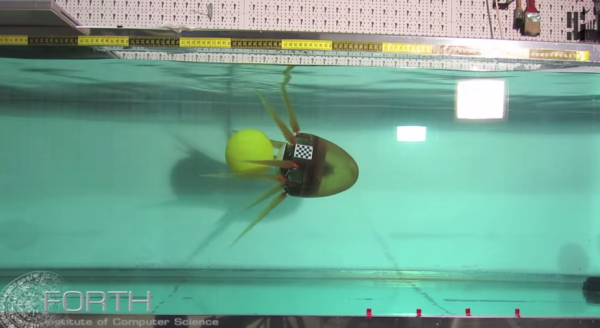
[Matthew] calls his creation the Glaucus, after the blue sea slug Glaucus atlanticus. Inside this silicone rubber blob are a series of voids, allowing compressed air to expand the legs, gently inching Glaucus across a table under manual or automatic control.

Even though no one seems to do it, making a few molds for casting on a 3D printer is actually pretty easy. [Matthew] is taking this technique to an extreme, though: First, a mold for the interior pressure bladders are printed, then a positive of this print made in silicone rubber. These silicone molds – four of them, for the left, right, top and bottom – are then filled with wax, and the wax parts reassembled inside the final ‘body’ mold. It’s an amazing amount of work to make just one of these soft robots, but once the molds and masters are made, [Matthew] can pop out a soft robot every few hours or so.

There’s a lot more info on Glaucus over on the official site for the build, and a somewhat simpler ‘compressed air and silicone rubber’ tentacle [Matthew] built showing off the mechanics. Video below.


Continue reading “Soft Robotics, Silicone Rubber, And Amazing Castings”

Building The Mountainbeest

mounainbeest-pic

Builder extraordinaire and Hackaday alum [Jeremy] was asked by a friend about “doing something really crazy” for his local Makerfaire this year. That Makerfaire clock is ticking down, and not wanting to build awesome from scratch, referred his friend to a few of the temporarily shelved projects from the last year. The winning incomplete build was the Mountainbeest, a four-legged mechanical walker inspired by [Theo Jansen]’s Strandbeest.

We’ve seen the beginnings of the Mountainbeest before, starting with [Jeremy] building the linkages for one leg. This build turned into two legs and now it’s a full-on quadruped, theoretically capable of rambling over the lush mountains in [Jeremy]’s backyard.

The plan now is for [Jeremy] to get is Beest walking with the help of windshield wiper motors left over from a failed hexapod build. He’s not ging all the details yet, but it looks like the power train will be made out of bike parts. Video of the current state of the project below.

Continue reading “Building The Mountainbeest”

Real Or Fake? The Amazing Ping-Pong Robot

Would you like to play a robot in ping pong (translated)? We sure would. Inspired by an upcoming face-off between man and machine, [Jakob] wrote in to tell us about [Ulf Hoffmann’s] ping-pong playing robot. If you ever wanted to play ping-pong when no one else was around or are just sick and tired of playing against the same opponents this project is for you. Boy is this thing amazing; you simply must see the robot in action in the video after the break.

While the robot’s build is not documented all in one post, [Ulf Hoffmann’s] blog has many videos and mini posts about how he went about building the paddle wielding wonder. The build runs the range from first ideas, to hand-drawn sketches, to the technical drawings seen above. From these the parts of the arm were built, but the mechanical assembly is only one portion of the project. It also required software to track the ball and calculate how to properly return it. Be sure to browse through his past posts, there is a wealth of information there.

Also be sure to check in on March 11th to see who wins the epic face-off between man and machine. See the trailer (the second embedded video) after the break.

UPDATE: Many commentators are calling this one a fake. It’s so sad to think that, because this is a really cool project. But we’ve changed the title and are asking you to weigh in on whether you think it is real or fake. We’ve also contacted [Ulf] and asked if it is real hardware, or a CGI enhanced video. We’ll let you know if/when we hear back from him.

Continue reading “Real Or Fake? The Amazing Ping-Pong Robot”