[Easton’s] Robot Arm Takes 2nd Place In The International Science And Engineering Fair

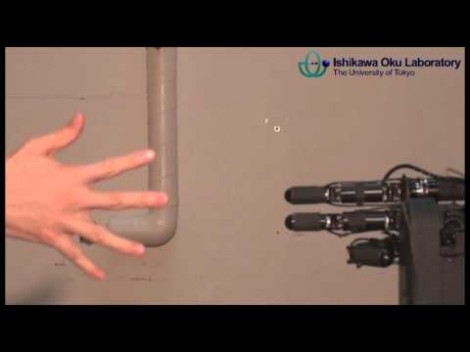
Here we see [Easton LaChappelle] getting a congratulatory handshake from the robotic arm he built. This project is aimed at human prosthetics, and we’re happy to report that [Easton] won second place in Electrical and Mechanical engineering division of this year’s International Science and Engineering Fair (PDF listing the winners).

In the video he gives us a great look of the state of the project. Since we checked in with him last he’s added a body for the arm to mount to. The arm now has shoulder movement, which uses geared DC motors along with some potentiometers for orientation feedback. For the elbow he wanted to have the same setup but ran into trouble mounting the potentiometer. His solution was to use some shapelock to mold a bracket (shapelock is the plastic you melt in water to form any shape). In addition to the aforementioned joints, the wrist, fingers, and hand have all seen improvements in how they are supported and in their performance.

We think this is amazing work for anyone, especially a 16-year-old High School student. Great job [Easton]!

Continue reading “[Easton’s] Robot Arm Takes 2nd Place In The International Science And Engineering Fair”

Shoulder Robot For The Forever Alone

Don’t have anyone to share activities with? Forget Siri, she’s just a disembodied voice in a box. You need to get yourself a shoulder-mounted robot pal.

The idea behind this design actually has something to do with telepresence. Let’s say you and your best friend want to go check out the local Hackerspace. The problem is that you met your best friend on the Internet and they live thousands of miles away. Well just strap on your shoulder robot and have your friend log on. There’s a camera to give him or her feedback, and twenty degrees of freedom lets them control the torso, arms, and head of the bot in a realistic and creepy way. This works much like a marionette, with motors pulling wires to actuate the robot’s movements. You can get a very brief look at this in the clip after the break.

Continue reading “Shoulder Robot For The Forever Alone”

CalTech’s Manipulator-arm Equipped Robot

[Justin] wrote in to tell us about the rover which his CalTech team has entered in NASA’s Exploration Robo-Ops Competition. Their time to shine is later this week, but you can see some of the test footage after the break.

The operator pictured above is using a controller which is a scale model of the manipulator arm, with two cameras giving feedback. One of those monitors shows a feed from the arm itself, providing a view of the gripper. The other feed is a wide shot of the working area from the body of the robot. The arm has six degrees of freedom actuated by servo motors. The controller is a replica of the arm laser cut from acrylic. At each joint there’s a potentiometer whose value is used to establish the position of the frame.

At first we thought that this would be more fatiguing and less convenient than using a gaming controller. But as we look at the dexterity of the arm it becomes obvious that joysticks and buttons would just make things more difficult.

Continue reading “CalTech’s Manipulator-arm Equipped Robot”

Climbing Robot Glues It’s Own Feet To The Wall

The problem of gripping all surfaces has always plagued the field of climbing robotics. But if you don’t care about damaging the wall, why not just let the robot glue its feet to the surface. That’s exactly how this robot does it, using a couple of climbing feet in conjunction with a hot melt glue gun wielding arm. It seems to be a predecessor of the hot glue 3D printing robot which we saw last week.

Check out the video to get a full overview of the climbing process, but here’s the gist of it. The legs and arm are able to pivot around the central axis of the robot, parallel to the climbing surface. Once one leg is glued in place the robot swivels around it so that the body is directly above that leg. From there it reaches up with the arm to deposit some glue on the wall, then moves it out of the way so the other foot can be pressed against the hot adhesive. When the newly attached foot has cooled sufficiently, the lower foot is reheated to free it from the wall. At this point the whole process repeats.

We’re still fond of vacuum-based climbers like this parachute-equipped robot. But the design of the hot-glue arm on this guy is something that might make it into one of our own projects someday.

Continue reading “Climbing Robot Glues It’s Own Feet To The Wall”

An Arduino Based Quadruped Robot

Arduino-Based-Four-Legged-Robot

Sure, we see hexapods all the time at [HAD], but moving around with four legs can be more tricky kinematics-wise. This Instructable shows you how to make one out of balsa wood.

Although one might not think of balsa to make their robot out of [vexedpheonix] explains that this was chosen because it’s extremely light and easy to work with. Since he was trying to keep costs down, the cheapest servos available were used. These weren’t all that powerful, so the lighter the body the better! According to the included bill of materials, he was able to keep the entire robot build under $100.

According to the article, the hardest part was making four copies of the same leg. We might suggest using a CNC router, but building one would obviously add a huge layer of complication to the project!

Thanks for the tip on this one [SteveT]! Be sure to check out the video of this little robot waving one of it’s legs or trying to walk after the break! Continue reading “An Arduino Based Quadruped Robot”

Robot Fish Detect Pollutants

If you happen to visit the Spanish port of Gijon, you may notice some giant yellow robotic fish swimming around. These 5 foot long swimmers are part of a proposed sensor network to detect pollutants in the water.  Equipped with an array of sensors, the fish can test for general water quality, or swap out the sensors for specific testing. They communicate with each other to keep from straying too far from the rest of the network and the base charging station.

The fish was designed by the Shoal Consortium, a European commission funded program that draws from intelligent minds in universities all over europe. While the fish cost over $35,000 right now, mass production should reduce that cost considerably.

You can see them swimming around in the BBC video at the link.