Converting A Roomba Into A Mars Rover

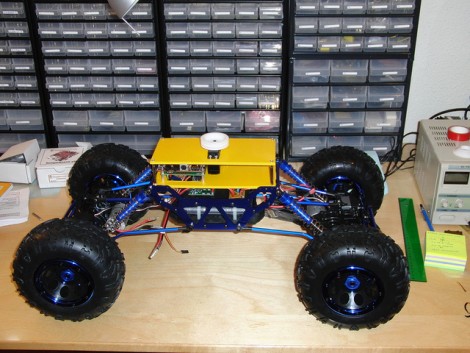
When we first heard of [Dino]’s all-terrain Roomba, we hoped the ‘stair-climbing Roomba’ problem had finally been solved, but the final build turned out much cooler.

A year ago, [Dino] built a small robot based on a rocker-bogie suspension. This suspension system has been used on every Mars rover, including the huge Mars Science Labratory scheduled to land on Mars next year. [Dino] beefed up the suspension from the previous version and changed the wheels and center of gravity. Now, the little Roomba rover seems quite capable of climbing over objects as tall as itself.

The control of the rover is similar to other Roomba hacks we’ve seen – just tapping a few transistors. [Dino] is using a Seeduino and an ultrasonic sensor to avoid collisions. [Dino] says that he’s thinking about pivoting each wheel independently to get around the skid-steering, but maybe an omnidirectional wheel would be better suited.

Check out the video after the break for a demo of the Roomba rover traversing the treacherous boulder strewn terrain in [Dino]’s garage.

Continue reading “Converting A Roomba Into A Mars Rover”

Mini Google Street View Car Built From Lego

lego_street_view

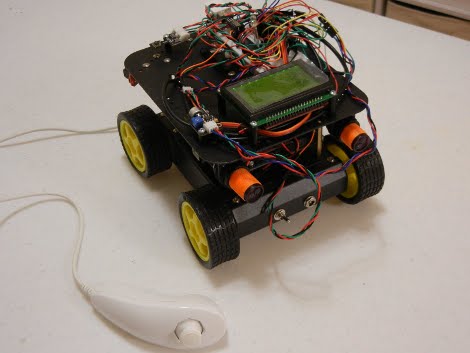
[Mark] was playing around with a small GPS sensor when a light bulb lit over his head. He imagined it would be pretty cool to replicate one of Google’s Street View cars at a fraction of the scale using Lego NXT parts. He figured it would be easy enough to rig a few cameras to a remote controlled car, recording images and GPS coordinates as it went along.

The mini Street View car is controlled by a single NXT module that receives commands from a PS2 controller via a PSPNx sensor he purchased. A trio of cameras have been attached to the car, which are meant to take pictures in all different directions when triggered by his remote. A handful of additional motors are also used for driving the car, steering, and for activating the shutter release on the cameras.

The car worked decently during testing, but [Mark] says there is still plenty of room for improvement. He is having issues reliably triggering all cameras at the moment, but we’re sure he’ll have it sorted out soon enough.

Keep reading to see a video of his mini Street View car in action.

Continue reading “Mini Google Street View Car Built From Lego”

The Party Popper “Security” Robot

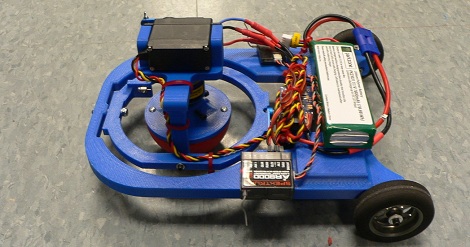
This “security” robot is based around the Lego Mindstorms NXT platform. As shown in the video after the break, this robot is capable of firing a “popper” at any intruder the owner of the robot sees fit.  It takes a decent amount of force to fire a popper, so this is pretty impressive with a Lego components by itself. If you’ve been looking for components to build your next robot, Lego might be worth a look.

This bot also features, according to the 14 year old Australian that built this, an HD webcam person ID system that sends him an email when it sees someone.  It uses bluetooth for control. Lego designs have come a long way since the grey castles some of you may have built in the 80s and 90s. Be sure to check out the video after the break. Continue reading “The Party Popper “Security” Robot”

Modifying A Cheap Robot Arm For Arduino Control

Many a hacker has put together one of those cheap $30 robot arm kits you can get in just about any store with a section labeled, “science”.  In an ongoing search for a cheap robot arm, [Larry] decided to modify one of them to be controlled with a PC through an Arduino. The article doubles as a really basic tutorial on dc motor control. On the site he gives a brief explanation of how to use H-bridges and a good explanation of how he wired them up for this purpose. He eventually goes on to add a processing interface to the project. The next step would be figuring out how to add some kind of position feedback, such as encoders. Though, if modifying an arm is not your style, [Larry] has another cool article on rolling your own robot arm cheaply with some foam board and hobby servos.

The WALL-E Robot

[Dino’s] latest Hack a Week project, the WALL-E Robot shows quite simply what you can create from a few dollars worth of toys from garage sales and cheap stores. When he found the WALL-E toy at a garage sale, Dino decided that he had to give it a brain. Using the geared motors from some Rumble Robots, the H-bridges from some $5 remote control cars (after his own H-bridges cooked themselves), an ultrasonic sensor and an Arduino, WALL-E was brought to life.

The WALL-E Robot might not be the brightest bot, or the most stable, but the project definitely demonstrates some effective scrounging for parts that would have done WALL-E proud. It also shows how even the most simple projects can cause the most headaches when they don’t go right. Check out the video after the break for the build details, a demonstration and to see a man talk to a toy robot.

Continue reading “The WALL-E Robot”

An Autonomous Car Using A “Webcam”

This autonomous remote control-style car from Cornell students was designed for a senior level engineering course there. It’s main “sensor” is a low-res webcam style camera. As shown in the video after the break, this car does quite well staying within two black lines on a white surface using it’s vision processing. It also has an IR sensor to detect objects in front of the car and stop without crashing.

All “vision” computations are handled by an Atmel Mega644 MCU, an 8-bit processor. Because of the processing limits of this chip, much work had to be done to make this process computationally efficient. These students go through an incredibly detailed account of their project, focusing on the code and electrical design. Check out the video of their car in action after the break. Continue reading “An Autonomous Car Using A “Webcam””

AVRcam For Small Robot Machine Vision

It’s neat how a project from 2004 can still be relevant if it’s done really well. This is the case with AVRcam.  It uses an Atmel AVR mega8 and can do some pretty impressive things, like track up to eight objects at 30fps. The hardware and software is also open source, so it should be possible to build one yourself. There are many projects like it on the internet, though often they require much beefier hardware. Although, these days you can fit a computer inside a match box, so we see more and more projects just throwing a full USB camera on a robot to do simple things like line following.  It’s debatable which solution is more elegant, but maybe not which one is more impressive.