ArduDelta Would Make A Great Pick And Place Machine

[Bogdan] sent in a great build of a delta robot he originally posted on the Arduino forum, but he didn’t receive much feedback there. We think a build like this deserves a lot more credit.

After working for 7 months on his robot, [Bogdan] has a pretty stable (and very classy) platform made out of wood. The platform and arms in delta robots are usually extremely light to reduce the inertia of the tool so [Bodan] crafted these out of carbon fiber tubes and plexiglas. Everything is controlled by an Arduino Mega2560 encased in a plexiglas enclosure with a 20×4 LCD, status LEDs, and an infrared receiver.

Continue reading “ArduDelta Would Make A Great Pick And Place Machine”

Propeller-based Robot With Basic Object Avoidance

propeller_development_robot

The Parallax Propeller is a pretty powerful MCU as [Dino] recently discovered in his latest Hack a Week installment. He wanted to build a simple robotics platform that he could use for testing out various sensors, and he figured he might as well learn about a different type of micro controller in the process.

He pieced together his robot using a pair of old Roomba motors he had sitting around, mounting them on a standard RadioShack project box. A Propeller MSR1 control board runs the show, and a Propeller PING sensor is used to get an idea of what the robot’s surroundings look like. He is an admitted newbie when it comes to using Propeller micro controllers, but [Dino] was able to give his robot some rudimentary object avoidance abilities fairly easily. A few small bugs aside, he had the robot up and running in short order, a testament to how easy it is to work with the Propeller platform.

Stick around to see a brief video covering the robot’s construction we have embedded below.

Continue reading “Propeller-based Robot With Basic Object Avoidance”

Kinect-controlled Quadrotor

kinect_quadrotor_control

The team over at the Flying Machine Arena has been busy combining two of our favorite toys – quadrotors and Kinect.

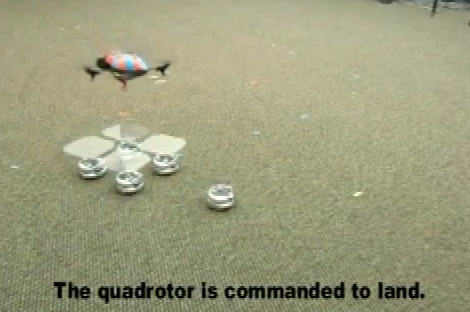
Like many other hacks, they are using Kinect to monitor their joint positions, mapping a handful of actions to the operator’s movements. Once the quadrotor is aloft, it can be directed around the room using the operator’s right hand. The gesture recognition system responds almost instantly, guiding the vehicle in all directions with ease. When the user’s left hand is raised, the quadrotor does a mid-air flip and awaits its next command, while a quick clap of the hands brings the machine to rest on the ground.

For the protection of anyone testing out the system, overhead motion tracking cameras are used to keep track of the Kinect’s position, creating an invisible midair barrier through which the quadrotor is not allowed to pass.

If you have a minute, check out the video below – controlling quadrotors looks way more fun than any Kinect game we’ve come across.

Continue reading “Kinect-controlled Quadrotor”

Voice Controlled Robot Controlled By An Android Phone

[Jeff] sent in a build of a voice controlled robot he just finished based on the Android ADK and an iRobot Create.

The robot is able to obey voice commands telling it where to go. Currently the robot responds to forward, reverse, left, right, stop, and ‘whistle while you work.’ It’s a creative use of the Android ADK with some obvious applications, but this project really shines with the write up on instructables. It’s rare that we’ve seen a project so well documented; it’s a great project for someone who wants to get their feet wet in the world of robotics.

[Jeff]’s write up goes through the steps of hooking up the ADK board to iRobot and providing all the electronic necessities. [Jeff] graciously provided the code for his robot if anyone would like to add to his project.

The ultimate goal [Jeff] is currently working towards is something akin to a TurtleBot, while keeping the voice control of the robot. In all, a very nice project.

Robotic Schadenfreude – Quadrotor Blooper Reel

quadrotor_fail

While quadrotors might just become the killing machines of choice some time in the future, we’re pretty sure it will be awhile before they run amok and wipe humans off the face of the planet, if the following video is any indication.

The team over at UPenn’s GRASP Lab film everything they do when it comes to quadrotors for posterity’s sake. When your awesome job consists of directing quadrotors through all sorts of acrobatic hijinks however, mistakes are going to happen. Thankfully, the team doesn’t keep these a secret, and while we’re typically wowed by what these flying machines can do, it’s also pretty fun to see them fail in such spectacular fashion.

If you have a spare minute, kick back, fire up the video, and enjoy the mechanical mayhem that ensues. We certainly sleep better at night knowing that while these things are awesome, a well-placed hula hoop is all it takes to ensure continued human supremacy.

Continue reading “Robotic Schadenfreude – Quadrotor Blooper Reel”

MSP430-based Palm Size Quad Copter

palm_sized_quadcopter_msp430

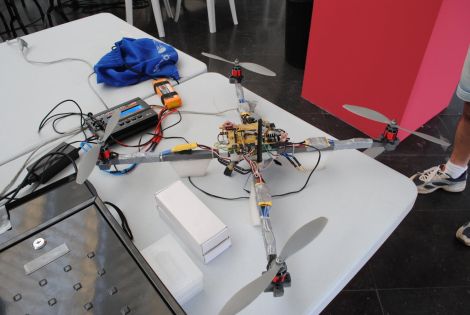
[Thanh] has spent some time flying quad-copters measuring 12” motor to motor, but wanted to build something smaller so that he could fly indoors. Instead of building just one, he actually constructed five different quad-copters, with motor to motor arm spans ranging from 10” to just 3”.

In his forum post, he highlights the construction process of his 10” copter, covering each step in great detail. While he breaks down his component lists into two categories based on motor to motor span, the one common item is the TI MSP430-based controller board. In particular, he used the eZ430-RF2500 development kit, which has the added benefit of a built-in 2.4 GHz wireless radio. His quad-copter uses a Wii Motion Plus gyro board to help keep it aloft, as well a handful of other components which should be pretty familiar to most of our readers.

It’s great to see the construction broken down in such detail, we imagine it will be a great resource for anyone else looking to build their own quad-copter.

Stick around to see a quick video demonstration of his mini quad-copter in action.

[Thanks, Panikos]

Continue reading “MSP430-based Palm Size Quad Copter”

Building A Robot Without Using A Machine Shop

We usually avoid the prospect of buying new tools just for one project. In the long run we’re sure we’d use them again, but sometimes even with that outlook you can’t afford it. Case in point is our life-long-lust for a laser cutter; we just can’t justify the upfront cost but we sure would use it constantly if we had one.

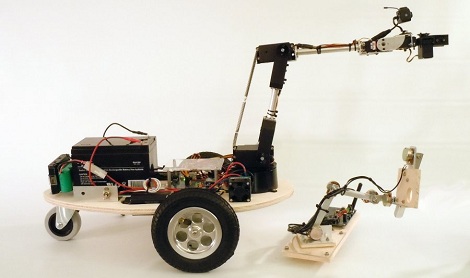
If you do find that you’re interested in taking on a project that calls for laser cut parts, [I Heart Robotics] shows you how to do it with a few simple hand tools. The bot seen above is their TurtleBot. You can cut your own parts using a laser cutter, you can buy a kit from them, or you can bust out a ruler, compass, drill, coping saw, printer, and tape to make the pieces by hand.

It’s a simple enough concept. Print out the templates, tape them to your hard board, then start drilling and sawing. You won’t get the precision a machine tool can, but in some cases you don’t need to be all that perfect.

[via Adafruit]