Domo Kun Robot Achieves Balance Sans Gyroscope

Every time it tips over, the FSM kills a kitten

Most self-balancing robots use some sort of circuitry like gyroscopes or accelerometers to keep them upright. Some bots however, can achieve nearly the same effect by far less complicated means.

Meet the Domo Kun wobbly bot, created by [Chein]. The robot is essentially a pendulum, where the pivot point is even with the wheel axle. The base of the robot is loaded with batteries, motors, and weights, all of which keep the robot relatively steady while zooming about the room. A light balsa wood frame was fitted to the top of the metal chassis, and a thin cardboard Domo Kun shell was mounted on top of that. The robot is driven using the remote control circuitry that he stripped from a toy car. He also mentions that the positioning of the batteries and weights is key to getting the robot to balance and roll properly – something that took several attempts to get just right.

Now if he could only program it to autonomously chase kittens…

Be sure to check out the pair of videos we have below of the robot chassis in testing as well as the final product.

[via HackedGadgets]

Continue reading “Domo Kun Robot Achieves Balance Sans Gyroscope”

Android Skips Uncanny Valley – Fills In At The Office For You

For those that are unaware, Androids are often judged by where they fall on the uncanny valley curve, a graph that maps human revulsion to robots that closely resemble humans but are just a bit off (similar to how a corpse resembles a living person). This offering jumps right over that dip of the curve and takes its rightful place as a human stand-in. Well, except that you’re probably going to notice the limbless torso… but pay no attention to the man behind the curtain!

This is the result of research by Geminoid Lab at Aalborg University. It is the twin of its creator and in an effort to be as human as possible, movements are mimicked using facial recognition from a human operator. We’d bet that with some clever learning routines you can map out and index common mannerisms from the original person for later use with this body-snatcher-esque copy. Take a look at the clips after the break; we don’t think you’ll be creeped out at all.

Continue reading “Android Skips Uncanny Valley – Fills In At The Office For You”

Automatic Lock Cracker Makes Breaking And Entering A Breeze

automatic_lockcracker

For most people, forgetting the combination on a lock means breaking out the bolt cutters and chopping off the lock. Some students at the [Olin College of Engineering] decided there was a far more elegant way to do the job, so they built an automated lock-cracking machine.

The machine consists of a clamp to hold the lock, a solenoid to pull the lock open, and a stepper motor to run through the combinations. Most of the processing is done on the attached computer, using software they created. The application will brute-force all of the possible combinations if you request it, but it also allows you to enter the first, second, or third numbers of the combination if you happen to remember them.

Once the machine is started, the motor begins spinning the lock and the solenoid yanks on the latch until the combination is discovered, which takes a maximum of about two hours to complete. The opening of the latch trips a limit switch and causes the mechanism to stop. A simple button press then returns the lock’s combination to the user.

Be sure to check out the video embedded below of the lock cracker in action.

[via Wired]

Continue reading “Automatic Lock Cracker Makes Breaking And Entering A Breeze”

CNC-built R2-D2 Brings Childhood Dreams To Life

r2d2_build

As a kid, [Wes] always dreamed of building a full-size, functional R2-D2 droid from Star Wars. While most youthful aspirations such as this fall to the wayside amid adult responsibilities and commitments, he did not allow his dreams to disappear along with his childhood.

He began his droid-building journey armed only with his dreams and some assistance from the friendly folks over at R2Builders. The entire replica was built using MDF, wood, and styrene sheeting, along with just one tool: a CNC machine. He walks you through the every step of the construction, stopping to give recommendations on CNC hardware, software, etc. along the way. He also provides Gcode files for each of the pieces he has constructed, which should be a huge help to anyone looking to build a R2-D2 clone of their own.

It looks like he is just getting around to fitting motors into the leg housings of his R2-D2 replica, but we can’t wait to see what it looks like once he has all of the electronics and other details finished.

If you are interested in more R2-D2 coverage, look no further than right here.

Coming Soon To A Store Near You: Remote-control Cockroaches

roboroach

Given a box full of cockroaches, the first thing most of us would do is try to locate the nearest source of fire. Lucky for the roaches, the team over at Backyard Brains look at things a bit differently than we do.

Their latest effort combines cockroaches and electronics to create a bio-electrical hybrid known as the RoboRoach. Using control circuitry donated from a HexBug inchworm and some 555 timers to create properly timed pulses, they have been able to control the gross movement of cockroaches. Stimulation is directly delivered to the antennae nerves of the cockroaches, enabling them to tell the roach which direction to turn and when.

Currently there are some ahem, bugs in the system, which they are working diligently to resolve. Only about 25% of the roaches they wire up can be controlled at present. Once that ratio improves however, they will be looking to offer RoboRoach as a beta product. If you are aiming to add a beetle air force to supplement your remote-controlled cockroach army, be sure to check this out.

Continue reading to see a video of the RoboRoach in action.

Continue reading “Coming Soon To A Store Near You: Remote-control Cockroaches”

Autonomous Cars Already Drive The Roads Among Us

Google’s showing off this autonomous car at the TED convention right now, but the hardware has already made automated trips from San Fransisco to Los Angeles. According to the commentary in the video after the break, the scene above shows the car “hauling Prius ass” on a closed course. The car learned this route while being driven by a person and now the vehicle is set to take riders through an aggressively driven loop in the cone-adorned parking ramp. But on the open road you do not need to teach it anything. It has no problem taking a GPS route and following the rules of the road while traveling from one waypoint to another.

The link above doesn’t include hardware information but they did point to a Times article which includes an infographic. The spinning box on the top of the car is 3D-mapping LIDAR with a 200 foot radius. There’s a rotary encoder on one of the wheels for precise movement data, radar sensors on the front and back bumpers, and a rear-view-mirror-mounted camera for image processing. It makes us wonder how the system performs when the car is coated in road-muck? Maybe you just add a dedicated wiper for each sensor.

Continue reading “Autonomous Cars Already Drive The Roads Among Us”

Analog Robot Navigates Around The Workshop With Ease

556_wall_following_robot

Many of the robots we feature here are driven by some sort of microcontroller, whether it be an Arduino, Launchpad, Picaxe, etc. Rarely do we see a robot however, using analog circuits to perform higher-level functions typically relegated to those more complex controllers. Instructables user [hasn0life] built such a robot recently, which he entered into a contest at his college. After hearing about the 555 design contest from a friend, he tweaked his project and created a wall-following robot using a 556 timer.

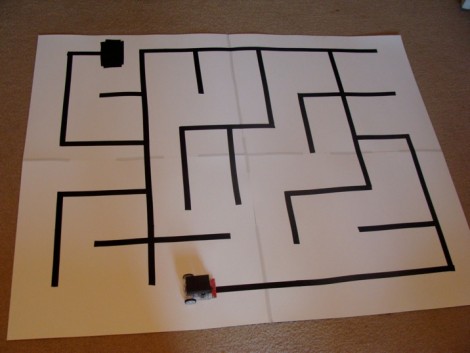
The robot is fairly simple when you take a close look, though that does not take away from the elegance of his design. A single IR sensor is used to detect objects in the robot’s periphery, guiding the robot along. When the robot gets too close to a wall, one wheel reverses, pulling the robot away. Once the robot has moved a sufficient distance, the other wheel is reversed in order to straighten out the robot. Then, both wheels work in concert to get the robot moving forward.

Take a look at the video below to watch the robot navigate its way around his workshop, and if you are interested in learning more about analog robotics, check out this post from a few days back.

Continue reading “Analog Robot Navigates Around The Workshop With Ease”