Hacking Pleo For Face Recognition And Remote Control


GRIP, the Group for Interdisciplinary Psychology at the University of Bamberg have put together a couple tutorials on hacking the Pleo. For those unfamiliar, the Pleo is a small robot shaped like a dinosaur. Their goal was to make it cute and simulate emotion at a higher level than previously attained by consumer robots. Ugobe, the makers of Pleo encourage hacking of the unit and the controlling software. Look at the “developers” area of their site to download all kinds of tools to work on your Pleo.

The two tutorials released by GRIP cover adding wireless communication with a PC and adding a higher resolution camera to the unit. The goal was to make the platform capable of doing facial recognition.

Continue reading “Hacking Pleo For Face Recognition And Remote Control”

Remote Controlled Pill-bot


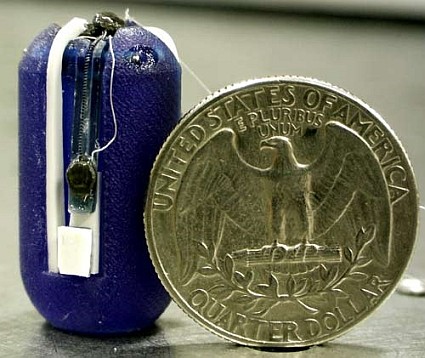
The NanoRobotics Lab at Carnegie Mellon University has come up with a medical robot that can be swallowed, and is then able to be controlled from outside the body. The device has small arms with adhesives that can attach to slippery internal surfaces, which has previously proven difficult. Once inside the body, it can be used to view damaged areas, deliver drugs, as well as biopsy questionable tissues, and possibly even be used to cauterize bleeding wounds with a small laser. The device could be stopped, and even reversed to get a better look at areas that may have gone unnoticed otherwise. This would be a major advancement in diagnosing intestinal problems, and could lead to potentially life saving treatments. Did we mention that it has lasers?

[via Neatorama]

Autonomous SWARM At Large


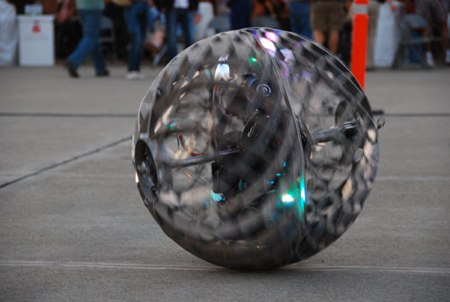
SWARM has been showing up at a number of places. Until now, the mysterious spheres have been under human control. However, the SWARM has taken the first steps to autonomous control. The SWARM is a kinetic art project consisting of several large self-propelled metallic spheres that interact with each other and their environment. Each orb in the swarm is fitted out with a processor, GPS, accelerometers, and Zigbee wireless communications. The entire project is open source. Slated to appear at the 2008 Burning Man festival, the orbs will use their GPS to wander within a specified area, keeping themselves “in bounds”.

Continue reading “Autonomous SWARM At Large”

SONAR Controlled USB Missile Launcher


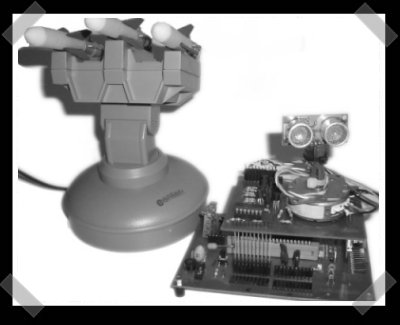
Check out this add on for that cheap USB missile launcher we know you bought last year. It uses ultrasonic sensors to provide sonar feedback for the aiming system. A PIC 18F455 drives a servo to aim the sensor and massage the signal from the sensor. It still depends on a PC application to put everything together. If you’d rather play with faster hardware, keep your eyes open for this years defcon bots contest.

Build A ROBONOVA-I


On the latest episode of Systm, they talk to [David Calkins], founder of the RoboGames competition, about humanoid robotics. The robots featured in the episode are Hitec’s ROBONOVA-I. The ROBONOVA is about a foot high and has 16 servos with support for up to 24, all connected to an Atmel controller. The episode is quite long: At around 15 minutes, they demonstrate the programming enviroment. You can program it traditionally or pose the bot to work out the motions. At 30 minutes, [David] mentions that next year’s competition will allow airsoft weapons to be attached, but bots have to be controlled from a first person perspective. If you’re interested in one of these kits, they have a ROBONOVA special of $900 or as low as $500 for educational institutions (that’s us, right?). Now is the perfect time to get one since you’ll have nearly a full year to prepare for RoboGames.

Related: You’ll hear builder [Matt Bauer]’s name mentioned several times.

[via BotJunkie]

Shih Chieh Huang’s Recycled Bots


We’re really sorry to have missed GLOW. It was a unique all-night art and music event that took place the evening of July 19, 2008, in Santa Monica, and lasted until dawn. We were most intrigued by [Shih Chieh Huang]’s haunting robotic sculptures. They were eerily beautiful, and appeared to be alive and “breathing”. He took some unusual materials – plastic bags and bottles, computer fans and circuit boards, among others, and combined them all to give the creatures otherworldly auras. Simultaneously familiar and strange, the sculptures are designed to evoke marine life, yet they’re completely different, in both materials and structure. More coverage and pictures of the event can be found at LAist, NOTCOT, and on Flickr.