12 Year Old Builds Successful Fusor At Home

Nuclear fusion, as a method of power generation, continues to elude humanity. It promises cheap, virtually limitless energy, if only we could find a way to achieve it. On the other hand, achieving nuclear fusion of a few atoms just for the fun of it is actually quite doable, even in the home lab. [Jackson Oswalt] is one of the youngest to pull it off, having built a working fusor at home at the age of 12.

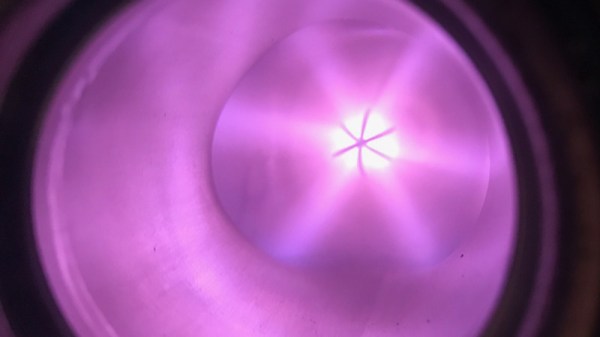
The fusor consists of a cross-shaped chamber, which is pumped down to a high vacuum to enable the fusion reaction to occur. Deuterium is then pumped into the chamber, and confined by an applied electric field from a power supply in the vicinity of 50 kV. With the right combination of geometry, vacuum and other factors, it’s possible to fuse atoms and observe the characteristic glow of the reaction taking place.

In order to be recognised as having achieved fusion by the Open Source Fusor Research Consortium, one must typically have proof of the release of neutrons from the fusion reaction. [Jackson] showed this with a neutron detector setup, by inserting and removing it during a run to demonstrate the fusor was the source of the signal. Photos of the glowing fusor don’t go astray, either, and [Jackson] was more than happy to deliver.

We’ve seen fusor builds before – [Erik]’s build got him into the Plasma Club back in 2016.

[via Fox News]

Noise: It Turns Out You Need It

We don’t know whether quantum physics proves the universe is truly a strange place or that we are living in a virtual reality simulation, but we know it turns a lot of common sense into garbage. Take noise, for example. Noise — as in random electrical noise — is bad, right? We spend a lot of time designing to minimize noise. Researchers in Austria, Germany, and Australia recently published a paper that shows that noise can actually improve the flow of energy. While the paper is behind a paywall, the Focus article is available and, of course, you can probably find a copy of the paper if you want to read the entire thing.

The paper, titled “Environment-Assisted Quantum Transport in a 10-qubit Network” uses trapped calcium atoms to study an effect suspected of being a key factor in high-efficiency energy transfer such as the transfer observed in optical fibers and photosynthesis.

Continue reading “Noise: It Turns Out You Need It”

DIY X-Ray Machine Becomes CT Scanner

Once you’ve built your own X-ray machine to take 2D images of the insides of stuff, there’s really only one logical next step: building your own computed tomography (CT) scanner to get 3D reconstructions instead. That’s exactly what [Fran Piernas] has done, and documented over on hackaday.io. While the original X-ray machine build dealt with scary hardware stuff such as high voltage and ionizing radiation, this time it’s the turn of scary mathematics like inverse radon transforms.

The original build, which we wrote about in December, uses a commercial dental X-ray tube and a home-made 65 kV power supply to send X-rays through objects. Transmitted X-rays are viewed using an intensifying screen that converts the rays to visible light. The result is a 2D image similar to that we’re all familiar with.

To create a 3D reconstruction of an object, you need a number of X-ray images taken from different angles. If you’ve ever been unlucky enough to need a medical CT scan, you’ll remember staying motionless in the tunnel while the X-ray apparatus rotated around you. In this build, [Fran] rotates the object instead, using a motor that may have once been part of a microwave oven (one of those “mystery motors” we all have laying around). The required sequence of images is simply obtained by recording video of the X-ray screen while the motor rotates the object.

Continue reading “DIY X-Ray Machine Becomes CT Scanner”

Visualizing Eddy Currents

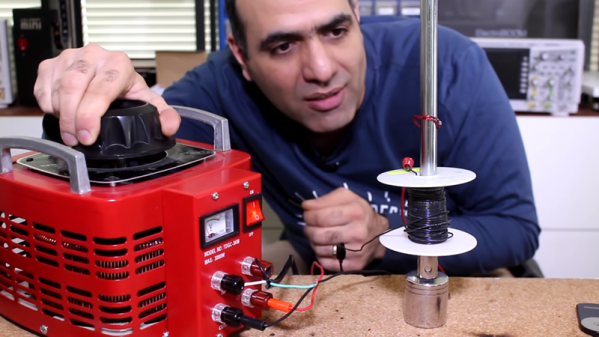
If [Electroboom] gives up making videos and decides to become a lounge lizard in the Poconos, we hope he adopts the stage name Eddy Currents. However, he is talking about eddy currents in his recent video post that you can see below.

We know he doesn’t really think he can get the magnet to slow down with one sheet of aluminum foil and that he stages at least most of his little electric accidents, but we still enjoy watching it. Meanwhile, he also has a good explanation of why a copper pipe will slow down a magnet and how eddy current affects transformer efficiency.

Continue reading “Visualizing Eddy Currents”

The Future Circular Collider: Can It Unlock Mysteries Of The Universe?

In the early 1990s, I was lucky enough to get some time on a 60 MeV linear accelerator as part of an undergraduate lab course. Having had this experience, I can feel for the scientists at CERN who have had to make do with their current 13 TeV accelerator, which only manages energies some 200,000 times larger. So, I read with great interest when they announced the publication of the initial design concept for the Future Circular Collider (FCC), which promises collisions nearly an order of magnitude more energetic. The plan, which has been in the  works since 2014, includes three proposals for accelerators which would succeed CERN’s current big iron, the LHC.

Want to know what’s on the horizon in high-energy physics?

Continue reading “The Future Circular Collider: Can It Unlock Mysteries Of The Universe?”

Open Source Biological Gear For The Masses

At the risk of putting too fine a point on it, Hackaday exists because people are out there building and documenting open source gadgets. If the person who built a particular gizmo is willing to show the world how they did it, consider us interested. Since you’re reading this, we’ll assume you are as well. Over the years, this mentality has been spreading out from the relatively niche hacker community into the greater engineering world, and we couldn’t be happier.
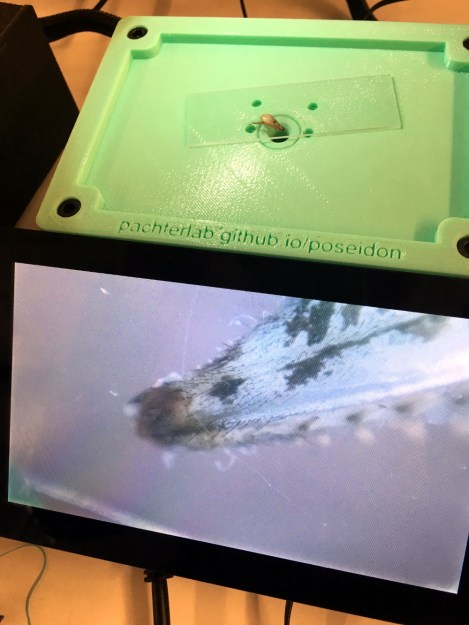
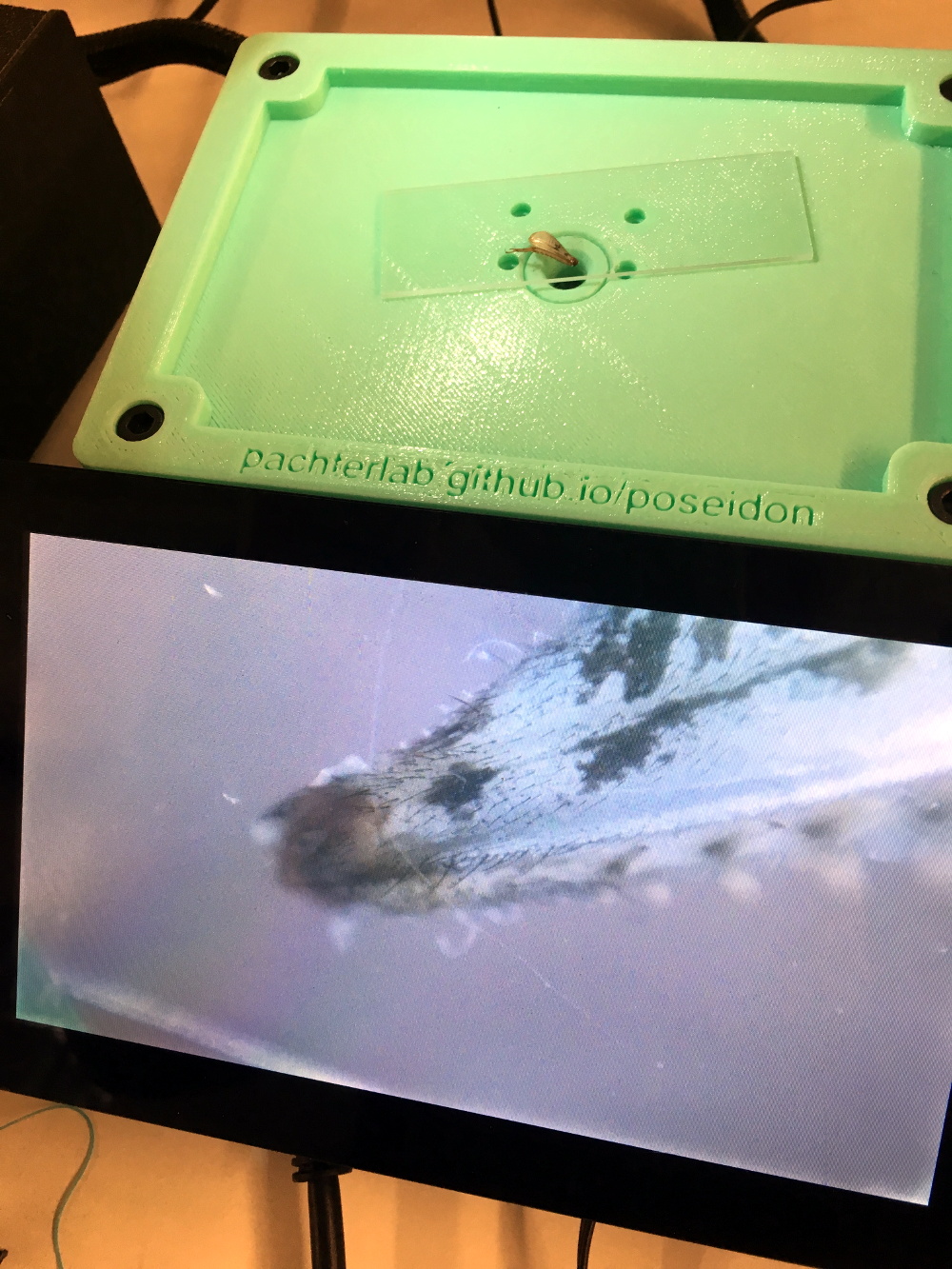
Case in point, the Poseidon project created at the California Institute of Technology. Developed by students [Sina Booeshaghi], [Eduardo Beltrame], and [Dylan Bannon], along with researcher [Jase Gehring] and professor [Lior Pachter], Poseidon consists of an open source digital microscope and syringe pump which can be used for microfluidics experiments. The system is not only much cheaper than commercial offerings, but is free from the draconian modification and usage restrictions that such hardware often comes with.

Of course, one could argue that major labs have sufficient funding to purchase this kind of gear without having to take the DIY route. That’s true enough, but what benefit is there to limiting such equipment to only the established institutions? As in any other field, making the tools available to a wider array of individuals (from professionals to hobbyists alike) can only serve to accelerate progress and move the state of the art forward.

The Poseidon microscope consists of a Raspberry Pi, touch screen module, and commercially available digital microscope housed in a 3D printed stage. This device offers a large and clear view of the object under the microscope, and by itself makes an excellent educational tool. But when running the provided Python software, it doubles as a controller for the syringe pumps which make up the other half of the Poseidon system.

Almost entirely 3D printed, the pumps use commonly available components such as NEMA 17 stepper motors, linear bearings, and threaded rods to move the plunger on a syringe held in the integrated clamp. Controlled by an Arduino and CNC shield, these pumps are able to deliver extremely precise amounts of liquid which is critical for operations such as Single-cell RNA sequencing. All told a three pump system can be built for less than $400 USD, compared to the tens of thousands one might pay for commercially available alternatives.

The Poseidon project joins a relatively small, but very exciting, list of DIY biology projects that we’ve seen over the years. From the impressive open source CO2 incubator we saw a few years ago to the quick and dirty device for performing polymerase chain reaction experiments, there’s little doubt about it: biohacking is slowly becoming a reality.

Continue reading “Open Source Biological Gear For The Masses”

Amateur Astronomers Spot Meteorite Impact During Lunar Eclipse

According to ancient astronaut theorists, the lunar eclipse this weekend had an unexpected visitor. Right around the time of totality, a meteoroid crashed into the moon, and it was visible from Earth.

Meteoroids crash into the Earth and Moon all the time, although this usually happens either over the ocean (70% of the Earth) where we can’t see it, on the far side of the moon (~50% of the Moon) where we can’t see it, or on the sunlit side of the Moon (another, different 50%), where we can’t see it. These meteoroids range from the size of a grain of sand to several meters across, but only the largest could ever be seen by the human eye. This weekend’s lunar eclipse, the Super Blood Wolf Moon was visible to a large portion of the population, and many, many cameras were trained on the Moon. Several telescopes livestreamed the entire eclipse, and multiple people caught a glimpse of a small flash of light, seeming to come from around Lagrange crater. Because this event was seen by multiple observers separated by thousands of miles, the only conclusion is that something hit the moon, and its impact event was recorded on video.

This is not the first time an impact event has been recorded on the moon. The Moon Impacts Detection and Analysis System (MIDAS) running out of La Hita Observatory has regularly recorded impact events, including one that was comparable to an an explosion of 15 tons of TNT. These automated observatories aren’t running during a full moon, like during a lunar eclipse, because no camera would be able to pick up the flash of light. We were somewhat lucky last weekend’s impact happened during totality, and with dozens of cameras trained on the Moon.

Further investigation will be necessary to determine the size of the meteoroid and obtain pictures of its impact crater, but for a basis of comparison, the LCROSS mission plowed a Centaur upper stage (2.2 tons) into the lunar surface at 2.5 km/s. This should have resulted in a flash visible through binoculars, but it didn’t. The meteoroid that struck the moon last weekend would have been traveling faster (a minimum of about 12 km/s), but the best guess is that this rock might have been of suitable size to have fit in the back of a pickup truck, or thereabouts.